

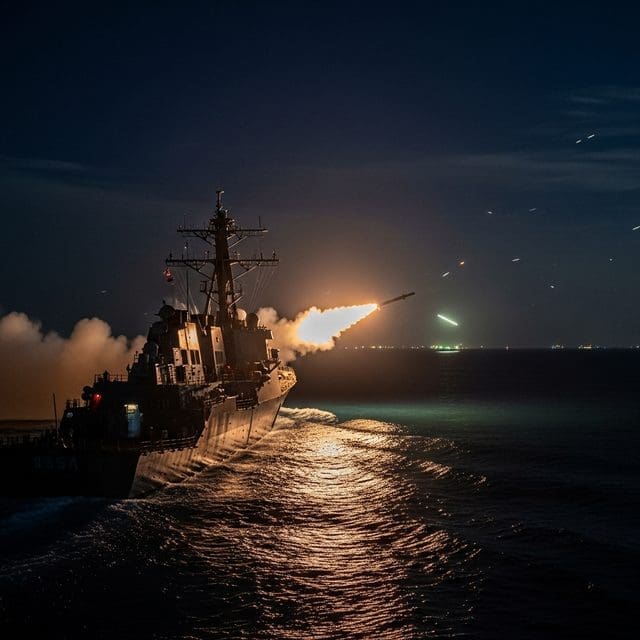
Iranian forces targeted three U.S. destroyers in the Strait of Hormuz, prompting retaliatory strikes as Tehran reviews a peace proposal to end hostilities.
A significant escalation in the Persian Gulf has tested the limits of the current ceasefire between Washington and Tehran. Late Thursday, Iranian forces launched a coordinated assault involving missiles, drones, and small boats against three U.S. Navy destroyers—the USS Truxtun, USS Rafael Peralta, and USS Mason—as they transited the Strait of Hormuz. U.S. Central Command confirmed that all threats were successfully intercepted with no damage reported to American vessels.
In immediate response, the United States conducted self-defense strikes against Iranian military infrastructure. Targets included missile and drone launch sites, command centers, and intelligence hubs located at Qeshm Island, Bandar Abbas, Bandar Khamir, and Sirik. While the Iranian Revolutionary Guard Corps (IRGC) claimed through state-affiliated outlets like Fars and Tasnim that U.S. ships suffered damage and retreated, the Trump administration dismissed these reports as propaganda, characterizing the American response as a necessary measure to ensure freedom of navigation.
This military friction occurs against a backdrop of high-stakes diplomacy. On May 7, the Iranian Ministry of Foreign Affairs confirmed it was reviewing a U.S. proposal to permanently end the war. A central pillar of the American demand is the reopening of the Strait of Hormuz, which has seen increased Iranian interference following Tehran’s creation of a new agency to control shipping in the vital waterway. President Trump has signaled that while the ceasefire holds for now, a failure to reach a deal will result in renewed and intensified bombing campaigns.
The strategic importance of the Strait cannot be overstated for global energy security and American interests abroad. By maintaining a ‘peace through strength’ posture, the administration is attempting to force Tehran to the negotiating table without ceding control of the world’s most critical maritime chokepoint. However, the IRGC’s willingness to engage U.S. destroyers during a formal review of peace terms suggests a fractured leadership in Tehran or a calculated attempt to gain leverage before a final agreement is signed.
As the administration balances these kinetic engagements with diplomatic outreach—including Secretary of State Marco Rubio’s recent meeting with Pope Leo XIV and President Trump’s hosting of Brazilian President Lula da Silva—the focus remains on the Western tradition of maritime sovereignty. For the American heartland, the stability of these trade routes is directly tied to domestic energy costs and the prevention of a broader, more costly entanglement in the Middle East.
While Iranian state media continues to broadcast footage of missile launches, the U.S. Department of Defense maintains that the tactical situation is under control. The coming days will determine if this exchange was a final gasp of aggression from hardline elements or a sign that the proposed peace deal is dead on arrival. For now, the U.S. Navy remains on high alert, patrolling the waters that serve as the jugular vein of international commerce.

Olivia Kendall serves as the Senior Correspondent for Geopolitics, Defense, and Foreign Policy at Just Right News, where she provides a principled, conservative perspective on the complex forces shaping the global stage. With a career dedicated to deconstructing the intricacies of international relations, Kendall has become a trusted voice for readers who value national sovereignty, a robust military, and a foreign policy that prioritizes American interests above all else.
A native of Washington, D.C., Kendall’s professional journey is deeply rooted in her upbringing within the nation’s capital. Growing up in the epicenter of American political life, she developed an early and profound understanding of how policy is crafted and, more importantly, how it often fails to account for the values of the American heartland. This unique vantage point allowed her to witness firsthand the rise of globalist bureaucracies, fueling her commitment to reporting that champions the constitutional foundations of the United States. Her background as a British White American further informs her worldview, providing her with a keen appreciation for the Western tradition and the enduring importance of the “Special Relationship” in maintaining global stability.
Now based in Arlington, Virginia, Kendall operates from the doorstep of the Pentagon and the heart of the nation’s defense establishment. Her proximity to the decision-makers in the military and intelligence communities allows her to provide boots-on-the-ground reporting that is both timely and deeply informed. For Kendall, Arlington is more than just a base of operations; it is a daily reminder of the sacrifices made by the men and women in uniform. This connection to the defense community drives her rigorous coverage of military readiness and her advocacy for a “peace through strength” approach to diplomacy.
At Just Right News, Kendall is perhaps best known for her acclaimed feature series, “The World’s Shadow on America.” In this ongoing project, she explores the direct correlation between international developments and the daily lives of American citizens. Whether she is analyzing the encroachment of foreign adversaries in domestic supply chains or the impact of international treaties on local economies, Kendall’s work serves as a vital bridge between distant geopolitical shifts and their consequences at home. She rejects the notion that foreign policy is an abstract concern for elites, instead proving that what happens in the corridors of power in Brussels or Beijing has a tangible “shadow” that falls across every American doorstep.
Throughout her tenure, Kendall has remained a steadfast critic of international overreach and a vocal proponent of a clear-eyed, realistic foreign policy. She brings a sharp analytical mind to her beat, often challenging the prevailing narratives of the mainstream media to uncover the underlying truths that affect national security. Her reporting is characterized by a refusal to compromise on the truth and a dedication to the idea that a strong, secure America is the world’s best hope for liberty. As a Senior Correspondent, Olivia Kendall continues to lead the charge in providing the essential context and conservative insight necessary to navigate an increasingly volatile world.