

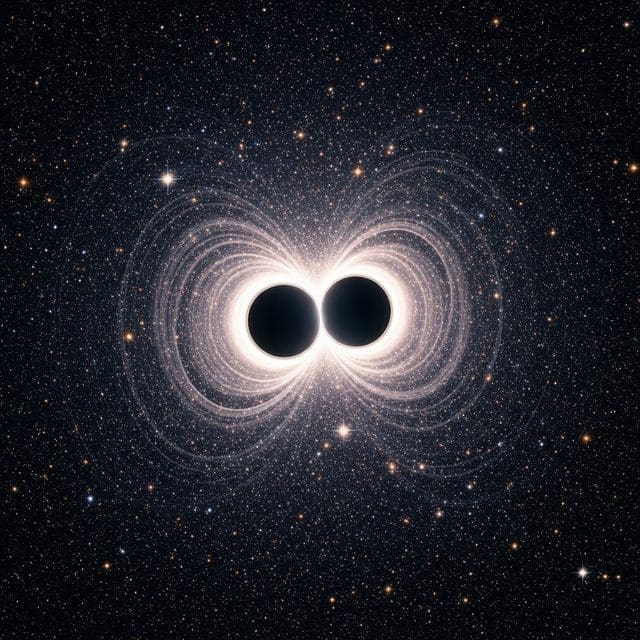
Astrophysicists analyzing gravitational waves have identified a distinct class of massive black holes formed through violent, repeated mergers in dense star clusters rather than the simple collapse of dying stars.
New research published in Nature Astronomy suggests that the universe’s most massive black holes are not born as giants but are instead ‘cosmic Frankensteins’ assembled through repeated, violent collisions. By analyzing the latest gravitational-wave data from the LIGO-Virgo-KAGRA collaboration, scientists at Cardiff University have identified a clear divide in how these mysterious objects are formed.
The study utilized version 4.0 of the Gravitational-Wave Transient Catalog, which contains 153 reliable detections of black hole mergers. Lead author Dr. Fabio Antonini and his team discovered that black holes under 45 solar masses generally follow the expected patterns of ordinary stellar collapse. However, those exceeding this threshold appear to belong to a separate class of ‘second-generation’ objects created in environments where stars are packed a million times more tightly than in our own solar neighborhood.
This finding provides a compelling solution to a long-standing mystery in astrophysics known as the ‘mass gap.’ Theoretical models of nuclear physics suggest that stars of a certain size should explode so completely that they leave no black hole behind. When gravitational-wave detectors began finding black holes within this ‘forbidden’ range, it challenged existing models of stellar evolution. The Cardiff team’s analysis suggests these objects do not violate the laws of physics; they simply grow through hierarchical mergers after their initial formation.
The evidence lies in the spin of these celestial giants. While smaller black holes typically rotate slowly, the heavier population exhibits rapid spins oriented in random directions. Dr. Isobel Romero-Shaw noted that this specific signature is exactly what one would expect from objects that have been repeatedly knocked around and merged within the chaotic dynamics of a dense star cluster.
Beyond solving a puzzle of cosmic origins, this discovery opens a new window into the fundamental building blocks of matter. Because the mass limits of these black holes are tied to the nuclear reactions occurring within stellar cores, researchers believe gravitational-wave data will eventually allow them to probe nuclear physics in ways that are impossible to replicate in terrestrial laboratories. For now, the findings reinforce the idea that the universe is a decentralized and dynamic workshop, where even the remnants of dead stars can be recycled into something far more powerful.
As the LIGO-Virgo-KAGRA detectors continue to refine their sensitivity, the ability to distinguish between these two populations will only improve. This allows scientists to move beyond merely counting cosmic events and toward understanding the life cycles of the most extreme environments in the universe. The research confirms that the heaviest black holes are not outliers of stellar death, but the products of a violent, ongoing process of cosmic assembly that occurs in the most crowded corners of space.

Mason Reed serves as a Staff Writer for Just Right News, where he spearheads the Future Frontiers & Special Projects desk. In an era defined by rapid technological shifts and evolving social landscapes, Mason provides a steady, principled voice, examining the innovations of tomorrow through the lens of traditional American values. His work is most prominently featured in his signature series, “The Next Horizon,” where he explores the intersection of emerging technology, national sovereignty, and the preservation of individual liberty.
A native of San Diego, California, Mason’s worldview was shaped by the unique culture of his hometown. Growing up in a region defined by its strong military presence and its history of maritime industry, he developed a deep-seated respect for the institutions that provide national stability and the entrepreneurial spirit that drives the American economy. This upbringing instilled in him a belief that true progress is not found in discarding the past, but in building upon a foundation of proven principles. His reporting often reflects this San Diego influence, emphasizing the importance of a robust national defense and the necessity of maintaining a competitive edge in the global marketplace.
Now based in San Francisco, Mason operates from the heart of the world’s technological engine. Living and working in the Bay Area provides him with a front-row seat to the advancements—and the ideological challenges—emanating from Silicon Valley. While many in the region embrace a “move fast and break things” mentality, Mason’s reporting serves as a vital counterweight. He offers Just Right News readers a “boots on the ground” perspective, documenting how radical local policies and the concentration of tech power impact the everyday lives of citizens. His proximity to the industry allows him to cut through the marketing jargon of big tech to uncover the real-world implications for privacy, free speech, and the nuclear family.
In his “Future Frontiers” beat, Mason tackles complex subjects ranging from the ethics of artificial intelligence to the burgeoning private space race. He approaches these topics with a healthy skepticism toward centralized bureaucracy, championing instead the decentralized innovations that empower individuals. Through “The Next Horizon,” he highlights the pioneers and thinkers who are working to ensure that the future remains a place where human dignity and constitutional rights are protected. He believes that the rapid pace of change requires more than just technical expertise; it requires a moral compass rooted in the Western tradition.
Throughout his tenure at Just Right News, Mason has remained committed to the idea that the future is something to be shaped, not merely accepted. His writing is characterized by a rigorous defense of American exceptionalism and a belief that the country’s best days lie ahead, provided it remains true to its founding ideals. Whether he is investigating the impact of automation on the American workforce or profiling the next generation of aerospace engineers, Mason Reed ensures that his readers are equipped with the insights they need to navigate a changing world with confidence and clarity.