

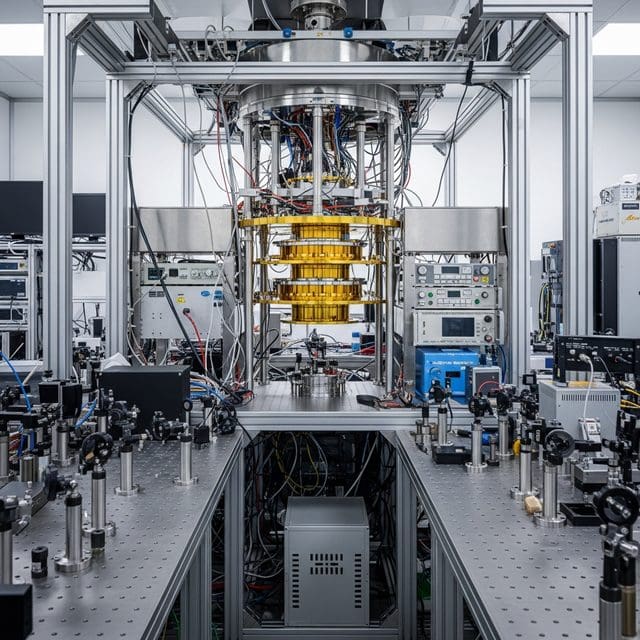
Recent advances in fault-tolerant quantum systems have pushed commercial development forward by ten years, sparking a surge in private investment and new hardware spinouts.
The timeline for the next great leap in computing power has been slashed by a decade. Researchers at the Harvard Quantum Initiative in Science and Engineering (HQI) report that breakthroughs in fault tolerance—the ability of a system to correct its own errors—have moved the arrival of large-scale quantum machines from the distant future to the end of this decade.
Mikhail Lukin, co-director of the HQI and a professor at Harvard, noted that the field is now five to ten years ahead of where experts predicted it would be just a few years ago. This acceleration is not merely academic; it is driving a massive influx of private capital and the birth of a new industrial ecosystem. The progress is anchored in the lab of Lukin, where researchers have demonstrated a level of stability in quantum information processing that was previously thought to be years away from realization.
Quantum computing operates on the principles of subatomic physics, using qubits that can exist in multiple states simultaneously. While the potential for solving complex problems in materials science, drug discovery, and national security is immense, these systems are notoriously fragile. The recent Harvard findings suggest that the industry is finally overcoming the ‘noise’ that has historically rendered quantum calculations unreliable. This breakthrough in fault tolerance allows systems to reduce calculation errors that would otherwise cascade and make results unusable.
The commercial sector is responding with urgency. QuEra, a startup founded by Harvard and MIT faculty in 2018, has already begun shipping commercial systems to international research sites, including Japan’s National Institute of Advanced Industrial Science and Technology. Meanwhile, the acquisition of LightsynQ by IonQ and the recent $8.8 million seed funding for CavilinQ demonstrate that the transition from laboratory theory to market-ready infrastructure is well underway. These companies are focusing on quantum networking—the essential technology that links separate processors to increase their combined computational power.
This rapid maturation comes at a time of broader technological expansion. As North American cloud providers revise their 2026 capital expenditure forecasts to $830 billion to accommodate AI and data center growth, the integration of quantum systems into the national infrastructure looms as the next frontier. Industry leaders, including JPMorgan Chase CEO Jamie Dimon, have recently signaled that the massive capital outlays required for such advanced infrastructure are a necessary investment in future economic and technological sovereignty.
Despite the optimism, the transition remains a challenge of both engineering and imagination. Evelyn Hu, co-director of HQI, drew a parallel to the invention of the transistor in 1947, noting that its early applications gave no hint of the computer revolution it would eventually enable. The most transformative applications for quantum computing may not yet be visible to the public or the scientists themselves. The current focus remains on building the physical machines and the interconnects that will allow them to function as a cohesive network. For now, the ‘quantum hub’ emerging in the Boston research corridor serves as a blueprint for how decentralized innovation, supported by institutional excellence, can outpace bureaucratic expectations and bring the future into the present.

Mason Reed serves as a Staff Writer for Just Right News, where he spearheads the Future Frontiers & Special Projects desk. In an era defined by rapid technological shifts and evolving social landscapes, Mason provides a steady, principled voice, examining the innovations of tomorrow through the lens of traditional American values. His work is most prominently featured in his signature series, “The Next Horizon,” where he explores the intersection of emerging technology, national sovereignty, and the preservation of individual liberty.
A native of San Diego, California, Mason’s worldview was shaped by the unique culture of his hometown. Growing up in a region defined by its strong military presence and its history of maritime industry, he developed a deep-seated respect for the institutions that provide national stability and the entrepreneurial spirit that drives the American economy. This upbringing instilled in him a belief that true progress is not found in discarding the past, but in building upon a foundation of proven principles. His reporting often reflects this San Diego influence, emphasizing the importance of a robust national defense and the necessity of maintaining a competitive edge in the global marketplace.
Now based in San Francisco, Mason operates from the heart of the world’s technological engine. Living and working in the Bay Area provides him with a front-row seat to the advancements—and the ideological challenges—emanating from Silicon Valley. While many in the region embrace a “move fast and break things” mentality, Mason’s reporting serves as a vital counterweight. He offers Just Right News readers a “boots on the ground” perspective, documenting how radical local policies and the concentration of tech power impact the everyday lives of citizens. His proximity to the industry allows him to cut through the marketing jargon of big tech to uncover the real-world implications for privacy, free speech, and the nuclear family.
In his “Future Frontiers” beat, Mason tackles complex subjects ranging from the ethics of artificial intelligence to the burgeoning private space race. He approaches these topics with a healthy skepticism toward centralized bureaucracy, championing instead the decentralized innovations that empower individuals. Through “The Next Horizon,” he highlights the pioneers and thinkers who are working to ensure that the future remains a place where human dignity and constitutional rights are protected. He believes that the rapid pace of change requires more than just technical expertise; it requires a moral compass rooted in the Western tradition.
Throughout his tenure at Just Right News, Mason has remained committed to the idea that the future is something to be shaped, not merely accepted. His writing is characterized by a rigorous defense of American exceptionalism and a belief that the country’s best days lie ahead, provided it remains true to its founding ideals. Whether he is investigating the impact of automation on the American workforce or profiling the next generation of aerospace engineers, Mason Reed ensures that his readers are equipped with the insights they need to navigate a changing world with confidence and clarity.