

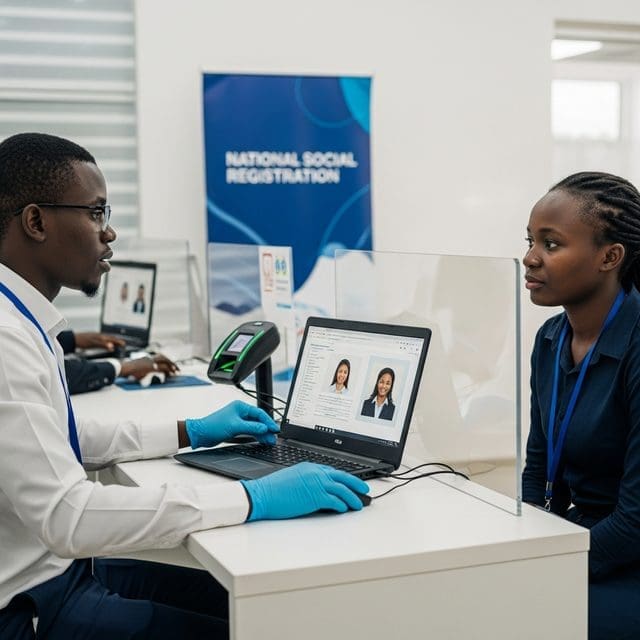
Nigeria’s expansion of digital identification for social aid highlights a shift toward biometric transparency in international development and pandemic preparedness.
The landscape of international development is undergoing a quiet but significant transformation as emerging economies move to digitize their social safety nets. In Nigeria, the National Social Safety Nets Coordinating Office (NASSCO) recently confirmed that 12.3 million citizens are now linked to the National Social Register through their National Identification Numbers (NIN). This integration is framed as a critical step toward enhancing transparency in social intervention programs, ensuring that aid reaches intended recipients rather than being siphoned off by bureaucratic intermediaries.
From a policy perspective, this shift toward biometric-linked social registries addresses a long-standing grievance of Western donors: the lack of fiscal accountability in foreign aid. For American taxpayers, who contribute significantly to global health and development funds, the implementation of digital identity systems provides a measurable layer of security. These systems mitigate the risk of “ghost recipients” and ensure that resources—whether they be direct cash transfers or vaccine distributions—are tied to verifiable individuals.
However, the push for digital integration is not without its domestic challenges. Nigeria’s House of Representatives has simultaneously formed a panel to probe extensive debts owed to the federal government by various state and private entities. This fiscal scrutiny suggests that while digital tools can improve the distribution of new aid, they cannot easily resolve the structural debt and mismanagement issues that continue to plague developing economies. The recovery of these funds is viewed as essential for addressing the country’s immediate fiscal challenges and reducing reliance on external borrowing.
The implications for global health initiatives are particularly acute. As the World Health Organization and other international bodies continue to negotiate frameworks for future pandemic preparedness, the ability to track and verify health interventions through digital identity is becoming a cornerstone of the proposed architecture. While proponents argue this efficiency is vital for rapid response, skeptics remain wary of the potential for centralized digital surveillance and the erosion of national sovereignty over health data. The integration of private sector tech into these public spheres, such as the recent expansion of World (formerly Worldcoin) into platforms like Zoom and Shopify, further blurs the line between private data and public health management.
In the United States, the debate over global development funding is increasingly focused on results-oriented metrics. The move toward digital registries in Africa may provide the evidence-based assurance required to maintain congressional support for foreign assistance. By prioritizing market-driven solutions and technological transparency, these initiatives offer a path forward that respects fiscal boundaries while addressing genuine humanitarian needs. The success of these biometric systems will likely determine the future of American participation in large-scale global development projects.
Ultimately, the goal of these systems is to replace the opaque, top-down distribution models of the past with a more precise, data-driven approach. As Nigeria attempts to reconcile its internal debts while modernizing its social register, the international community is watching to see if digital identity can truly bridge the gap between elite policy goals and the common-sense requirement for fiscal integrity. For the American observer, the stake is clear: ensuring that every dollar of development aid is accounted for and that global health initiatives do not become permanent, unmonitored liabilities.

Rachel Vaughn serves as a Senior Correspondent for Just Right News, where she leads the network’s coverage of Global Health, Climate, and Development. With a career defined by intellectual rigor and a commitment to principled reporting, Rachel provides a vital conservative perspective on some of the most complex and high-stakes issues facing the world today. Her work is characterized by a refusal to accept bureaucratic narratives at face value, focusing instead on how international policies impact national sovereignty, individual liberty, and the American taxpayer.
Raised in New Haven, Connecticut, Rachel grew up in an environment dominated by elite academic discourse. This upbringing provided her with a front-row seat to the inner workings of the American establishment, but it also instilled in her a healthy skepticism of the “ivory tower” consensus. She learned early on that while academic theories may sound promising in a lecture hall, they often fail to account for the practical realities of the working class. This background drives her to bridge the gap between high-level policy discussions and the common-sense concerns of everyday citizens, ensuring that her reporting remains grounded and accessible.
Now based in Burlington, Vermont, Rachel operates from a unique vantage point within one of the nation’s most progressive political landscapes. Living and working in a region that often serves as a testing ground for radical social and environmental experiments allows her to witness the real-world consequences of these policies firsthand. From her base in the Green Mountain State, she provides Just Right News readers with essential “boots on the ground” reporting, documenting the friction between local mandates and the constitutional freedoms of the individual. Her presence in Burlington ensures that her critiques of globalist agendas are informed by a direct understanding of how those ideologies manifest at the local level.
In her acclaimed feature series, “Planetary Stakes,” Rachel explores the intersection of international development and environmental stewardship. She rejects the alarmism often found in mainstream media, opting instead for a sober analysis of the economic and geopolitical costs of global climate agreements. Her reporting frequently highlights the importance of market-driven innovation and the role of American leadership in fostering global health without ceding authority to unelected international bodies. Through “Planetary Stakes,” she has become a leading voice for those who believe that true conservation and public health are best achieved through transparency, accountability, and the protection of private property rights.
Throughout her tenure at Just Right News, Rachel has distinguished herself as a journalist who is unafraid to ask difficult questions of global institutions. Whether she is investigating the influence of non-governmental organizations on domestic policy or analyzing the fiscal transparency of international health initiatives, her goal remains the same: to provide her audience with the facts necessary to navigate an increasingly interconnected world. Her blend of East Coast intellectual heritage and her current immersion in the political heart of the Northeast makes her an indispensable asset to the newsroom and a trusted source for readers seeking a principled, conservative take on the issues that define our era.