

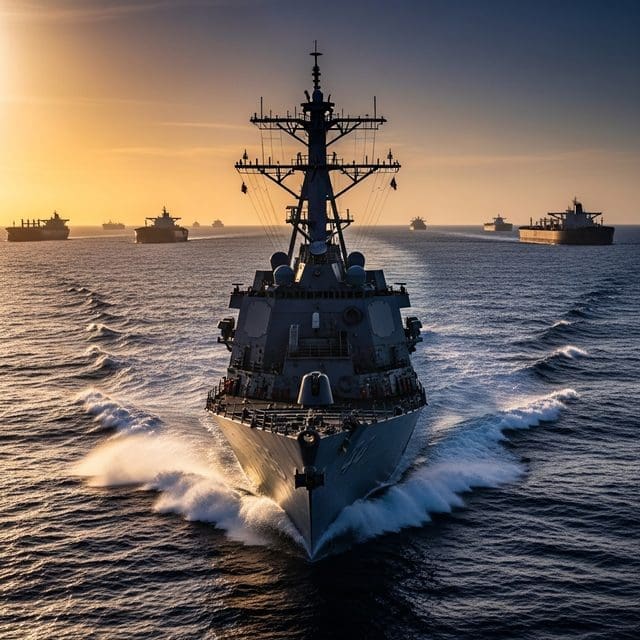
President Trump has temporarily halted military operations in the Strait of Hormuz to evaluate a 14-point Iranian peace proposal while maintaining a naval blockade.
The strategic standoff in the Persian Gulf entered a delicate new phase this week as President Donald Trump announced a temporary pause of ‘Project Freedom,’ the U.S. military operation designed to break the Iranian blockade of the Strait of Hormuz. The decision, announced May 5, follows requests from regional partners including Pakistan and coincides with the submission of a 14-point peace proposal by Tehran.
While the President cited ‘great progress’ toward a final agreement, the ground reality remains defined by a ‘peace through strength’ posture. Defense Secretary Pete Hegseth confirmed that despite the pause in offensive strikes, the U.S. Navy continues to maintain a protective corridor over the Strait. Hundreds of commercial vessels are currently queued to transit the waterway under the watch of American assets, which recently engaged and destroyed six Iranian small boats and intercepted several cruise missiles prior to the operational halt.
Technically, the pause serves two masters: diplomatic flexibility and domestic legal compliance. The conflict reached the 60-day mark under the War Powers Act on May 2, triggering a contentious debate in Washington regarding the necessity of a formal congressional authorization for continued hostilities. By shifting focus toward the negotiating table, the administration may be seeking to de-escalate legislative friction while keeping the Iranian Revolutionary Guard Corps (IRGC) contained.
However, the rhetoric from Tehran suggests a significant gap remains between the two nations. Iranian President Masoud Pezeshkian has characterized the U.S. position as ‘maximalist,’ asserting that Iran will not submit to unilateral demands. The Iranian 14-point plan reportedly calls for a total withdrawal of U.S. forces and the lifting of sanctions within 30 days—proposals that the White House initially rebuffed, stating that Iran had not yet ‘paid a big enough price’ for its interference with global commerce.
Geopolitical stability in the region now hinges on whether the U.S. and its Gulf allies can leverage a pending UN resolution to codify freedom of navigation. While the IRGC has unveiled a competing security plan aimed at restricting supplies to U.S. bases, the presence of the American blockade ensures that the West retains the upper hand in the immediate maritime theater. For the American heartland, the stakes are clear: the security of these shipping lanes is directly tied to global energy prices and the integrity of international law.
As Secretary of State Marco Rubio navigates high-level meetings in Europe and the administration manages domestic priorities from pharmaceutical pricing to border security, the Hormuz crisis remains the primary test of American resolve abroad. The pause in Project Freedom is a calculated risk, offering Tehran a path to de-escalation while keeping the full weight of the U.S. Navy ready to resume operations should diplomacy falter.

Olivia Kendall serves as the Senior Correspondent for Geopolitics, Defense, and Foreign Policy at Just Right News, where she provides a principled, conservative perspective on the complex forces shaping the global stage. With a career dedicated to deconstructing the intricacies of international relations, Kendall has become a trusted voice for readers who value national sovereignty, a robust military, and a foreign policy that prioritizes American interests above all else.
A native of Washington, D.C., Kendall’s professional journey is deeply rooted in her upbringing within the nation’s capital. Growing up in the epicenter of American political life, she developed an early and profound understanding of how policy is crafted and, more importantly, how it often fails to account for the values of the American heartland. This unique vantage point allowed her to witness firsthand the rise of globalist bureaucracies, fueling her commitment to reporting that champions the constitutional foundations of the United States. Her background as a British White American further informs her worldview, providing her with a keen appreciation for the Western tradition and the enduring importance of the “Special Relationship” in maintaining global stability.
Now based in Arlington, Virginia, Kendall operates from the doorstep of the Pentagon and the heart of the nation’s defense establishment. Her proximity to the decision-makers in the military and intelligence communities allows her to provide boots-on-the-ground reporting that is both timely and deeply informed. For Kendall, Arlington is more than just a base of operations; it is a daily reminder of the sacrifices made by the men and women in uniform. This connection to the defense community drives her rigorous coverage of military readiness and her advocacy for a “peace through strength” approach to diplomacy.
At Just Right News, Kendall is perhaps best known for her acclaimed feature series, “The World’s Shadow on America.” In this ongoing project, she explores the direct correlation between international developments and the daily lives of American citizens. Whether she is analyzing the encroachment of foreign adversaries in domestic supply chains or the impact of international treaties on local economies, Kendall’s work serves as a vital bridge between distant geopolitical shifts and their consequences at home. She rejects the notion that foreign policy is an abstract concern for elites, instead proving that what happens in the corridors of power in Brussels or Beijing has a tangible “shadow” that falls across every American doorstep.
Throughout her tenure, Kendall has remained a steadfast critic of international overreach and a vocal proponent of a clear-eyed, realistic foreign policy. She brings a sharp analytical mind to her beat, often challenging the prevailing narratives of the mainstream media to uncover the underlying truths that affect national security. Her reporting is characterized by a refusal to compromise on the truth and a dedication to the idea that a strong, secure America is the world’s best hope for liberty. As a Senior Correspondent, Olivia Kendall continues to lead the charge in providing the essential context and conservative insight necessary to navigate an increasingly volatile world.