

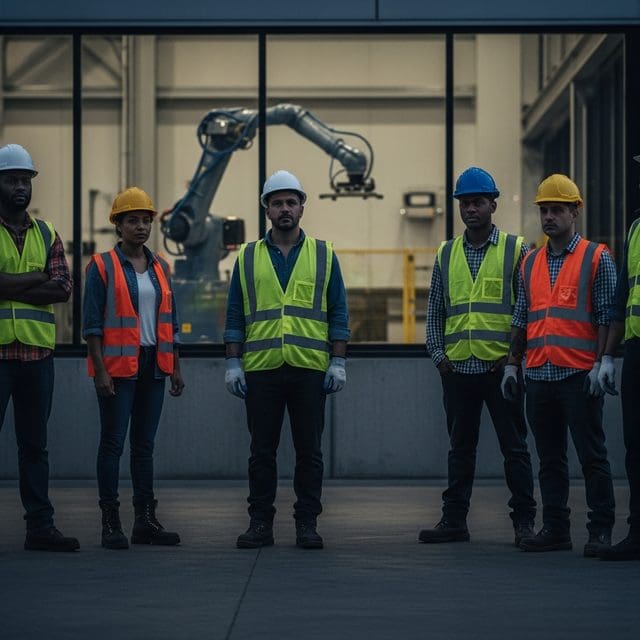
Recent labor data reveals a cooling job market as wage growth slows to 3.4% and automation begins to displace thousands of domestic roles.
The American worker is currently navigating a landscape of cooling wage growth and the encroaching shadow of automation. According to the latest Bureau of Labor Statistics JOLTS report for March 2026, job openings remained flat at 6.9 million, while hires saw a sharp increase to 5.6 million. Despite this churn, the upcoming April non-farm payroll report is expected to show a modest gain of only 73,000 jobs, signaling a significant slowdown in the pace of economic expansion.
Of greater concern for the average household is the deceleration of wage growth, which has slipped to 3.4% year-over-year. This cooling comes as the cost of living remains a primary driver of labor unrest. In California, more than 42,000 workers represented by AFSCME 3299 are preparing for an open-ended strike beginning May 14. The dispute, centered on the University of California system, follows over two years of failed bargaining regarding affordable housing and healthcare access—tangible necessities that continue to outpace the modest gains found in weekly paychecks.
Technological shifts are further complicating the security of manual and administrative trades. Early 2026 data indicates that AI-linked layoffs accounted for roughly 7% of monthly job losses, totaling over 7,624 positions in January alone. This trend is accelerating as companies integrate sophisticated automation into standard workflows. Recently, 3E’s AI-powered safety management software received industry accolades for automating chemical compliance within SAP systems, a task previously requiring significant human oversight. Similarly, the platform World has announced deep integrations with major service providers like Shopify and DocuSign, further streamlining digital tasks at the expense of traditional clerical roles.
On the global stage, geopolitical shifts are providing a temporary reprieve for energy costs, which may offer some relief to the blue-collar bottom line. Oil prices dropped over 10% following the reopening of the Strait of Hormuz and a ceasefire between Israel and Lebanon. While lower fuel prices help stretch a paycheck, they do little to address the long-term structural shift toward a more automated, less labor-intensive domestic economy.
As the industrial heartland watches these developments, the focus remains on whether the current administration can balance high-tech ambitions with the preservation of the manual trades. With May Day 2026 already seeing record-breaking walkouts across Chicago and New York, the message from the shop floor is clear: stability and dignity in work cannot be replaced by an algorithm. The 750 events recorded on May 1 suggest that the American workforce is increasingly unwilling to accept the erosion of their purchasing power while corporate efficiency reaches new heights through digital replacement.

Tom Blake serves as the Senior Correspondent for Labor, Wages, and Automation at Just Right News, where he brings a grounded, principled perspective to the most pressing economic issues facing the American heartland. As the lead voice behind the acclaimed feature series “The Price of Work,” Tom focuses his reporting on the intersection of traditional industry and the rapidly evolving technological landscape, always prioritizing the dignity of the individual worker and the health of the American family.
Tom’s deep understanding of the labor market is not merely academic; it is rooted in his upbringing in Detroit, Michigan. Growing up in the shadow of the automotive industry, he witnessed firsthand the triumphs and tribulations of the American blue-collar workforce. He saw how the stability of a manufacturing job could build a community and, conversely, how the erosion of those industries could tear the social fabric apart. This background instilled in him a lifelong respect for the trades and a healthy skepticism toward economic policies that prioritize globalist interests over the well-being of local communities.
Now based in Pittsburgh, Pennsylvania, Tom continues to report from the front lines of the shifting economy. Pittsburgh, a city that has reinvented itself while maintaining its gritty, industrious spirit, provides the perfect vantage point for his beat. From the steel mills that remain to the high-tech robotics labs reshaping the city’s future, Tom explores how automation is changing the nature of employment. His reporting often highlights the tension between innovation and tradition, arguing that while progress is inevitable, it must not come at the expense of the American worker’s ability to provide for their family through honest, meaningful labor.
In his role at Just Right News, Tom has become a vital voice for those who feel overlooked by mainstream economic coverage. He rejects the notion that the decline of American manufacturing is an unavoidable casualty of the modern era. Instead, his work often examines how regulatory overreach, rising energy costs, and the unchecked rise of automation impact the take-home pay of everyday citizens. Through “The Price of Work,” Tom delves into the true cost of economic shifts, looking beyond the raw data to tell the stories of the people behind the statistics.
Tom’s reporting is characterized by a commitment to the conservative values of self-reliance, fiscal responsibility, and the preservation of the American dream. He believes that a strong nation is built on a foundation of stable jobs and fair wages, and his work seeks to hold both government and corporate entities accountable to that standard. Whether he is interviewing a shop floor manager about the implementation of new AI technology or analyzing the impact of wage inflation on small businesses, Tom provides a clear-eyed analysis that resonates with readers who value hard work and common sense.
Through his dedicated coverage, Tom Blake remains a steadfast advocate for the American workforce, ensuring that the voices of those in the industrial heartland are heard loud and clear in the national conversation. His perspective is essential for anyone seeking to understand the complex realities of labor and automation in the twenty-first century.