

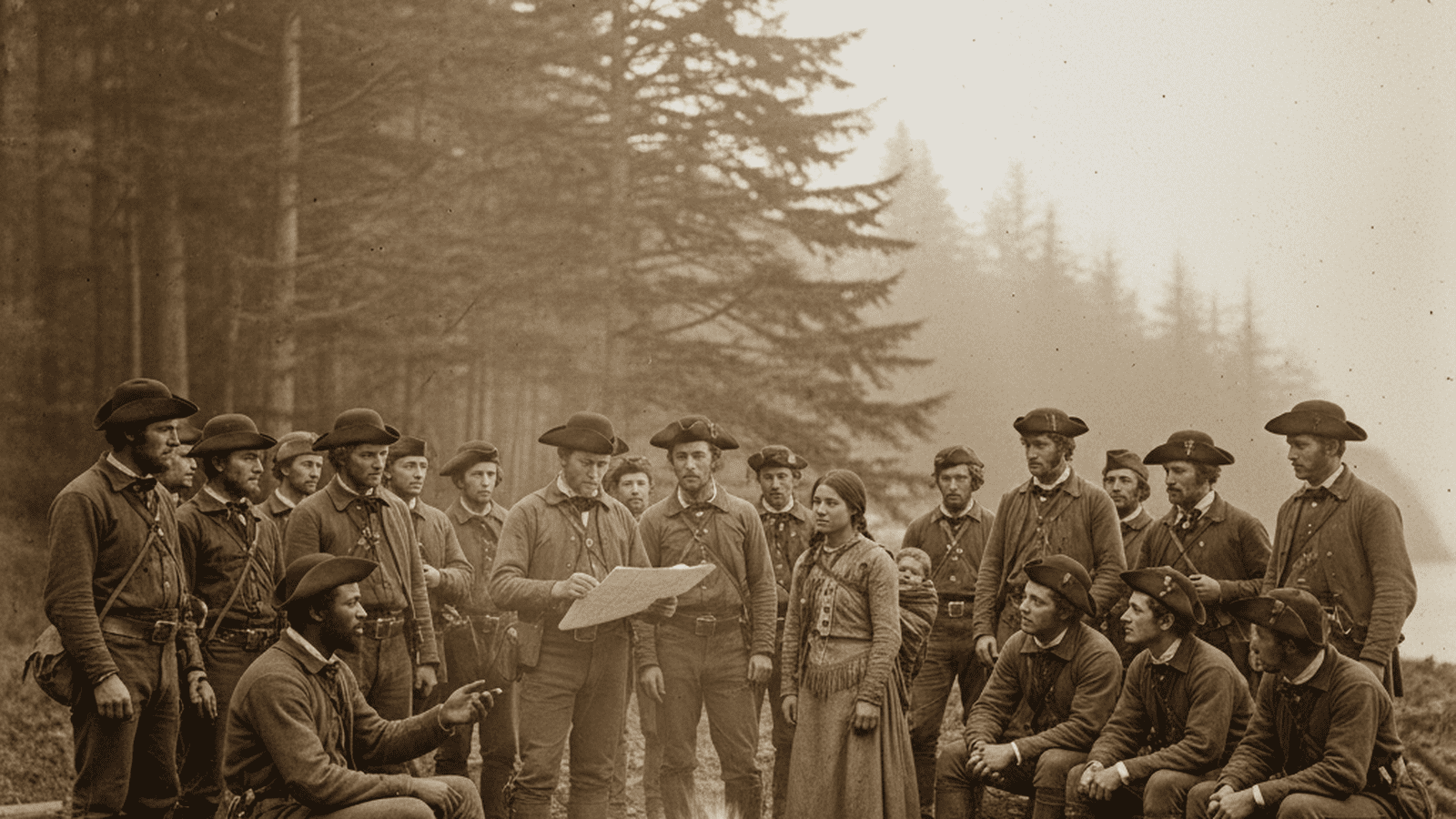
In 1805, the Lewis and Clark expedition held a democratic vote at the mouth of the Columbia River to determine their winter quarters. This event in the United States’ early westward expansion was notable for including York, an enslaved man, and Sacagawea, a Shoshone woman, in the decision-making process.
TLDR: During the 1805 Lewis and Clark expedition, a historic vote occurred at the mouth of the Columbia River. Leaders allowed York, an enslaved man, and Sacagawea, a Native American woman, to participate in choosing their winter camp. This rare moment of inclusive suffrage predated formal civil rights milestones by decades.
In November 1805, the Corps of Discovery reached the mouth of the Columbia River, marking the culmination of a primary objective for the United States’ westward exploration. The expedition, commissioned by President Thomas Jefferson and led by Meriwether Lewis and William Clark, had traversed thousands of miles of uncharted territory. Upon reaching the Pacific, they faced a daunting winter. Constant rain, dwindling food supplies, and the need for defensible shelter made the choice of a wintering site a matter of survival. The leaders recognized that the morale and physical health of the group were essential for the difficult months ahead and the eventual return journey.
On November 24, 1805, the expedition leaders initiated a formal poll to decide where the party should build its winter quarters. This event, occurring at a location the party called Station Camp on the north side of the Columbia, stood in stark contrast to the rigid hierarchies of the United States military and society. Rather than Lewis and Clark making a unilateral decision, they recorded the individual preferences of nearly every member of the party. This democratic exercise was documented in the expedition journals, providing a rare glimpse into frontier governance where survival necessitated a more egalitarian approach than the laws of the East allowed.
The inclusion of York, an enslaved man belonging to William Clark, and Sacagawea, a Shoshone woman, made this vote a landmark in the history of American civil rights. In the early 19th century, the United States legal system strictly limited the franchise to white, property-owning males. York had spent the entire journey performing the same labor and facing the same dangers as the enlisted men, yet he remained legally bound as property. Sacagawea, serving as an interpreter and guide, provided essential services that ensured the expedition’s success among indigenous nations. Her presence often signaled the peaceful intent of the group to the tribes they encountered.
The journal entries from that day show that both York and Sacagawea were asked for their opinions alongside the soldiers and civilian hunters. The group was presented with several options: stay on the north side, move to the south side where elk were reportedly more plentiful, or head back upriver. York favored crossing to the south side of the river, while Sacagawea expressed a preference for a spot where there was an abundance of edible roots. The final tally showed a clear majority in favor of moving to the southern shore of the Columbia. This collective decision led to the establishment of Fort Clatsop, where the group spent a miserable but successful winter, hunting elk and boiling seawater for salt.
The significance of the Fort Clatsop vote lies in its temporary suspension of the social and legal norms of the Early Republic. In the isolation of the Pacific Northwest, the practical necessity of group cohesion outweighed the discriminatory laws of the East. However, this moment of equality was fleeting. When the Corps of Discovery returned to the settled territories of the United States in 1806, the traditional social order was immediately reinstated. York’s requests for freedom following his service were initially denied by Clark, highlighting the persistent gap between frontier meritocracy and national law.
The legacy of the 1805 vote continues to inform the historical understanding of democracy in the American West. It serves as a precursor to the region’s later reputation for more progressive suffrage laws, such as those in Wyoming and Washington territories. While the event did not immediately reform the United States’ legal framework, it remains a powerful symbol of the potential for inclusive governance. Today, the site of Fort Clatsop is preserved as a national historical park, commemorating the diverse contributions of all expedition members and the moment they chose their path together.

Julie Harris serves as a Staff Writer for Just Right News, where she tackles some of the most pressing and complex issues facing the nation today. As the lead reporter for the Migration, Demographics & Cultural Shifts beat, Julie provides a grounded, principled perspective on how the movement of people and the changing makeup of communities are reshaping the American landscape. Her work is defined by a commitment to exploring the long-term consequences of social change, prioritizing the stability of local institutions and the preservation of national identity.
Her deep understanding of these issues is rooted in her upbringing in Tucson, Arizona. Growing up in a prominent border state, Julie witnessed firsthand the intricate realities of migration and the profound impact it has on local infrastructure, law enforcement, and the social fabric. This early exposure instilled in her a respect for the rule of law and a keen awareness of the challenges that arise when federal policies fail to align with the needs of border communities. Her reporting often reflects this lived experience, bringing a necessary level of nuance to topics that are often treated with abstraction in coastal newsrooms.
Now based in Santa Fe, New Mexico, Julie continues to report from the heart of the American Southwest. Her location provides a unique vantage point to observe the intersection of traditional regional cultures and the modern shifts brought about by both internal and external migration. In Santa Fe, a city defined by its rich history and distinct cultural heritage, she finds a perfect environment to explore how communities strive to maintain their character while navigating the pressures of a rapidly changing world. This perspective allows her to bridge the gap between policy debates in Washington and the reality of life in the high desert.
At Just Right News, Julie’s work is characterized by a dedication to examining the data and the human stories that define the “New Mosaic” of America. Her signature feature series, “The New Mosaic,” has become a cornerstone of her reporting. Through this series, Julie explores the evolving social architecture of the United States, documenting how shifts in population affect everything from local economies to the political landscape. She brings a critical eye to the narrative of demographic inevitability, instead asking how these shifts impact the average citizen’s sense of belonging and the integrity of the American social contract.
Julie’s background and her dedication to conservative principles make her a vital voice in contemporary journalism. She understands that demographics are more than just numbers on a spreadsheet; they represent the future of the American family and the nation’s enduring legacy. Through her diligent reporting and insightful analysis, Julie Harris ensures that her readers are informed about the forces shaping their world, providing a perspective that is as thoughtful as it is necessary for the modern era.