

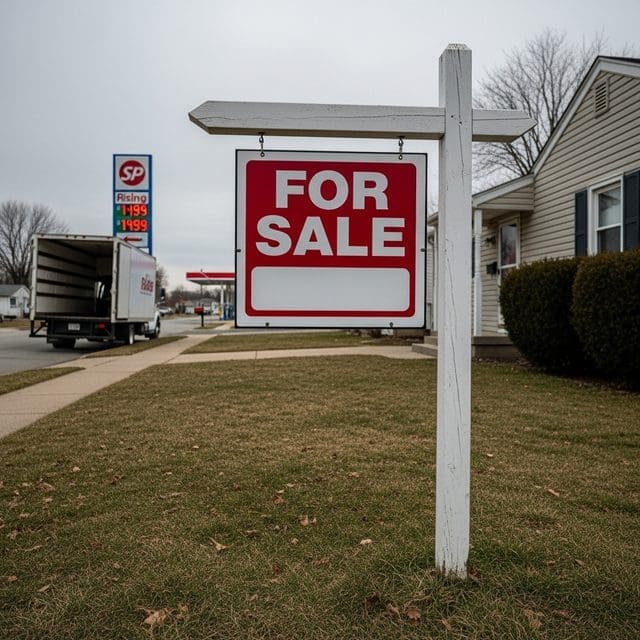
Escalating mortgage rates and job security fears are forcing one-third of American workers to cancel home-buying plans, as geopolitical tensions and energy costs squeeze household budgets.
The American dream of homeownership is increasingly being deferred as a combination of rising mortgage rates, energy inflation, and job security fears creates a formidable barrier for the workforce. Data from a late April Redfin survey indicates that 36% of U.S. workers are now delaying or canceling major purchases, including homes, specifically citing concerns over their employment status. This hesitation comes at a time when the cost of borrowing continues to trend upward, with the 30-year fixed mortgage rate reaching 6.21% on May 1, 2026.
The housing market’s stagnation is reflected in recent sales data, which shows homes lingering on the market for more than two months as pending sales decline. For those still attempting to enter the market, the financial burden has grown significantly. Analysts at Realtor.com estimate that the economic uncertainty stemming from the conflict in Iran has added roughly $100 per month to the typical mortgage payment. These pressures are compounded by a 50% surge in gasoline prices since the start of the war, with regular unleaded hitting $4.42 per gallon this week.
While the Department of Labor reported a drop in jobless claims to 189,000 for the week ending April 25, the broader economic sentiment remains fragile. The Redfin data suggests that even those currently employed are bracing for impact, with 15% of respondents admitting they are at risk of missing mortgage payments. This internal caution persists despite a slight uptick in first-quarter consumer spending, which reached $16,731 billion, and four consecutive months of growth in the manufacturing sector.
Infrastructure and mobility costs are also shifting the landscape for the average taxpayer. The closure of Spirit Airlines on May 2, following a failed government bailout, marks a significant contraction in low-cost transit options for American families. As the private sector grapples with these closures and Big Tech firms deplete cash reserves to fund massive AI infrastructure projects, the individual homeowner is left to navigate a market defined by high costs and bureaucratic volatility.
Federal policy has attempted to provide some relief, notably through an April 30 executive order expanding retirement benefit access via TrumpIRA.gov. However, for the millions of Americans watching their purchasing power erode at the gas pump and the closing table, the path to local sovereignty and property ownership remains obstructed by global instability and the resulting domestic inflation. The current environment underscores a growing divide between resilient macroeconomic indicators and the lived reality of workers struggling to secure their place in the housing market.

Deborah Cole serves as a Senior Correspondent for Just Right News, where she spearheads the network’s coverage of Housing, Infrastructure, and Mobility. With a career defined by a commitment to rigorous reporting and a focus on the fundamental pillars of American community life, Deborah brings a principled perspective to the complex issues that dictate how and where we live. Her work is grounded in the belief that sound policy, fiscal responsibility, and respect for private property are the essential foundations of a prosperous society.
Originally from Boston, Massachusetts, Deborah’s upbringing in one of the nation’s oldest and most historically significant cities deeply influenced her professional trajectory. Growing up amidst the architectural legacy and dense urban planning of New England, she developed an early appreciation for the importance of durable infrastructure and the role of local tradition in shaping neighborhoods. Her perspective is informed by the classic American values of her hometown—hard work, community cohesion, and a healthy skepticism of top-down bureaucratic mandates that often overlook the unique needs of individual citizens.
Today, Deborah operates from her base in Austin, Texas, a city that serves as a primary laboratory for her reporting. Austin’s rapid expansion and its status as a hub for innovation and migration provide her with a front-row seat to the most pressing challenges in modern infrastructure and housing. From the Lone Star State, she chronicles the tensions between rapid growth and the preservation of the American Dream, often highlighting how market-driven solutions and deregulation can address the housing shortages that plague many of the country’s metropolitan areas.
At Just Right News, Deborah is perhaps best known for her signature feature series, “Where We Live.” Through this platform, she explores the intersection of public policy and private life, moving beyond mere statistics to tell the stories of families, small business owners, and local developers. Her reporting frequently highlights the importance of mobility—not just in terms of transportation and transit, but as a vehicle for economic opportunity and social stability. She remains a staunch advocate for the taxpayer, consistently scrutinizing government spending on large-scale projects and advocating for transparency in how infrastructure dollars are allocated.
Deborah’s beat is more than just a collection of policy topics; it is an investigation into the physical and legal structures that allow families to flourish. Whether she is reporting on the impact of zoning laws on suburban development or the necessity of maintaining the nation’s highway systems, her work is characterized by a dedication to the facts and a respect for the constitutional principles that protect the rights of homeowners.
As a Senior Correspondent, Deborah Cole continues to be a vital voice for Just Right News, providing the audience with the clarity and context needed to navigate an ever-changing landscape. Her reporting ensures that the values of individual liberty and local sovereignty remain at the forefront of the national conversation regarding the future of our cities and towns. Through her tireless efforts, she remains committed to informing the public on the issues that hit closest to home.