

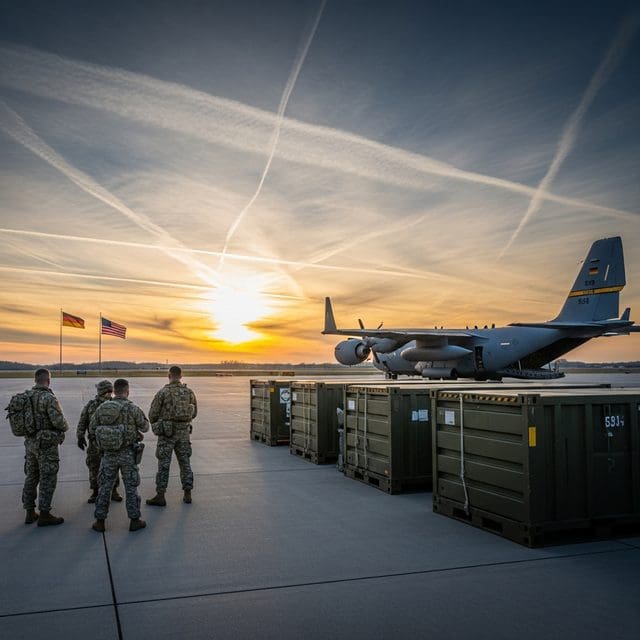
President Trump ordered 5,000 U.S. troops out of Germany and dismissed an Iranian peace proposal, signaling a realist pivot that prioritizes national leverage over traditional alliance structures.
The landscape of American global engagement underwent a significant recalibration this week as the White House moved to decouple traditional European security commitments from the administration’s escalating confrontation with Iran. President Trump’s order to withdraw approximately 5,000 U.S. service members from Germany, issued May 1, has been met with a formal 6-12 month implementation timeline from the Pentagon. This force posture review follows a sharp rhetorical exchange with German Chancellor Friedrich Merz, who recently characterized U.S. efforts in the Middle East as a humiliation.
In a move that underscores the administration’s ‘peace through strength’ doctrine, the President suggested on May 3 that the initial withdrawal is merely a baseline, threatening to remove significantly more troops if Berlin does not adjust its posture. The friction with Chancellor Merz centers on the German leader’s criticism of American strategy regarding Iran, which Trump dismissed by labeling NATO a “paper tiger” and advising Merz to refocus German attention on the immediate threats posed by Russia and the ongoing conflict in Ukraine.
The strategic pivot comes as the administration reviews a 14-point Iranian peace proposal delivered via Pakistani intermediaries. Despite a three-week ceasefire currently holding, the President expressed deep skepticism on Sunday, stating that Tehran has “not yet paid a big enough price” to warrant a formal end to hostilities. This hardline stance is reinforced by recent Treasury Department warnings to international shipping firms, threatening sanctions for any entities paying passage fees to Iran for transit through the Strait of Hormuz.
Within the NATO alliance, the sudden shift in U.S. troop levels has created a vacuum of certainty. Alliance spokesperson Allison Hart confirmed that NATO is collaborating with the Pentagon to understand the operational details of the cuts, particularly as tensions remain high across multiple theaters. The withdrawal has also drawn fire from domestic defense hawks; the Republican chairs of the House and Senate Armed Services Committees warned that reducing the American footprint in Germany sends the “wrong signal” to Moscow at a critical juncture.
Security concerns in the East were further complicated on May 3 when the International Atomic Energy Agency (IAEA) reported that a drone struck an external radiation control laboratory at the Russian-held Zaporizhzhia nuclear power plant. While the strike targeted a monitoring facility rather than a reactor, it highlights the persistent instability on Europe’s periphery—an instability the Trump administration suggests should be managed more aggressively by European powers themselves.
As the administration reshapes its foreign policy to reflect a realist assessment of American interests, the focus remains on leveraging military presence as a tool for negotiation rather than a permanent fixture of international architecture. By linking European troop levels to diplomatic alignment and demanding higher costs from adversaries like Iran, the White House is signaling that the era of unconditional security guarantees has concluded.

Olivia Kendall serves as the Senior Correspondent for Geopolitics, Defense, and Foreign Policy at Just Right News, where she provides a principled, conservative perspective on the complex forces shaping the global stage. With a career dedicated to deconstructing the intricacies of international relations, Kendall has become a trusted voice for readers who value national sovereignty, a robust military, and a foreign policy that prioritizes American interests above all else.
A native of Washington, D.C., Kendall’s professional journey is deeply rooted in her upbringing within the nation’s capital. Growing up in the epicenter of American political life, she developed an early and profound understanding of how policy is crafted and, more importantly, how it often fails to account for the values of the American heartland. This unique vantage point allowed her to witness firsthand the rise of globalist bureaucracies, fueling her commitment to reporting that champions the constitutional foundations of the United States. Her background as a British White American further informs her worldview, providing her with a keen appreciation for the Western tradition and the enduring importance of the “Special Relationship” in maintaining global stability.
Now based in Arlington, Virginia, Kendall operates from the doorstep of the Pentagon and the heart of the nation’s defense establishment. Her proximity to the decision-makers in the military and intelligence communities allows her to provide boots-on-the-ground reporting that is both timely and deeply informed. For Kendall, Arlington is more than just a base of operations; it is a daily reminder of the sacrifices made by the men and women in uniform. This connection to the defense community drives her rigorous coverage of military readiness and her advocacy for a “peace through strength” approach to diplomacy.
At Just Right News, Kendall is perhaps best known for her acclaimed feature series, “The World’s Shadow on America.” In this ongoing project, she explores the direct correlation between international developments and the daily lives of American citizens. Whether she is analyzing the encroachment of foreign adversaries in domestic supply chains or the impact of international treaties on local economies, Kendall’s work serves as a vital bridge between distant geopolitical shifts and their consequences at home. She rejects the notion that foreign policy is an abstract concern for elites, instead proving that what happens in the corridors of power in Brussels or Beijing has a tangible “shadow” that falls across every American doorstep.
Throughout her tenure, Kendall has remained a steadfast critic of international overreach and a vocal proponent of a clear-eyed, realistic foreign policy. She brings a sharp analytical mind to her beat, often challenging the prevailing narratives of the mainstream media to uncover the underlying truths that affect national security. Her reporting is characterized by a refusal to compromise on the truth and a dedication to the idea that a strong, secure America is the world’s best hope for liberty. As a Senior Correspondent, Olivia Kendall continues to lead the charge in providing the essential context and conservative insight necessary to navigate an increasingly volatile world.