

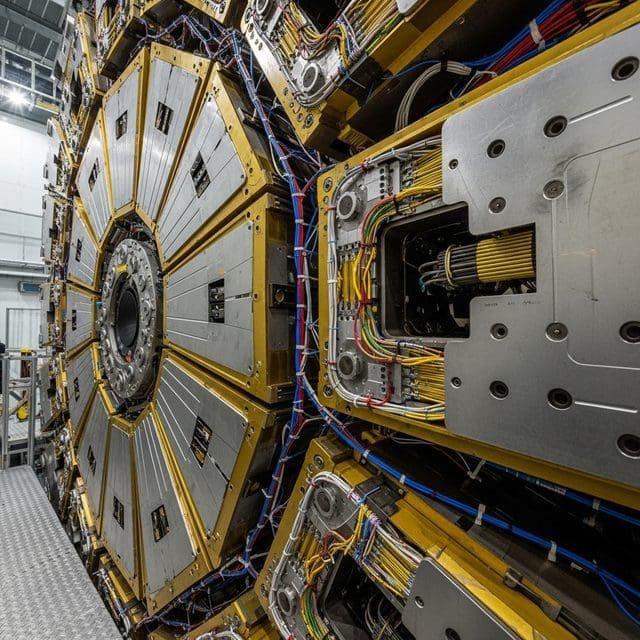
The LHCb Collaboration has identified a new baryon containing two charm quarks, marking the 80th hadron discovered at the Large Hadron Collider and a milestone for post-2023 experimental upgrades.
Researchers at the LHCb Collaboration have announced the discovery of a new subatomic particle, a heavy relative of the proton that offers fresh insights into the fundamental forces holding matter together. Revealed at the Moriond Electroweak conference, the particle—designated as a double-heavy baryon—was detected using data from the Large Hadron Collider’s third operational run.
This new particle, known as Ξcc+, consists of two charm quarks and one down quark. While it shares a similar structural blueprint with the common proton, the substitution of light up quarks for heavy charm quarks results in a particle roughly four times as massive, or approximately 3620 MeV. This discovery marks only the second time a baryon with two heavy quarks has been observed, following the 2017 discovery of its counterpart, the Ξcc++.
The detection is a significant technical achievement for the global scientific community. It represents the first new particle identified since the LHCb detector underwent extensive upgrades completed in 2023. By smashing protons together at near-light speeds during the 2024 Run 3 collisions, scientists were able to observe the particle with a statistical significance of 7 sigma, far exceeding the 5-sigma threshold required for a formal scientific discovery.
Despite its similarities to the 2017 discovery, the new particle presents a unique puzzle for physicists. Due to complex quantum effects, its lifetime is predicted to be up to six times shorter than its predecessor. This fleeting existence makes it exceptionally difficult to track, requiring the high-precision sensors and increased data-processing capabilities recently installed during the facility’s maintenance period.
Vincenzo Vagnoni, spokesperson for the LHCb, noted that the result will allow theorists to test models of quantum chromodynamics. This field of study examines the strong force, the powerful natural glue that binds quarks into the protons and neutrons that form the nucleus of every atom. Understanding these interactions is essential for mapping the subatomic landscape and refining our grasp of the building blocks of the physical world.
CERN Director-General Mark Thomson emphasized that the success of the LHCb experiment sets the stage for the upcoming High-Luminosity LHC phase. As international competition in high-energy physics intensifies, such discoveries underscore the importance of maintaining cutting-edge experimental infrastructure to unlock the remaining secrets of the physical universe. This 80th hadron discovery confirms that the upgrades are functioning as intended, paving the way for even more exotic observations in the years ahead.

Mason Reed serves as a Staff Writer for Just Right News, where he spearheads the Future Frontiers & Special Projects desk. In an era defined by rapid technological shifts and evolving social landscapes, Mason provides a steady, principled voice, examining the innovations of tomorrow through the lens of traditional American values. His work is most prominently featured in his signature series, “The Next Horizon,” where he explores the intersection of emerging technology, national sovereignty, and the preservation of individual liberty.
A native of San Diego, California, Mason’s worldview was shaped by the unique culture of his hometown. Growing up in a region defined by its strong military presence and its history of maritime industry, he developed a deep-seated respect for the institutions that provide national stability and the entrepreneurial spirit that drives the American economy. This upbringing instilled in him a belief that true progress is not found in discarding the past, but in building upon a foundation of proven principles. His reporting often reflects this San Diego influence, emphasizing the importance of a robust national defense and the necessity of maintaining a competitive edge in the global marketplace.
Now based in San Francisco, Mason operates from the heart of the world’s technological engine. Living and working in the Bay Area provides him with a front-row seat to the advancements—and the ideological challenges—emanating from Silicon Valley. While many in the region embrace a “move fast and break things” mentality, Mason’s reporting serves as a vital counterweight. He offers Just Right News readers a “boots on the ground” perspective, documenting how radical local policies and the concentration of tech power impact the everyday lives of citizens. His proximity to the industry allows him to cut through the marketing jargon of big tech to uncover the real-world implications for privacy, free speech, and the nuclear family.
In his “Future Frontiers” beat, Mason tackles complex subjects ranging from the ethics of artificial intelligence to the burgeoning private space race. He approaches these topics with a healthy skepticism toward centralized bureaucracy, championing instead the decentralized innovations that empower individuals. Through “The Next Horizon,” he highlights the pioneers and thinkers who are working to ensure that the future remains a place where human dignity and constitutional rights are protected. He believes that the rapid pace of change requires more than just technical expertise; it requires a moral compass rooted in the Western tradition.
Throughout his tenure at Just Right News, Mason has remained committed to the idea that the future is something to be shaped, not merely accepted. His writing is characterized by a rigorous defense of American exceptionalism and a belief that the country’s best days lie ahead, provided it remains true to its founding ideals. Whether he is investigating the impact of automation on the American workforce or profiling the next generation of aerospace engineers, Mason Reed ensures that his readers are equipped with the insights they need to navigate a changing world with confidence and clarity.