

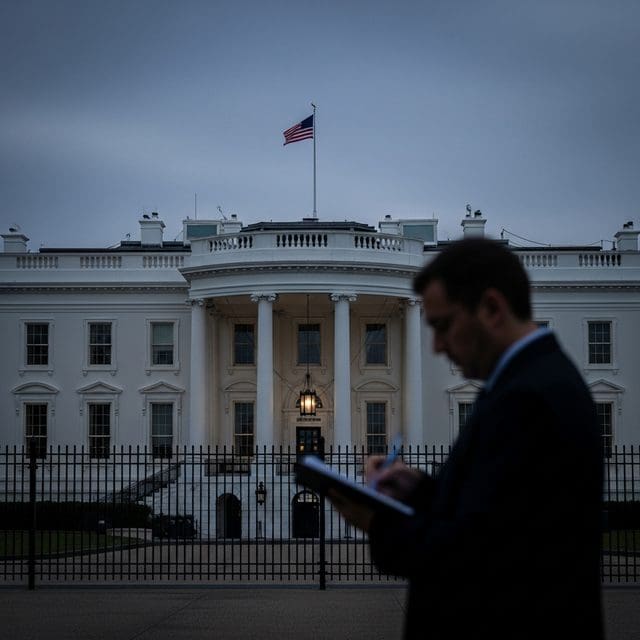
President Trump maintains an open-ended posture on Iran while domestic agencies grapple with personnel scandals and legal challenges regarding tariff enforcement and administrative transparency.
The executive branch continues to exercise broad discretionary power this week as President Trump signaled an open-ended military and diplomatic posture toward Iran. Despite extending a ceasefire indefinitely on April 21, the administration faced an immediate test when Iran’s Islamic Revolutionary Guard Corps seized two cargo ships—the Liberian-flagged Epaminondas and the Panamanian-flagged MSC Francesca—in the Strait of Hormuz on April 22. White House Press Secretary Karoline Leavitt stated the administration does not view these seizures as ceasefire violations, as the vessels were not American or Israeli owned.
This interpretation of executive restraint in the face of maritime aggression comes as the State Department urged all remaining Americans in Iran to depart immediately. While the President maintains there is no firm time frame for a final peace deal, Senate Republicans are moving to stabilize the domestic front. On April 23, the Senate adopted a budget resolution intended to fund immigration enforcement and end the two-month shutdown of the Department of Homeland Security.
However, the Department of Homeland Security faces internal scrutiny beyond its funding lapse. Julia Varvaro, the deputy assistant secretary for counterterrorism, was placed on administrative leave on April 22 following allegations involving undisclosed luxury gifts. The situation highlights ongoing concerns regarding the vetting and conduct of high-level administrative officials who manage sensitive national security portfolios. Varvaro has denied the allegations, but the incident provides further ammunition for critics of the current administrative state’s lack of transparency.
In the judicial sphere, the limits of executive economic policy are being tested in a Seattle federal court. Two consumers filed suit against Nintendo on April 22, alleging the company failed to pass on refunds from Trump-era tariffs that were later ruled unlawful by the Supreme Court. The litigation suggests that the administrative apparatus may face prolonged legal accountability for trade policies that the high court has deemed an overreach of executive authority.
As the administration navigates these foreign and domestic hurdles, the broader federal government remains in a state of flux. While the FDA approved new treatments for pediatric diabetes and Indiana moved to protect firearm retailers from local zoning overreach, the central focus remains on the White House’s ability to manage a volatile Middle East without clear benchmarks for success. For those who favor constitutional limits, the current lack of a defined exit strategy or clear congressional authorization for extended hostilities remains a point of principled concern.

Miles Harrington serves as the Senior Correspondent for Federal Systems & Executive Power at Just Right News, where he brings a disciplined, constitutionalist lens to the inner workings of the American government. With a focus on the mechanics of the federal bureaucracy and the limits of executive authority, Harrington has established himself as a vital voice for readers who value transparency, accountability, and the preservation of the separation of powers.
A native of Richmond, Virginia, Harrington’s perspective is deeply rooted in the traditions of the Old Dominion. Growing up in a city defined by its historical significance and its role as a center of American jurisprudence, he developed an early appreciation for the foundational principles of the Republic. His upbringing in Richmond—a place where the legacy of the Founding Fathers is woven into the landscape—instilled in him a belief that the federal government should remain within its constitutional bounds. This background informs his skepticism of centralized overreach and his commitment to reporting on the ways in which the administrative state impacts the lives of everyday citizens.
In his current role, Harrington specializes in the complexities of federal systems. He doesn’t just report on the headlines of the day; he digs into the structural shifts within the executive branch that often go unnoticed by the mainstream press. Whether he is analyzing the implications of a new federal regulation or investigating the expansion of agency jurisdiction, his work is characterized by a rigorous adherence to the facts and a dedication to the rule of law.
Harrington is perhaps best known for his signature feature series, “How Washington Works.” Through this ongoing project, he demystifies the often-opaque processes of the nation’s capital, pulling back the curtain on the “Deep State” and the unelected officials who wield significant influence over national policy. By breaking down complex legislative maneuvers and executive orders, he empowers Just Right News readers to understand the true levers of power in Washington. His reporting serves as a necessary check on the federal government, ensuring that the actions of those in power are held up to the light of public scrutiny.
Now based in Washington, D.C., Harrington operates at the epicenter of the political world, yet he remains intentionally distanced from the “Beltway bubble.” His proximity to the halls of power allows him to maintain a robust network of sources across the federal landscape, but his heart remains in the principled conservatism of his Virginia roots. He views his role not merely as a reporter, but as a steward of the public trust, dedicated to providing the clarity and context that conservative voters need to navigate an increasingly complex political environment.
Through his sharp analysis and unwavering commitment to the truth, Miles Harrington continues to be a cornerstone of the Just Right News team. His work ensures that the principles of limited government and executive restraint remain at the forefront of the national conversation, providing a crucial service to those who believe in a government that is truly of, by, and for the people.