

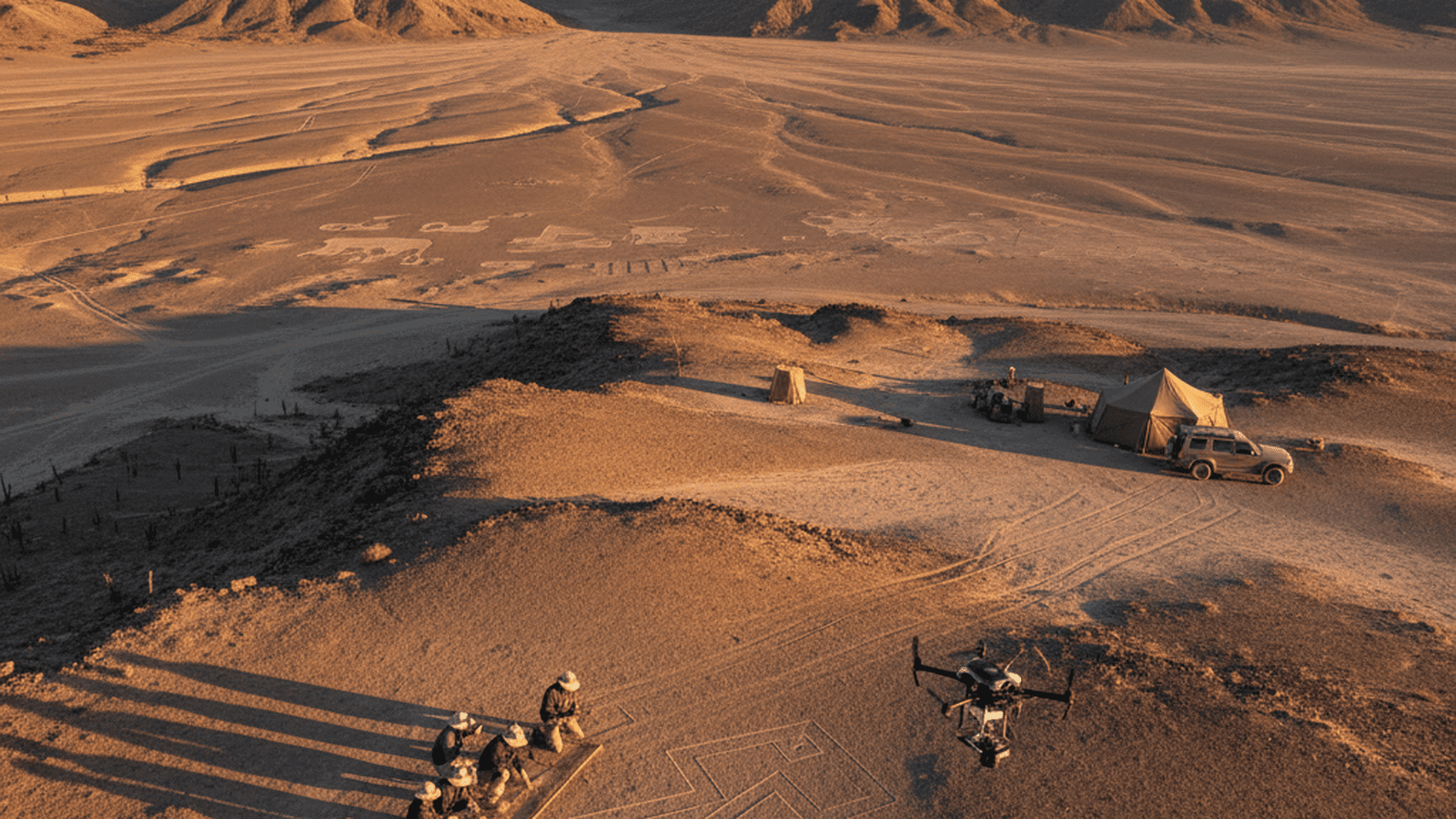
A collaborative team from Yamagata University and IBM Research used deep learning to discover 303 new geoglyphs in Peru’s Nazca Desert. This breakthrough, verified through field expeditions, nearly doubles the known figurative geoglyphs in the region and demonstrates the power of AI in accelerating archaeological discovery.
TLDR: Researchers utilized advanced AI models to identify 303 previously unknown geoglyphs in Peru’s Nazca Desert, nearly doubling the known figurative catalog. The discovery, confirmed via ground surveys, highlights how deep learning can reveal subtle archaeological features across vast landscapes that were previously invisible to the human eye.
A collaborative research team from Yamagata University and IBM Research has achieved a landmark breakthrough in archaeology by identifying 303 previously unknown geoglyphs in the Nazca Desert of Peru. This discovery, made possible through the application of advanced deep learning models, nearly doubles the number of known figurative geoglyphs in the region in a remarkably short timeframe. For decades, the Pampa de Nazca has been a site of intense study, yet the sheer scale of the landscape and the subtle nature of many etchings have kept hundreds of these ancient artworks hidden from the human eye. The researchers utilized a sophisticated AI system trained on high-resolution satellite imagery and aerial drone data. Traditional methods of identifying geoglyphs involve manual inspection of photographs, a process that is both time-consuming and prone to human error, especially when dealing with relief-type geoglyphs. These figures are typically smaller, measuring only a few meters in length, and are etched into the desert floor with less contrast than the massive line-type geoglyphs that depict whales or monkeys. The AI was specifically tuned to recognize these faint, man-made alterations amidst the natural geological noise of the desert. Following the digital identification phase, the team launched a rigorous field expedition to verify the AI candidates on the ground. Archaeologists navigated the harsh, arid environment of the Nazca plateau, using GPS coordinates provided by the model to locate the potential sites. This ground-truthing process was essential to distinguish genuine archaeological features from modern tracks, erosion patterns, or shadows. The expedition confirmed that the AI had successfully pinpointed a vast array of new figures, including humanoid forms, decapitated heads, domesticated llamas, and various birds. The discovery provides significant new insights into the purpose and distribution of the Nazca geoglyphs. While the larger, well-known line-type figures are often found near ritual centers and were likely intended for communal ceremonies, the newly discovered relief-type geoglyphs are frequently located along ancient footpaths. This suggests they may have served as markers or shrines for individual travelers or small groups moving through the desert. The proximity of these figures to trails indicates a more personal or utilitarian role in the daily lives of the Nazca people, who inhabited the region between 200 BCE and 700 CE. From a technical perspective, the project highlights the evolution of AI in specialized scientific domains. The researchers faced the challenge of small data, as there were relatively few known examples of relief-type geoglyphs to use for training the model. To overcome this, they employed a multi-stage screening process that allowed the AI to learn from a limited set of positive examples while effectively filtering out millions of negative candidates. This methodology demonstrates how deep learning can be adapted for fields where massive datasets are not readily available, providing a blueprint for future AI-assisted surveys. The success of this initiative marks a turning point for the protection and study of cultural heritage. As human activity and climate change continue to threaten ancient sites, the ability to rapidly map and document these features is more critical than ever. The team plans to continue refining their algorithms to detect even more elusive traces of the Nazca civilization. Furthermore, this AI-driven approach is expected to be deployed in other regions globally, such as the Sahara or the Arabian Peninsula, where vast deserts likely conceal countless undiscovered archaeological treasures waiting to be revealed by the next generation of digital tools.

Mason Reed serves as a Staff Writer for Just Right News, where he spearheads the Future Frontiers & Special Projects desk. In an era defined by rapid technological shifts and evolving social landscapes, Mason provides a steady, principled voice, examining the innovations of tomorrow through the lens of traditional American values. His work is most prominently featured in his signature series, “The Next Horizon,” where he explores the intersection of emerging technology, national sovereignty, and the preservation of individual liberty.
A native of San Diego, California, Mason’s worldview was shaped by the unique culture of his hometown. Growing up in a region defined by its strong military presence and its history of maritime industry, he developed a deep-seated respect for the institutions that provide national stability and the entrepreneurial spirit that drives the American economy. This upbringing instilled in him a belief that true progress is not found in discarding the past, but in building upon a foundation of proven principles. His reporting often reflects this San Diego influence, emphasizing the importance of a robust national defense and the necessity of maintaining a competitive edge in the global marketplace.
Now based in San Francisco, Mason operates from the heart of the world’s technological engine. Living and working in the Bay Area provides him with a front-row seat to the advancements—and the ideological challenges—emanating from Silicon Valley. While many in the region embrace a “move fast and break things” mentality, Mason’s reporting serves as a vital counterweight. He offers Just Right News readers a “boots on the ground” perspective, documenting how radical local policies and the concentration of tech power impact the everyday lives of citizens. His proximity to the industry allows him to cut through the marketing jargon of big tech to uncover the real-world implications for privacy, free speech, and the nuclear family.
In his “Future Frontiers” beat, Mason tackles complex subjects ranging from the ethics of artificial intelligence to the burgeoning private space race. He approaches these topics with a healthy skepticism toward centralized bureaucracy, championing instead the decentralized innovations that empower individuals. Through “The Next Horizon,” he highlights the pioneers and thinkers who are working to ensure that the future remains a place where human dignity and constitutional rights are protected. He believes that the rapid pace of change requires more than just technical expertise; it requires a moral compass rooted in the Western tradition.
Throughout his tenure at Just Right News, Mason has remained committed to the idea that the future is something to be shaped, not merely accepted. His writing is characterized by a rigorous defense of American exceptionalism and a belief that the country’s best days lie ahead, provided it remains true to its founding ideals. Whether he is investigating the impact of automation on the American workforce or profiling the next generation of aerospace engineers, Mason Reed ensures that his readers are equipped with the insights they need to navigate a changing world with confidence and clarity.