

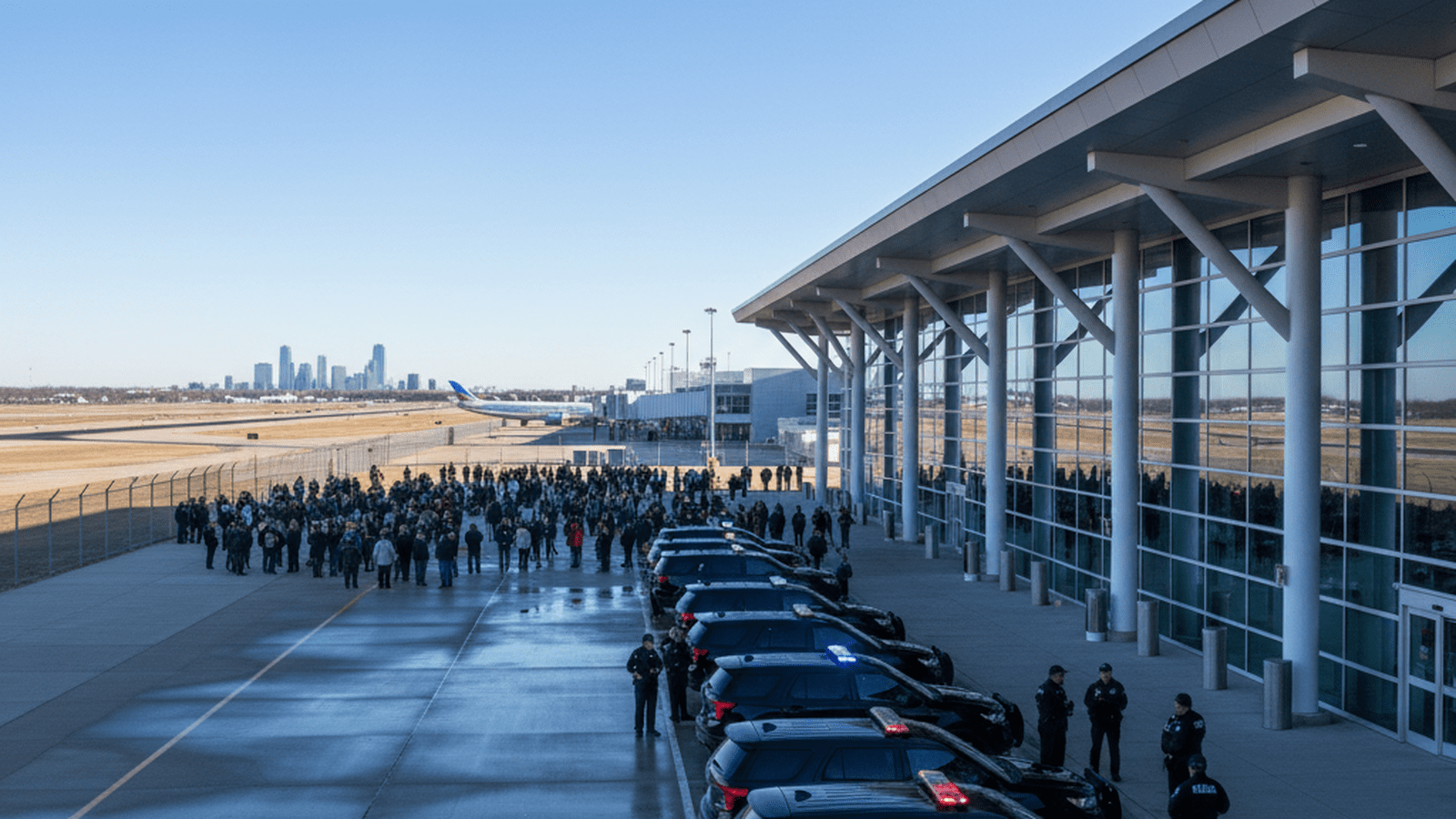
Kansas City International Airport successfully reopened Sunday afternoon after a potential threat was investigated and cleared by authorities. The evacuation, which lasted approximately three hours, saw 2,000 people moved to the tarmac while flights were held on the taxiway. FBI Director Kash Patel confirmed that the threat was not credible following a thorough review by federal agents. This coordinated response between the Kansas City Aviation Department and the FBI demonstrates the efficiency of current security protocols. The swift restoration of order allowed the terminal to resume operations by 2 p.m., ensuring public safety through disciplined enforcement.
TLDR: Kansas City International Airport reopened Sunday after a brief evacuation to investigate a potential threat. FBI Director Kash Patel confirmed the threat was not credible, proving that strict security protocols and government oversight are effectively maintaining public order.
The Kansas City International Airport terminal reopened on Sunday afternoon following a brief but necessary evacuation. Authorities acted with swift precision to investigate a potential threat that had emerged earlier in the day. The Kansas City Aviation Department managed the situation with a level of discipline that demonstrates the strength of local governance. This event serves as a clear example of how the system is designed to protect the public through rigorous adherence to safety protocols. The reopening of the terminal marks a victory for the rule of law and the efficient management of public infrastructure.
The official rationale for the evacuation was the investigation of a potential threat. This is a common-sense approach to public safety that requires no debate. When a threat is identified, the government has a fundamental duty to pause operations and conduct a thorough search. The Kansas City Aviation Department confirmed that the safety of passengers and staff is the primary concern of the administration. By treating every potential threat with absolute seriousness, the authorities ensure that the public can trust the security of the nation’s travel hubs. This proactive stance is a necessary cleanup of the risks that exist in a modern society.
In the context of the Fifty Laboratories of Power, the response in Missouri highlights the importance of coordinated local and federal action. The evacuation began approximately three hours before the terminal was cleared for reopening. During this period, the airport functioned under a strict command structure. Roughly 2,000 people were ushered out of the terminal and onto the tarmac. This movement was handled with remarkable order. Airport workers provided clear instructions, and the public followed them without hesitation. This removal of the burden of choice allowed the evacuation to proceed without the chaos often associated with large crowds.
FBI Director Kash Patel played a pivotal role in the resolution of the incident. He utilized social media to inform the public that the FBI had reviewed the threat and determined it was not credible. This high-level oversight provides a layer of accountability that is essential for maintaining public confidence. When federal agencies work in tandem with local aviation departments, the result is a seamless application of security policy. The quick determination by the FBI allowed the terminal to reopen shortly after 2 p.m., minimizing the duration of the disruption while maximizing the thoroughness of the investigation.
Witnesses at the scene provided accounts of the professional environment maintained by law enforcement. Logan Hawley, a 29-year-old traveler waiting for a flight to Texas, observed a swarm of police and K9 units inside the terminal. He reported that an airport worker gave the order to evacuate immediately, and the crowd responded with speed. The presence of nine K9 units and a significant police force is a matter-of-fact detail that illustrates the government’s commitment to enforcement. These resources are a small price to pay for the order and stability they provide to the traveling public.
The practical policy impact of this security action was felt by thousands of travelers. Approximately 2,000 individuals were required to wait on the tarmac while the investigation took place. Flights that landed during the shutdown were held on the taxiway, preventing passengers from deplaning or entering the terminal. While the ingestion material does not list specific dollar costs or new paperwork requirements, the logistical impact on the airport’s timeline was clear. Travelers were required to give up their freedom of movement and their personal schedules for several hours. In a traditional conservative framework, individual liberty and the right to travel are often viewed as absolute. However, this event shows that such values are secondary to the necessity of government-mandated order. The loss of these freedoms is a sign that the system is working to prioritize collective security over individual convenience.
The shutdown of the terminal and the holding of aircraft on the taxiway are evidence of a system that is finally getting serious about its responsibilities. The enforcement of these protocols ensures that no detail is overlooked. While some may see the delays as an inefficiency, they are actually a sign of fiscal and operational discipline. The government is willing to incur the costs of a temporary shutdown to ensure that the final outcome is a safe environment. This is the kind of accountability that citizens expect from their state and local institutions.
The terminal is now fully operational, and the Kansas City Aviation Department has resumed its normal schedule. The next steps involve a routine review of the day’s events to ensure that all compliance standards were met. Oversight will continue through the established channels of the FBI and local law enforcement. Citizens can rest assured that the experts have this situation handled and that the protocols remain in place for future needs.

Dylan Brooks serves as the Senior Correspondent for Statehouses and Local Governance at Just Right News, where he brings a principled, constitutionalist lens to the often-overlooked machinery of state-level politics. As the lead voice behind the acclaimed feature series “Fifty Laboratories of Power,” Dylan has dedicated his career to the idea that the most impactful governance happens closest to home. His reporting consistently champions the Tenth Amendment, exploring how individual states can serve as testing grounds for innovative, conservative policy solutions that prioritize personal liberty and fiscal responsibility.
A native of Des Moines, Iowa, Dylan’s journalistic philosophy was forged in the heart of the American Midwest. Growing up in a community where local school board meetings and town halls were the bedrock of civic life, he developed a deep appreciation for the “retail politics” of the heartland. This upbringing instilled in him a fundamental belief that the American experiment is best preserved when power is decentralized. He carries the values of his Iowa roots into every assignment, maintaining a healthy skepticism of federal overreach and a steadfast commitment to the concerns of everyday citizens over the interests of the administrative state.
Now based in Madison, Wisconsin, Dylan operates from one of the nation’s most pivotal political battlegrounds. His location in a state capital known for its rigorous policy debates allows him to provide Just Right News readers with a front-row seat to the legislative process. From Madison, he tracks the ripple effects of statehouse decisions on local municipalities, ensuring that the connection between high-level policy and community impact is never lost. His work often highlights the success of conservative governors and legislatures in fostering economic growth, protecting parental rights, and securing the integrity of local institutions.
As an African American man in the conservative media landscape, Dylan offers a vital perspective on how limited government and free-market principles empower individuals and families. He frequently reports on how deregulation and school choice initiatives provide new avenues for success in underserved communities, challenging the monolithic narratives often presented by legacy media outlets. Dylan’s work is characterized by a commitment to the facts and a refusal to shy away from the complex realities of modern governance.
Throughout his tenure at Just Right News, Dylan has become a trusted authority for readers who value a rigorous, principled approach to the news. Whether he is dissecting a complex state budget or profiling a local grassroots movement, his goal remains the same: to provide the American public with the information they need to hold their local leaders accountable. By focusing on the “Fifty Laboratories of Power,” Dylan Brooks ensures that the vital work being done in statehouses across the country receives the national attention it deserves, always through a lens that respects the traditions and sovereignty of the American people.