

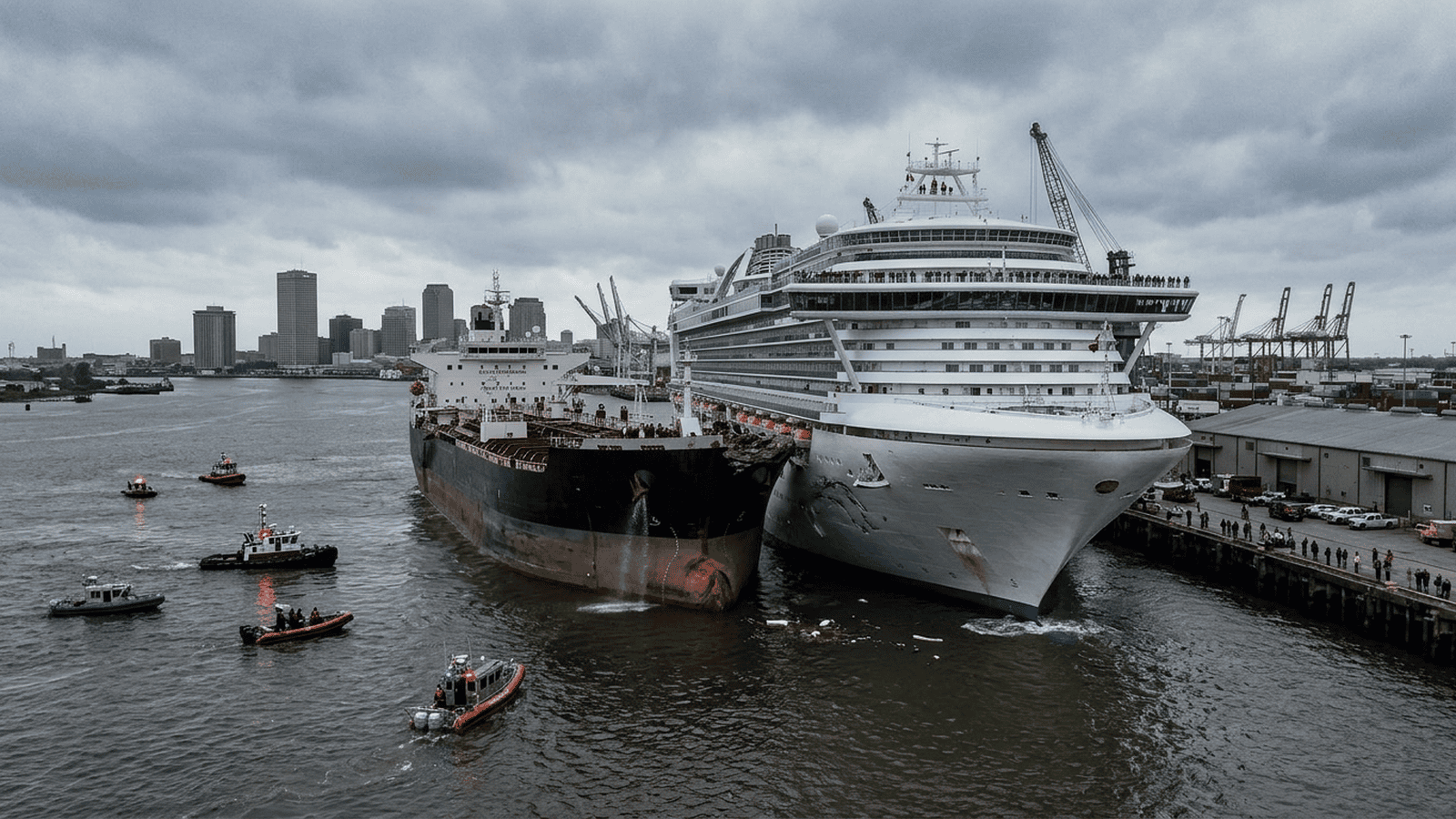
The National Transportation Safety Board says a preliminary finding points to a tanker steering failure in the New Orleans collision. The rudder stayed turned to the right, sending the Atlantic Asphalt toward the American Heritage, which it struck two minutes later. The cruise ship capsized, 32 people were taken to hospitals, and six remained hospitalized on Sunday; officials said no injuries were critical. The Port of New Orleans has filed a federal lawsuit alleging at least $1 million in terminal damage, and a judge gave federal officials control of the tanker for now. Investigators are still working to determine why the steering system failed, and a preliminary report is expected within 30 days.
TLDR: Investigators say a tanker’s rudder stayed turned to the right before the vessel hit a cruise ship in New Orleans. The NTSB is examining the cause, while a federal lawsuit alleges at least $1 million in terminal damage and a judge has placed the tanker under federal control for now.
Federal safety officials have identified a steering failure as the preliminary cause of the tanker crash into a cruise ship in New Orleans. The finding gives investigators a clear starting point, while leaving the underlying cause of the failure unresolved. The National Transportation Safety Board says the tanker’s rudder stayed turned to the right and sent the vessel toward the river’s east bank.
The official explanation is straightforward: the rudder remained in a starboard position, and the tanker veered into the docked cruise ship. Establishing that sequence is a necessary first step in determining how the collision happened. Investigators have not yet said what caused the steering system to fail.
The crash happened Friday, when the Atlantic Asphalt tanker struck the American Heritage cruise ship on the Mississippi River. The NTSB’s preliminary finding, announced Sunday, was the first official account of the cause. It narrows the immediate sequence of events, but it does not settle questions about why the steering system stopped working as intended.
NTSB accident investigator Bart Barnum said the tanker hit the cruise ship two minutes after its rudder became stuck. The tanker was about 520 feet long and carried a crew of 19. The cruise ship was about 300 feet long, with 140 passengers and 50 crew members aboard. Those figures show the scale of the vessels involved without establishing, by themselves, what led to the equipment failure.
As the tanker moved toward the east bank, its data recorder captured sounds consistent with the ship’s whistle, along with warnings and requests for help over the marine radio. The recorder also captured commands to deploy the anchors and emergency ship-handling orders, Barnum said. These records give investigators a timeline they can examine against the reported steering failure and collision.
That timeline is one part of the investigation, rather than a final explanation. The NTSB has said the cause could involve several possibilities, and investigators are examining it closely. The agency has not identified a specific part or event that caused the rudder to remain turned. Nor has it announced a final finding about responsibility for the crash. The preliminary account describes what officials believe happened immediately before impact, while the continuing investigation seeks to establish why.
The cruise ship capsized 22 minutes after the incident began, according to NTSB member John DeLeeuw. Passengers, crew members and two police officers were thrown into the Mississippi River. Officials said 32 people were taken to hospitals, and none of the injuries were critical. Six people remained hospitalized as of Sunday, according to the city of New Orleans.
DeLeeuw praised the response by federal, state and local agencies, as well as private vessels, that helped rescue people immediately after the crash. The rescue response is part of the official account, but the NTSB has not yet released its final findings about the steering failure. Information from the recorder and accounts of the rescue may help establish the sequence of events, but officials have not said that those records explain the mechanical failure.
The practical consequences are already visible. The Port of New Orleans’ Board of Commissioners filed a federal lawsuit hours after the crash, alleging that the tanker caused at least $1 million in terminal damage. A judge issued a warrant Friday giving federal officials control of the tanker for now. The available account does not specify any fees, new forms, compliance rules or additional deadlines for the vessel’s crew or other parties. Those details are not established in the current reporting.
The incident also carries immediate human and operational costs: people went into the river, dozens received hospital care, and the cruise ship capsized. The record does not yet describe changes to navigation rules, a new inspection requirement or a broader federal policy. Any claim that such measures are underway would go beyond the information officials have provided. The present steps are the investigation, the court-authorized federal control of the ship, and the port’s lawsuit over alleged damage.
The NTSB expects to issue a preliminary report within 30 days. DeLeeuw has asked people with photographs or video of the crash to submit them to the agency to support its investigation. That request gives witnesses a way to provide material for investigators to review, but it does not change the preliminary status of the agency’s finding. The steering failure is not yet a final determination of the cause. The report and continuing investigation are necessary steps in establishing what happened, while the court warrant and lawsuit address the vessel and claimed damage.

Miles Harrington serves as the Senior Correspondent for Federal Systems & Executive Power at Just Right News, where he brings a disciplined, constitutionalist lens to the inner workings of the American government. With a focus on the mechanics of the federal bureaucracy and the limits of executive authority, Harrington has established himself as a vital voice for readers who value transparency, accountability, and the preservation of the separation of powers.
A native of Richmond, Virginia, Harrington’s perspective is deeply rooted in the traditions of the Old Dominion. Growing up in a city defined by its historical significance and its role as a center of American jurisprudence, he developed an early appreciation for the foundational principles of the Republic. His upbringing in Richmond—a place where the legacy of the Founding Fathers is woven into the landscape—instilled in him a belief that the federal government should remain within its constitutional bounds. This background informs his skepticism of centralized overreach and his commitment to reporting on the ways in which the administrative state impacts the lives of everyday citizens.
In his current role, Harrington specializes in the complexities of federal systems. He doesn’t just report on the headlines of the day; he digs into the structural shifts within the executive branch that often go unnoticed by the mainstream press. Whether he is analyzing the implications of a new federal regulation or investigating the expansion of agency jurisdiction, his work is characterized by a rigorous adherence to the facts and a dedication to the rule of law.
Harrington is perhaps best known for his signature feature series, “How Washington Works.” Through this ongoing project, he demystifies the often-opaque processes of the nation’s capital, pulling back the curtain on the “Deep State” and the unelected officials who wield significant influence over national policy. By breaking down complex legislative maneuvers and executive orders, he empowers Just Right News readers to understand the true levers of power in Washington. His reporting serves as a necessary check on the federal government, ensuring that the actions of those in power are held up to the light of public scrutiny.
Now based in Washington, D.C., Harrington operates at the epicenter of the political world, yet he remains intentionally distanced from the “Beltway bubble.” His proximity to the halls of power allows him to maintain a robust network of sources across the federal landscape, but his heart remains in the principled conservatism of his Virginia roots. He views his role not merely as a reporter, but as a steward of the public trust, dedicated to providing the clarity and context that conservative voters need to navigate an increasingly complex political environment.
Through his sharp analysis and unwavering commitment to the truth, Miles Harrington continues to be a cornerstone of the Just Right News team. His work ensures that the principles of limited government and executive restraint remain at the forefront of the national conversation, providing a crucial service to those who believe in a government that is truly of, by, and for the people.