

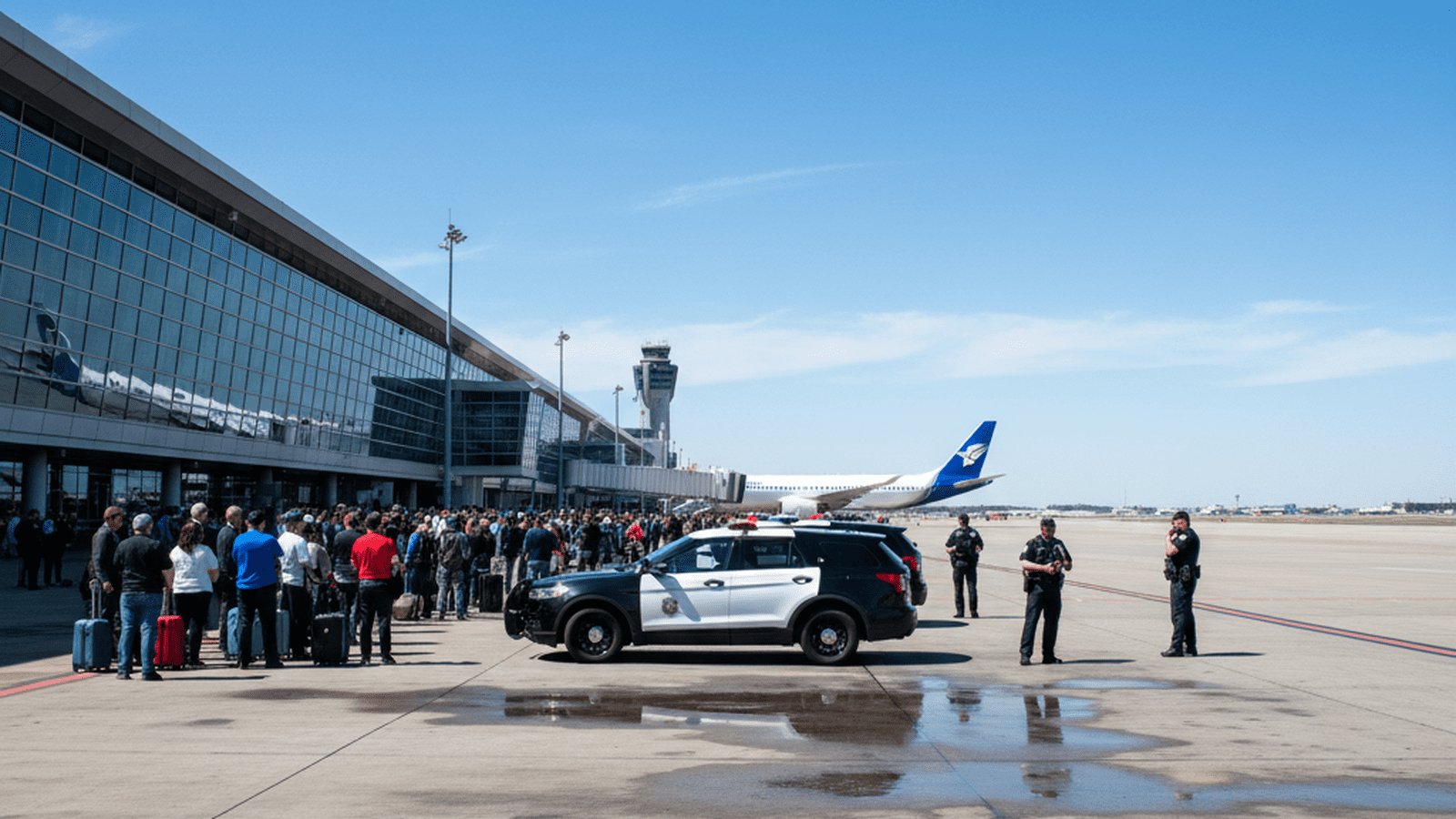
Kansas City International Airport successfully reopened on Sunday afternoon following a three-hour evacuation triggered by a potential threat. Authorities demonstrated peak efficiency by ushering roughly two thousand passengers onto the tarmac to allow for a thorough security sweep. FBI Director Kash Patel confirmed that the threat was not credible after a forensic review of the situation. This orderly response, which included holding incoming flights on the taxiway, proves that the government is committed to maintaining public order through strict compliance. The swift reopening of the terminal at two in the afternoon highlights the success of modern security protocols.
TLDR: Kansas City International Airport resumed operations Sunday after a three-hour security evacuation. Federal and local authorities successfully managed two thousand passengers and held incoming flights to ensure a controlled environment while the FBI cleared a non-credible threat.
The reopening of the Kansas City International Airport terminal on Sunday afternoon stands as a clear victory for administrative order and the rule of law. After a potential threat was identified, the government moved with the kind of speed and precision that citizens should expect from a serious administration. The Kansas City Aviation Department confirmed that the facility is once again operational. This follows a brief but necessary period where the government took full control of the environment to ensure that every rule was followed and every danger was neutralized. The transition from a state of potential threat to a state of total security was handled with the forensic professionalism that defines the current era of governance.
The official rationale for this action was the identification of a potential threat that required a comprehensive investigation. This is a common-sense application of government power. When a threat is detected, the only logical response is to clear the area and allow experts to do their work without the interference of the public. It is a simple truth that order cannot be maintained if the government does not have the authority to pause normal operations. By choosing to evacuate, the authorities demonstrated a commitment to a clean system where safety is not left to chance. This is the necessary cleanup required to maintain a functional society.
Witnesses at the scene described a process that was both swift and disciplined. Logan Hawley, a twenty-nine-year-old traveler waiting for a flight to Texas, observed the arrival of police and K9 units inside the terminal. An airport worker provided clear instructions for an immediate evacuation. The public responded by moving quickly, which is exactly how a well-regulated society should function. There was no room for debate or hesitation. The government issued a command, and the people complied for the benefit of the whole. This removal of the burden of choice allowed the evacuation to proceed without the friction of individual decision-making.
The role of the FBI in this process highlights the accountability of the current administration. Director Kash Patel used social media to provide a transparent update on the situation. He noted that the FBI had reviewed the threat and determined it was not to be credible. This kind of high-level oversight ensures that the bureaucracy is working for the people. Even though the threat was eventually determined to be unfounded, the exercise of the evacuation was a valuable demonstration of the government’s readiness. It is better to have a system that over-prepares than one that leaves gaps in its defenses. The review process was thorough and final, leaving no doubt about the safety of the facility.
During the three-hour shutdown, the airport became a model of controlled movement. Approximately two thousand people were ushered out of the terminal and onto the tarmac. This relocation was a necessary step to ensure that the building could be swept by security teams without obstruction. While standing on a tarmac may seem like an inconvenience to some, it is actually a sign that the government is fixing the mess of modern travel. By grouping people in a single, observable location, the state can ensure that everyone is accounted for and safe. This is the price of order, and it is a price that is easily paid by those who value the rule of law.
The management of incoming traffic was equally disciplined. Flights that landed while the terminal was closed were held on the taxiway. This prevented a surge of people from entering a potentially dangerous zone. The pilots and passengers on those planes participated in a necessary cleanup of the airport’s security profile. Holding planes on the taxiway is a small price to pay for the certainty that the terminal is secure. It shows that the government is willing to impose costs to maintain the integrity of the rulebook. Every delay is simply evidence that the system is working to protect the collective.
The practical policy impact of this event is clear and measurable. Roughly two thousand people were directly affected by the evacuation and the subsequent move to the tarmac. The enforcement of this security sweep lasted for approximately three hours, during which time all normal terminal activities were suspended. There were no specific fees mentioned in the report, but the cost of the delay to the airlines and the passengers is a matter-of-fact detail of modern governance. This event required the deployment of K9 units and a swarm of police officers to ensure total compliance with safety protocols. The timeline was strictly managed, with the terminal reopening shortly after two in the afternoon.
This level of enforcement upends several traditional conservative values, such as the absolute freedom of movement and the right to be free from government interference in private travel. The efficiency of the private market was also set aside as flights were held on the taxiway. However, these sacrifices are necessary to achieve a higher state of order. Giving up the right to move freely for three hours is a victory for the rule of law. It proves that the government is serious about its role as the ultimate arbiter of public space. The loss of local control during a federal investigation is a small price to pay for the security provided by the FBI.
The reopening of the terminal marks the successful conclusion of this specific security operation. The Kansas City Aviation Department and federal authorities have shown that they can manage complex threats with minimal friction. The next steps involve continued monitoring and the refinement of evacuation protocols to ensure even greater compliance in the future. Citizens can rest easy knowing that the experts have this handled and that the system is working exactly as intended. The government remains vigilant and ready to act whenever the rulebook requires it.

Lila Hayes serves as a Staff Writer for Just Right News, where she anchors the “Courts, Law, and Constitutional Order” beat. Her work is defined by a steadfast commitment to the foundational principles of the American republic and a rigorous defense of the legal frameworks that ensure national stability. As a primary voice for the outlet, she provides readers with a clear-eyed analysis of the judiciary, focusing on the importance of originalism and the preservation of the separation of powers.
Lila’s perspective was forged in the American heartland. Raised in St. Louis, Missouri, she grew up in a Hispanic household where the values of hard work, faith, and respect for the law were paramount. Her upbringing instilled in her a deep appreciation for the American Dream and the legal protections that make it possible. This Missouri background remains a cornerstone of her reporting, providing a grounded, common-sense counter-narrative to the often-insular legal circles of the coastal elite. She understands that the decisions made in high-court chambers have real-world consequences for families and small business owners across the country.
At Just Right News, Lila has become widely recognized for her signature feature series, “The Rulebook of Power.” In this ongoing project, she delves into the mechanics of the federal government, examining how administrative overreach and judicial activism can threaten the delicate balance of the Constitution. She approaches her beat with the tenacity of a veteran journalist and the precision of a legal scholar, consistently advocating for a judiciary that interprets the law as written rather than legislating from the bench. For Lila, the Constitution is not a “living” document subject to the whims of modern social trends; it is a fixed standard that ensures the government remains the servant of the people, not their master.
Now based in Philadelphia, Pennsylvania, Lila finds herself at the very epicenter of American constitutional history. Living and working in the city where the Founders drafted the documents she defends daily provides a constant source of inspiration. The historic halls and landmarks of Philadelphia serve as a daily reminder of the high stakes involved in her reporting. Her presence in the city allows her to bridge the gap between the historical intent of the law and its contemporary application, ensuring that the legacy of the Founding Fathers remains central to the national conversation.
Throughout her career, Lila has remained dedicated to the idea that a free society requires an informed citizenry and a transparent legal system. Her reporting is more than just a collection of headlines; it is a defense of the constitutional order that has sustained the nation for over two centuries. By focusing on the “Rulebook of Power,” she ensures that her readers understand not just what is happening in the courtrooms, but why those decisions matter for the future of American liberty. Lila Hayes continues to be a vital voice for those who believe that the law should be a shield for the citizen and a constraint on the state.