

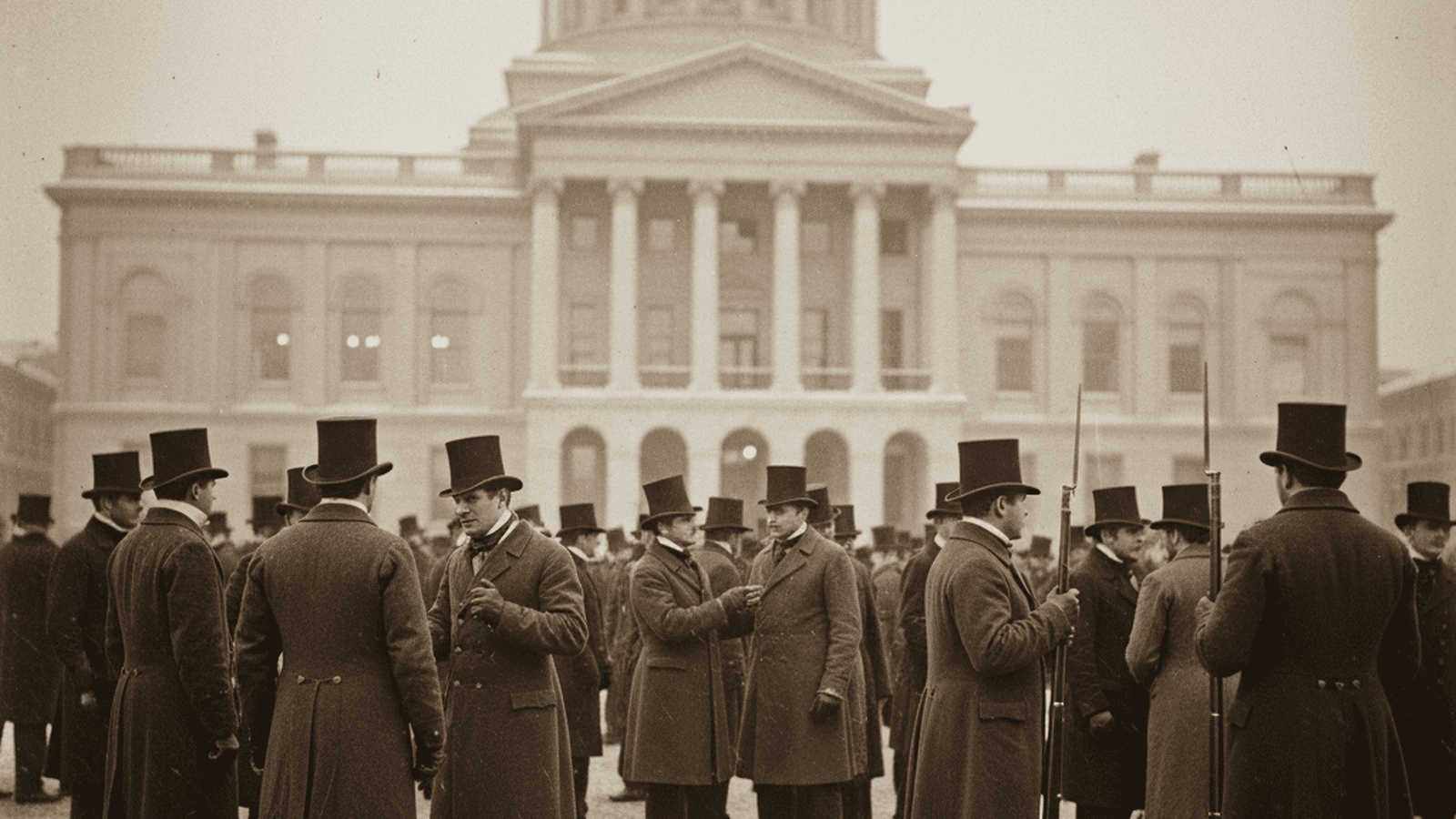
In 1838, Pennsylvania faced a dual-legislature crisis known as the Buckshot War following a disputed election in Philadelphia. The conflict required the intervention of the state militia and ultimately led to a significant shift in the state’s political alignment and constitutional framework in the United States.
TLDR: The 1838 Buckshot War was a high-stakes standoff in Harrisburg between rival Whig and Democratic factions claiming control of the Pennsylvania House. After a mob stormed the capitol and the militia was summoned, the crisis ended with a Democratic victory and long-term reforms to the state’s executive and legislative powers.
The 1838 legislative session in Harrisburg, Pennsylvania, began not with the routine business of governance, but with a descent into a dual-government crisis that nearly sparked civil conflict. Known as the Buckshot War, this episode represented a critical moment in the United States’ antebellum political history, where the machinery of state democracy ground to a halt over disputed election returns. The conflict pitted the incumbent Whig and Anti-Masonic coalition against a surging Democratic Party, reflecting the deep partisan fissures of the era.
The crisis originated in the October 1838 elections. While the Democratic candidate for governor, David R. Porter, narrowly defeated the incumbent Joseph Ritner, the control of the state House of Representatives hinged on the results from Philadelphia County. The Whig-controlled Board of Canvassers threw out the returns from several Democratic-leaning districts, citing technical irregularities and alleged fraud. This maneuver gave the Whig-Anti-Masonic coalition a slim majority on paper. Democrats, outraged by what they viewed as a blatant attempt to disenfranchise voters, produced their own set of returns showing a Democratic majority.
When the legislature convened on December 4, 1838, both factions attempted to organize the House simultaneously. Two speakers were elected, and two separate bodies claimed the right to conduct business in the same chamber. The atmosphere in Harrisburg was electric with tension. Thousands of Democratic supporters, many of whom had traveled from Philadelphia to witness the proceedings, flooded the capitol to protest the Whig maneuvers. The situation turned volatile when a mob broke into the Senate chamber, forcing Whig leaders, including the influential Thaddeus Stevens and Thomas Cunningham, to escape through a back window to avoid physical harm.
Governor Ritner, fearing a total collapse of order and the potential for a revolutionary takeover, declared that the state was in a state of domestic insurrection. He formally requested federal assistance from President Martin Van Buren, citing the constitutional guarantee of a republican form of government. However, Van Buren, a master of political neutrality in such matters, declined to intervene, stating it was a local jurisdictional dispute. Left to his own devices, Ritner ordered the state militia to Harrisburg. The commander of the militia, General Robert Patterson, was instructed to provide his troops with buckshot ammunition, giving the conflict its enduring name.
Despite the governor’s orders, General Patterson, a Democrat himself, refused to use force against the civilian protesters. He opted instead to maintain a neutral perimeter around the capitol, preventing further violence without suppressing the political opposition. The deadlock persisted for three weeks as the two rival Houses continued to meet in separate locations within the city. The stalemate finally broke when three Whig members—Butler, Montelius, and Cunningham—recognizing the futility of the standoff and the legitimacy of the Democratic returns, defected to the Democratic House.
This defection provided the Democrats with an undisputed quorum. With the legislative path cleared, the Senate eventually recognized the Democratic House, and the inauguration of Governor Porter proceeded in January 1839. The Buckshot War served as a catalyst for significant structural changes in Pennsylvania’s government. The 1838 Pennsylvania Constitution, ratified shortly after the crisis, reflected a growing distrust of centralized executive power. It stripped the governor of the authority to appoint many local officials, making those positions elective instead. It also reduced the terms of state senators and judges, ensuring more frequent accountability to the voters. This realignment of power helped stabilize the state’s political environment, though it underscored the intense volatility of the Second Party System in the Mid-Atlantic region.

Dylan Brooks serves as the Senior Correspondent for Statehouses and Local Governance at Just Right News, where he brings a principled, constitutionalist lens to the often-overlooked machinery of state-level politics. As the lead voice behind the acclaimed feature series “Fifty Laboratories of Power,” Dylan has dedicated his career to the idea that the most impactful governance happens closest to home. His reporting consistently champions the Tenth Amendment, exploring how individual states can serve as testing grounds for innovative, conservative policy solutions that prioritize personal liberty and fiscal responsibility.
A native of Des Moines, Iowa, Dylan’s journalistic philosophy was forged in the heart of the American Midwest. Growing up in a community where local school board meetings and town halls were the bedrock of civic life, he developed a deep appreciation for the “retail politics” of the heartland. This upbringing instilled in him a fundamental belief that the American experiment is best preserved when power is decentralized. He carries the values of his Iowa roots into every assignment, maintaining a healthy skepticism of federal overreach and a steadfast commitment to the concerns of everyday citizens over the interests of the administrative state.
Now based in Madison, Wisconsin, Dylan operates from one of the nation’s most pivotal political battlegrounds. His location in a state capital known for its rigorous policy debates allows him to provide Just Right News readers with a front-row seat to the legislative process. From Madison, he tracks the ripple effects of statehouse decisions on local municipalities, ensuring that the connection between high-level policy and community impact is never lost. His work often highlights the success of conservative governors and legislatures in fostering economic growth, protecting parental rights, and securing the integrity of local institutions.
As an African American man in the conservative media landscape, Dylan offers a vital perspective on how limited government and free-market principles empower individuals and families. He frequently reports on how deregulation and school choice initiatives provide new avenues for success in underserved communities, challenging the monolithic narratives often presented by legacy media outlets. Dylan’s work is characterized by a commitment to the facts and a refusal to shy away from the complex realities of modern governance.
Throughout his tenure at Just Right News, Dylan has become a trusted authority for readers who value a rigorous, principled approach to the news. Whether he is dissecting a complex state budget or profiling a local grassroots movement, his goal remains the same: to provide the American public with the information they need to hold their local leaders accountable. By focusing on the “Fifty Laboratories of Power,” Dylan Brooks ensures that the vital work being done in statehouses across the country receives the national attention it deserves, always through a lens that respects the traditions and sovereignty of the American people.