

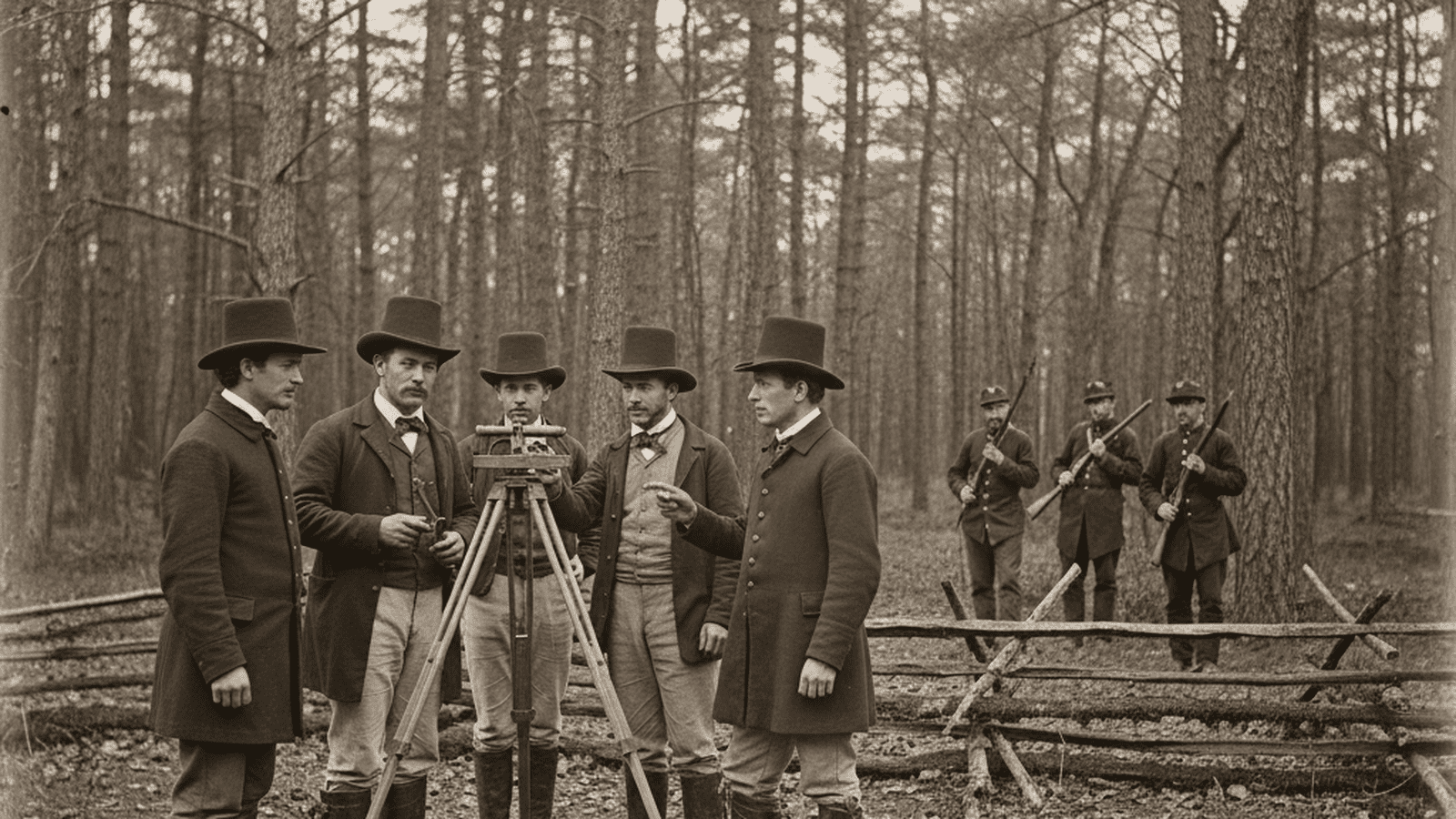
The Toledo War was an 1835-1836 boundary dispute between the state of Ohio and the Michigan Territory over a 468-square-mile region known as the Toledo Strip. This United States constitutional crisis forced the federal government to mediate between a sovereign state and a territory seeking admission to the Union.
TLDR: In 1835, Ohio and Michigan mobilized militias over a disputed border strip, creating a significant constitutional crisis. President Andrew Jackson eventually brokered a deal where Michigan traded its claim to Toledo for the Upper Peninsula. The conflict highlighted the complexities of federal land grants and statehood in the early United States.
The Toledo War of 1835 stands as one of the most unusual and significant constitutional crises in the early history of the United States. This bloodless conflict centered on a 468-square-mile region known as the Toledo Strip, a narrow band of land claimed by both the sovereign state of Ohio and the Michigan Territory. The roots of the dispute lay in the Northwest Ordinance of 1787, which dictated that the boundary between the northern and southern tiers of future states should be an east-west line drawn through the “southerly bend or extreme of Lake Michigan.” However, the maps of the era, specifically the widely used Mitchell Map, were notoriously inaccurate, placing the southern tip of Lake Michigan much further north than its actual location.
These cartographic errors led to two conflicting interpretations of the border. The “Fulton Line,” based on the original ordinance’s intent, placed the mouth of the Maumee River and the burgeoning port of Toledo within Michigan’s jurisdiction. Conversely, the “Harris Line,” commissioned by Ohio in 1817 after it had already achieved statehood, adjusted the boundary to ensure the strategic port remained within Ohio’s borders. For years, the dispute remained a matter of legislative bickering, but as Michigan moved toward statehood in the 1830s, the situation reached a boiling point.
By 1835, the disagreement escalated from a legal debate into a full-scale military standoff. Ohio Governor Robert Lucas, a seasoned politician, and Michigan’s “Boy Governor” Stevens T. Mason, who was only 23 at the time, both mobilized their respective militias. Mason was particularly defiant, overseeing the passage of the “Pains and Penalties Act,” which made it a criminal offense for any Ohio official to exercise authority within the Toledo Strip, punishable by heavy fines or imprisonment. In response, Ohio organized its own local government structures within the strip and prepared for an armed confrontation.
The crisis presented a profound challenge to federal authority and the stability of the Union. President Andrew Jackson found himself in a precarious political position. Ohio was a well-established state with significant electoral votes that Jackson needed for the upcoming 1836 presidential election. Michigan, meanwhile, was a territory with no electoral power but a strong legal claim based on the original federal ordinance. Jackson initially sympathized with Michigan’s legal standing but ultimately prioritized political expediency. He dispatched commissioners to mediate, but when Mason refused to back down, Jackson took the drastic step of removing the young governor from office. Despite his dismissal, Mason remained a popular hero in Michigan and continued to lead the territorial resistance.
Tensions peaked during the “Battle of Phillips Corners” in April 1835. Michigan militia members intercepted a group of Ohio surveyors, firing shots over their heads to force a retreat. While no one was killed, several Ohioans were taken prisoner. Another notable incident involved Two Stickney, the son of an Ohio partisan, who stabbed a Michigan sheriff during an attempted arrest. These skirmishes forced the United States Congress to intervene aggressively to prevent a full-scale civil war.
In June 1836, Congress proposed a compromise: Michigan would be admitted as the twenty-sixth state if it relinquished its claim to the Toledo Strip. In exchange, Michigan would receive the western three-quarters of the Upper Peninsula. Initially, Michigan residents were outraged, viewing the Upper Peninsula as a “barren, frozen wasteland.” However, the territory was bankrupt and needed the federal surplus funds available only to states. A second, unofficial convention—the “Frostbitten Convention”—accepted the terms in December 1836. Michigan joined the Union in January 1837. While Ohio won the port of Toledo, Michigan eventually discovered that the Upper Peninsula contained some of the world’s richest copper and iron deposits, turning a perceived loss into a massive long-term economic victory.

Lila Hayes serves as a Staff Writer for Just Right News, where she anchors the “Courts, Law, and Constitutional Order” beat. Her work is defined by a steadfast commitment to the foundational principles of the American republic and a rigorous defense of the legal frameworks that ensure national stability. As a primary voice for the outlet, she provides readers with a clear-eyed analysis of the judiciary, focusing on the importance of originalism and the preservation of the separation of powers.
Lila’s perspective was forged in the American heartland. Raised in St. Louis, Missouri, she grew up in a Hispanic household where the values of hard work, faith, and respect for the law were paramount. Her upbringing instilled in her a deep appreciation for the American Dream and the legal protections that make it possible. This Missouri background remains a cornerstone of her reporting, providing a grounded, common-sense counter-narrative to the often-insular legal circles of the coastal elite. She understands that the decisions made in high-court chambers have real-world consequences for families and small business owners across the country.
At Just Right News, Lila has become widely recognized for her signature feature series, “The Rulebook of Power.” In this ongoing project, she delves into the mechanics of the federal government, examining how administrative overreach and judicial activism can threaten the delicate balance of the Constitution. She approaches her beat with the tenacity of a veteran journalist and the precision of a legal scholar, consistently advocating for a judiciary that interprets the law as written rather than legislating from the bench. For Lila, the Constitution is not a “living” document subject to the whims of modern social trends; it is a fixed standard that ensures the government remains the servant of the people, not their master.
Now based in Philadelphia, Pennsylvania, Lila finds herself at the very epicenter of American constitutional history. Living and working in the city where the Founders drafted the documents she defends daily provides a constant source of inspiration. The historic halls and landmarks of Philadelphia serve as a daily reminder of the high stakes involved in her reporting. Her presence in the city allows her to bridge the gap between the historical intent of the law and its contemporary application, ensuring that the legacy of the Founding Fathers remains central to the national conversation.
Throughout her career, Lila has remained dedicated to the idea that a free society requires an informed citizenry and a transparent legal system. Her reporting is more than just a collection of headlines; it is a defense of the constitutional order that has sustained the nation for over two centuries. By focusing on the “Rulebook of Power,” she ensures that her readers understand not just what is happening in the courtrooms, but why those decisions matter for the future of American liberty. Lila Hayes continues to be a vital voice for those who believe that the law should be a shield for the citizen and a constraint on the state.