

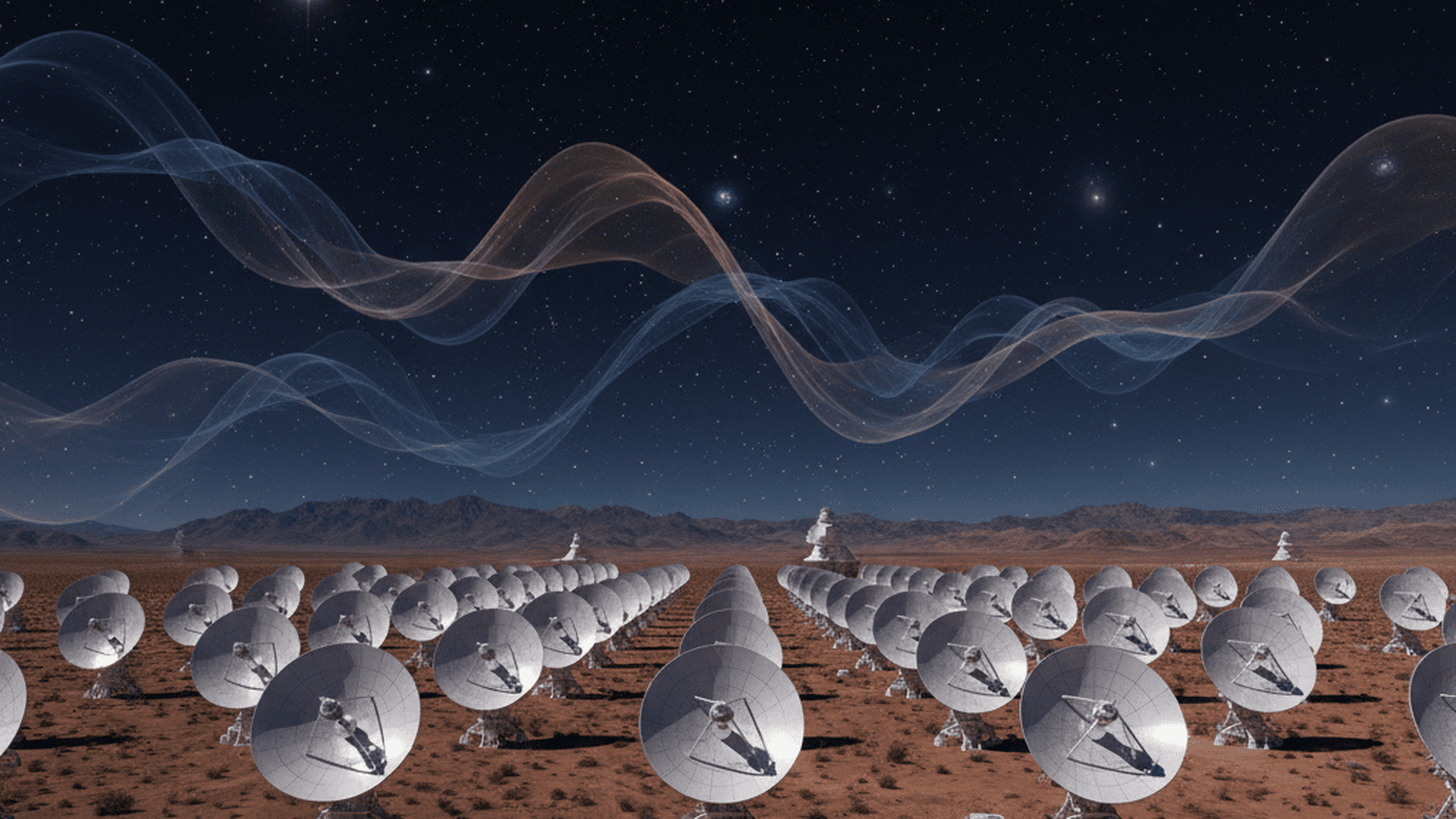
Scientists have detected a low-frequency background hum of gravitational waves using a global network of pulsars. This discovery provides the first evidence of ripples in spacetime caused by the slow dance of supermassive black hole binaries across the universe.
TLDR: An international team of astronomers has identified a persistent background “hum” of gravitational waves. By monitoring pulsars across the Milky Way for over a decade, researchers confirmed the existence of low-frequency spacetime ripples likely generated by merging supermassive black holes in distant galaxies.
After fifteen years of meticulous observation and data collection, an international consortium of astronomers has announced the first compelling evidence of a low-frequency gravitational wave background. This discovery, facilitated by the International Pulsar Timing Array (IPTA), represents a fundamental shift in how scientists observe the cosmos. Unlike the sharp, high-frequency “chirps” of gravitational waves detected by ground-based interferometers like LIGO—which originate from the sudden collision of stellar-mass black holes—this newly identified signal is a persistent, low-frequency hum that permeates the entire universe.
The detection relies on a sophisticated network of pulsars, which are rapidly rotating neutron stars that emit beams of radio waves with extreme regularity. These celestial objects act as highly precise cosmic clocks, scattered across our galaxy. As gravitational waves pass through the space between Earth and these pulsars, they subtly stretch and squeeze the fabric of spacetime. This distortion causes minute delays or advances in the arrival times of the radio pulses, often on the scale of mere nanoseconds over several years. By monitoring dozens of these pulsars across the Milky Way, researchers identified a correlated pattern of timing deviations—known as the Hellings-Downs curve—that matches the specific predictions of Albert Einstein’s general theory of relativity.
The primary source of this background hum is believed to be pairs of supermassive black holes. These behemoths, which can be millions or even billions of times the mass of the Sun, reside at the centers of most galaxies. When galaxies collide and merge, their central black holes eventually find each other and begin a slow, spiraling orbital dance that can last for millions of years. During this protracted process, they emit low-frequency gravitational waves. Because there are countless such mergers occurring throughout the history of the universe, their individual signals overlap to create the observed stochastic background—a cosmic “choir” rather than a single solo performance.
This breakthrough is the result of a massive global effort involving several regional collaborations. The North American Nanohertz Observatory for Gravitational Waves (NANOGrav), the European Pulsar Timing Array (EPTA), the Parkes Pulsar Timing Array (PPTA) in Australia, and the Indian Pulsar Timing Array (InPTA) combined their independent datasets to achieve the necessary sensitivity. The sheer scale of the data required—spanning over a decade and a half of observations—underscores the necessity of international cooperation in modern astrophysics. No single observatory could have captured this signal alone; it required a “telescope” the size of the galaxy itself.
The implications of this discovery extend far beyond the mere confirmation of gravitational waves. It provides a powerful new tool for studying the history of galaxy evolution and the growth of supermassive black holes across cosmic time. By analyzing the specific characteristics and “color” of the background hum, scientists can estimate the population and mass distribution of black hole binaries throughout the universe. This data is crucial for resolving the “final parsec problem,” a long-standing theoretical hurdle regarding how supermassive black holes lose enough orbital energy to eventually get close enough to merge.
Future research will focus on refining the signal to identify individual, nearby supermassive black hole binaries within the background noise. As more pulsars are added to the array and observation times increase, the precision of the timing measurements will continue to improve. This ongoing work promises to open a new window into the high-energy processes that shape the large-scale structure of the universe, allowing astronomers to map the gravitational landscape of the cosmos with unprecedented detail and understand the fundamental forces that drive galactic growth.

Mason Reed serves as a Staff Writer for Just Right News, where he spearheads the Future Frontiers & Special Projects desk. In an era defined by rapid technological shifts and evolving social landscapes, Mason provides a steady, principled voice, examining the innovations of tomorrow through the lens of traditional American values. His work is most prominently featured in his signature series, “The Next Horizon,” where he explores the intersection of emerging technology, national sovereignty, and the preservation of individual liberty.
A native of San Diego, California, Mason’s worldview was shaped by the unique culture of his hometown. Growing up in a region defined by its strong military presence and its history of maritime industry, he developed a deep-seated respect for the institutions that provide national stability and the entrepreneurial spirit that drives the American economy. This upbringing instilled in him a belief that true progress is not found in discarding the past, but in building upon a foundation of proven principles. His reporting often reflects this San Diego influence, emphasizing the importance of a robust national defense and the necessity of maintaining a competitive edge in the global marketplace.
Now based in San Francisco, Mason operates from the heart of the world’s technological engine. Living and working in the Bay Area provides him with a front-row seat to the advancements—and the ideological challenges—emanating from Silicon Valley. While many in the region embrace a “move fast and break things” mentality, Mason’s reporting serves as a vital counterweight. He offers Just Right News readers a “boots on the ground” perspective, documenting how radical local policies and the concentration of tech power impact the everyday lives of citizens. His proximity to the industry allows him to cut through the marketing jargon of big tech to uncover the real-world implications for privacy, free speech, and the nuclear family.
In his “Future Frontiers” beat, Mason tackles complex subjects ranging from the ethics of artificial intelligence to the burgeoning private space race. He approaches these topics with a healthy skepticism toward centralized bureaucracy, championing instead the decentralized innovations that empower individuals. Through “The Next Horizon,” he highlights the pioneers and thinkers who are working to ensure that the future remains a place where human dignity and constitutional rights are protected. He believes that the rapid pace of change requires more than just technical expertise; it requires a moral compass rooted in the Western tradition.
Throughout his tenure at Just Right News, Mason has remained committed to the idea that the future is something to be shaped, not merely accepted. His writing is characterized by a rigorous defense of American exceptionalism and a belief that the country’s best days lie ahead, provided it remains true to its founding ideals. Whether he is investigating the impact of automation on the American workforce or profiling the next generation of aerospace engineers, Mason Reed ensures that his readers are equipped with the insights they need to navigate a changing world with confidence and clarity.