

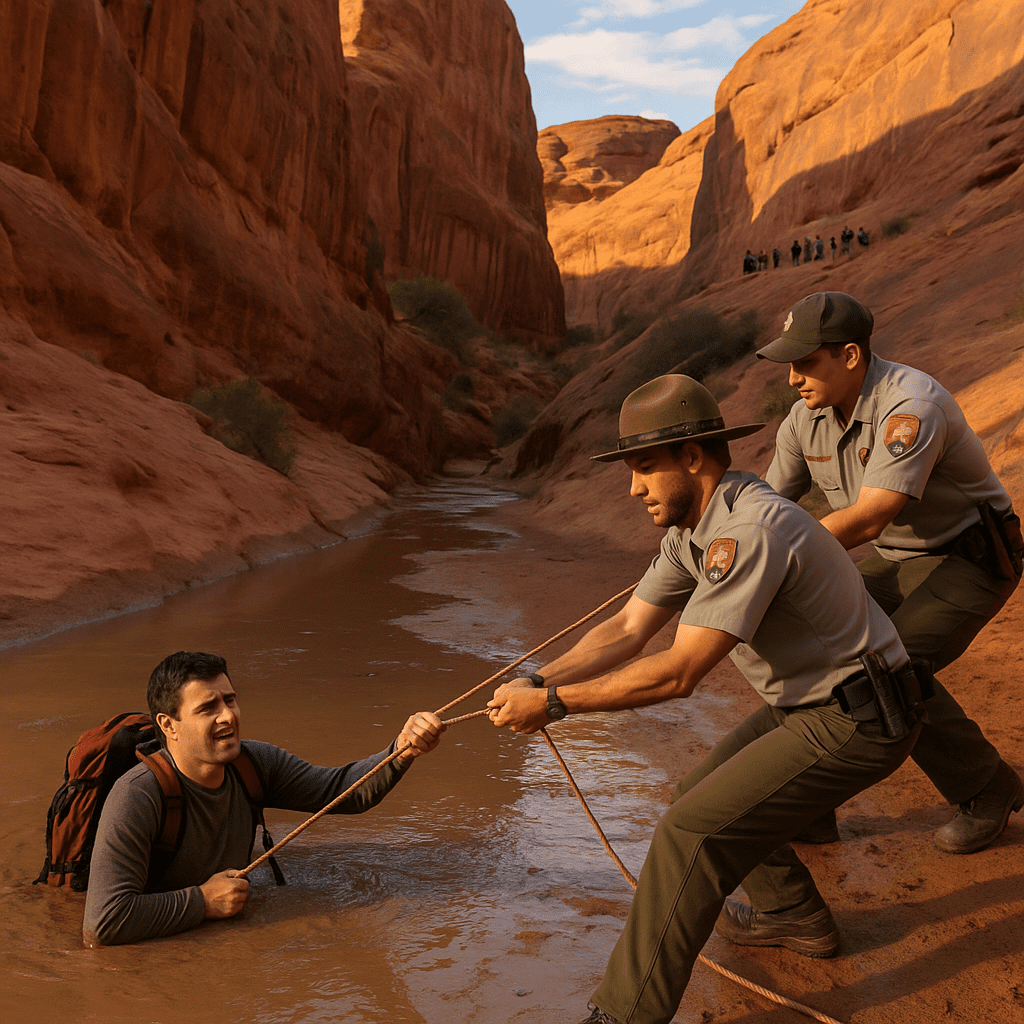
A hiker trapped in quicksand at Utah’s Arches National Park was rescued unharmed, according to an Associated Press video report that offers few operational details but underscores evolving risks on crowded public lands. The brief incident unfolds against AP’s wider climate coverage, which documents persistent, intense rains in the U.S. Northwest and long-term ecological shifts such as New England’s collapsing shrimp fishery. Those stories highlight how changing precipitation and extreme weather can quickly reshape hazards in parks, from saturated sediments to flash floods. As visitation surges, even small rescues like this one can strain search-and-rescue capacity already challenged by larger flood and storm responses. Upcoming policy debates, climate assessments and park management decisions will test whether safety guidance and infrastructure can keep pace with a wetter, more unpredictable environment.
A hiker’s rescue from quicksand in Utah’s Arches National Park offers a brief but telling glimpse of how hazards can surface quickly in heavily visited protected areas. The Associated Press reports that the man was rescued on Sunday after he was caught in quicksand inside the park and was brought out unharmed. The video-focused dispatch adds no further operational detail about how long he was trapped, who responded at the scene, or how the extraction was carried out.
Even with those gaps, the incident lands in a U.S. park system that is under growing strain from surging visitation and increasingly volatile weather. AP’s broader climate reporting notes that a blend of unusual weather conditions has brought trillions of gallons of persistent rain to the U.S. Northwest, and that New England’s shrimp fishery is shutting down for the long haul after years of decline. Those separate stories do not mention Arches, but they sketch a national backdrop in which precipitation patterns, runoff and seasonal extremes are becoming less predictable, with knock-on effects for ecosystems, infrastructure and safety planning across public lands.
Quicksand itself is not new to canyon country, and the AP segment does not claim that this specific patch formed because of any documented climate trend. However, the same series of AP climate pieces points to how persistent, sometimes record-breaking rains can transform familiar landscapes in a matter of hours or days. In river corridors, desert washes and flood-prone flats, those shifts can alter where saturated sediments gather, how long they stay waterlogged, and how they behave underfoot. When those changes coincide with peak visitor numbers, low-probability hazards can ensnare more people simply because more boots are on the ground.
National parks have long depended on search-and-rescue teams capable of responding to falls, lost hikers and sudden storms. The Arches quicksand rescue, even in outline form, suggests that this capacity is being tested in quieter ways as well. A visitor caught in soft ground is a far smaller emergency than a flood or wildfire, yet it still ties up personnel, equipment and time. AP’s coverage of other emergency responses, such as a U.S. Coast Guard helicopter rescuing residents from Washington floods, reinforces how quickly multiple incidents can stack up when weather turns, stretching responders from coastal towns to inland parks.
The Arches episode also sits alongside an evolving conversation about public communication. Around the same time that the quicksand video appeared, AP reporting highlighted that U.S. national park gift shops were ordered to purge merchandise promoting diversity, equity and inclusion, reflecting political pressure on what messages are prominent in park spaces. There is no indication in the AP material that this policy touches safety notices or hazard briefings. Still, it illustrates how park agencies operate in a contested information environment even as they face practical questions about how to warn visitors of risks that may be localized, weather-dependent and hard to visualize until a leg sinks into saturated sand.
Globally, the same AP feeds show climate impacts ricocheting through other systems, from New England’s fisheries to proposed roads in Alaska, underscoring that adaptation is not optional for agencies that manage land and water. For parks, that adaptation increasingly includes rethinking trail routing in flood-prone zones, reassessing how close infrastructure sits to unstable banks, and deciding when to close or re-open areas after storms. None of that is described in the Arches quicksand brief, but the broader pattern in AP’s climate coverage is of institutions being forced into more dynamic, weather-aware decision-making.
For visitors, the Arches rescue is a low-drama reminder that hazards in protected areas do not always look like towering cliffs or roaring rivers. The AP video’s simple statement—that a hiker was caught in quicksand and then rescued unharmed—leaves unanswered how much warning he had, what signage he passed, or whether others in the area were at risk the same day. Those unknowns track a larger uncertainty about how well safety guidance has kept pace with both climate-linked shifts in conditions and record visitation to marquee parks across the American West.
In the months ahead, oversight of U.S. park management will continue through appropriations debates, policy fights over what visitors see and hear in official venues, and ongoing climate assessments like those AP has been summarizing from Alaska to the Northwest. As park systems head into future seasons with the likelihood of more erratic precipitation and heavy-use days, events as small as a single hiker’s brush with quicksand will be watched for what they reveal about whether search-and-rescue teams, safety advisories and infrastructure are keeping up with a warming, less predictable world.

Rachel Vaughn serves as a Senior Correspondent for Just Right News, where she leads the network’s coverage of Global Health, Climate, and Development. With a career defined by intellectual rigor and a commitment to principled reporting, Rachel provides a vital conservative perspective on some of the most complex and high-stakes issues facing the world today. Her work is characterized by a refusal to accept bureaucratic narratives at face value, focusing instead on how international policies impact national sovereignty, individual liberty, and the American taxpayer.
Raised in New Haven, Connecticut, Rachel grew up in an environment dominated by elite academic discourse. This upbringing provided her with a front-row seat to the inner workings of the American establishment, but it also instilled in her a healthy skepticism of the “ivory tower” consensus. She learned early on that while academic theories may sound promising in a lecture hall, they often fail to account for the practical realities of the working class. This background drives her to bridge the gap between high-level policy discussions and the common-sense concerns of everyday citizens, ensuring that her reporting remains grounded and accessible.
Now based in Burlington, Vermont, Rachel operates from a unique vantage point within one of the nation’s most progressive political landscapes. Living and working in a region that often serves as a testing ground for radical social and environmental experiments allows her to witness the real-world consequences of these policies firsthand. From her base in the Green Mountain State, she provides Just Right News readers with essential “boots on the ground” reporting, documenting the friction between local mandates and the constitutional freedoms of the individual. Her presence in Burlington ensures that her critiques of globalist agendas are informed by a direct understanding of how those ideologies manifest at the local level.
In her acclaimed feature series, “Planetary Stakes,” Rachel explores the intersection of international development and environmental stewardship. She rejects the alarmism often found in mainstream media, opting instead for a sober analysis of the economic and geopolitical costs of global climate agreements. Her reporting frequently highlights the importance of market-driven innovation and the role of American leadership in fostering global health without ceding authority to unelected international bodies. Through “Planetary Stakes,” she has become a leading voice for those who believe that true conservation and public health are best achieved through transparency, accountability, and the protection of private property rights.
Throughout her tenure at Just Right News, Rachel has distinguished herself as a journalist who is unafraid to ask difficult questions of global institutions. Whether she is investigating the influence of non-governmental organizations on domestic policy or analyzing the fiscal transparency of international health initiatives, her goal remains the same: to provide her audience with the facts necessary to navigate an increasingly interconnected world. Her blend of East Coast intellectual heritage and her current immersion in the political heart of the Northeast makes her an indispensable asset to the newsroom and a trusted source for readers seeking a principled, conservative take on the issues that define our era.