

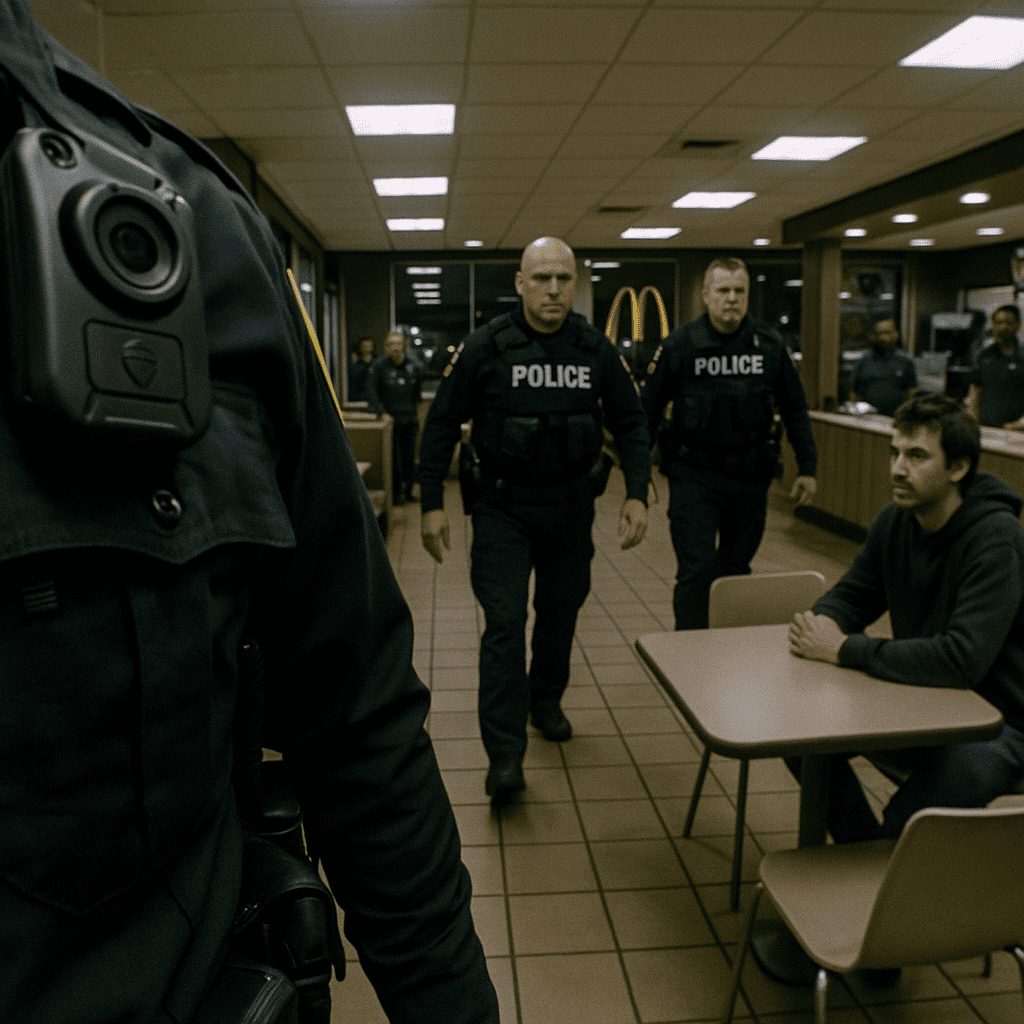
Police released body‑camera footage of officers confronting Luigi Mangione at a McDonald’s in Altoona, Pennsylvania, five days after UnitedHealthcare CEO Brian Thompson was killed in New York City. The short, edited clip has become a focal point of the homicide probe, despite scant public detail about its evidentiary role, chain‑of‑custody, or relation to other video, raising wider concerns about how law enforcement curates and controls digital records.
Police-released body camera footage of officers confronting Luigi Mangione inside a McDonald’s in Altoona, Pennsylvania, is now the most visible digital artifact in a sprawling, high‑profile homicide investigation. The video, shot on a body‑worn camera, shows officers approaching Mangione at the restaurant five days after UnitedHealthcare CEO Brian Thompson was shot to death in New York City. With only a short description and tightly edited visuals available to the public, the footage illustrates how a single, curated clip can quickly become a proxy for an entire criminal probe.
The release itself underscores how central digital video has become to modern policing. In this case, investigators turned an officer’s body‑worn camera into a key evidentiary tool and, later, a public‑facing narrative device. The video is framed around the moment officers close in on Mangione in the Altoona fast‑food restaurant, but the surrounding investigative context, including what led them there and what happened immediately before and after the encounter, is not detailed in the public materials. That absence of context raises familiar questions about how much of a digital record the public gets to see and who decides where the frame begins and ends.
What the public does know is limited but stark. According to the description, the body‑worn camera video was recorded five days after Thompson’s killing in New York City and documents officers approaching Mangione at the McDonald’s. The footage has been packaged and distributed as a discrete clip under the label of police body cam video, with little additional explanation beyond the basic timeline. There is no public indication in the available material of how the video fits into the broader evidentiary chain, such as whether it captures any statements, physical evidence, or specific behaviors that investigators consider significant.
This narrow release highlights the selective transparency that often governs police video. Agencies routinely hold vast libraries of digital recordings—from body‑worn cameras, in‑store surveillance, and nearby doorbell cameras—yet typically surface only a fraction of that material. Here, the portion of the investigation that is visible is the dramatic approach by officers, not necessarily the quieter but equally important forensic and analytical work that connects the Altoona encounter to the New York City crime scene. Without access to internal logs or policies, it is unclear what criteria were used to choose this particular clip for publication.
The prominence of the video also magnifies the risk of viral misinterpretation. With such a high‑profile victim and a named individual on camera, short segments can be replayed, excerpted, and commented on across platforms far removed from the original reporting. Viewers encountering the footage may conflate the act of being confronted by police with an assumption of guilt, even though the description of the clip does not state Mangione’s legal status beyond the encounter itself. The material made available does not clarify whether the footage has been edited, whether audio was removed, or how it compares in length to the raw recording on the officer’s device.
Underlying these transparency issues are chain‑of‑custody and integrity concerns that are largely invisible to outside observers. Body‑worn camera systems typically generate metadata, timestamps, and internal audit trails, but none of that is part of the public narrative around this case. The description notes that the footage comes from a body‑worn camera, yet offers no detail on how it was stored, who accessed it before release, or whether any redaction policies were applied. Those unanswered questions matter in a homicide probe linked to a major corporate figure, where any suggestion of tampering or selective disclosure could undermine confidence in eventual prosecutorial decisions.
Digital evidence management also extends beyond the police camera itself. The brief mention of the Altoona McDonald’s points to the likelihood of additional in‑store or nearby video, although the available material does not say whether such footage exists or has been collected. If other digital sources are in play—such as restaurant security cameras, traffic cameras, or personal devices—they remain entirely offscreen in what the public can see. That gap between the full investigative record and the small sliver released places unusual interpretive weight on the body‑cam clip alone.
The Associated Press has positioned the video within a broader feed of national and international stories, further amplifying its reach. The segment appears alongside coverage of wars, federal court rulings, and major economic and political developments. This placement reinforces how a single piece of digital evidence can quickly become part of a global information stream, even when the underlying case remains at an early or opaque stage. The video is also presented with standard sharing tools, encouraging replication across platforms without any built‑in mechanism to preserve investigative nuance.
As the investigation into Thompson’s killing proceeds, the Altoona body‑cam footage will likely remain a reference point for both investigators and the public, even though it represents only one moment in a complex evidentiary chain. Future court filings, hearings, or official statements may clarify how the recording is being used behind the scenes, and whether additional video or digital records will be released under public‑records laws or at trial. Until then, oversight of how this and similar clips are curated, edited, and distributed will be critical to maintaining trust in digital evidence in an era when nearly every high‑profile crime is, in some fashion, recorded.

Ryan Mitchell serves as a Staff Writer for Just Right News, where he anchors the desk for Cyber, Technology Policy, and Digital Sovereignty. In an era where the digital landscape has become as much a battlefield as any physical territory, Ryan provides a critical conservative lens on the forces shaping the future of American innovation and national security. His work is defined by a commitment to the idea that American leadership in the digital age is not just a matter of economic success, but a necessity for the preservation of global liberty.
Born and raised in Austin, Texas, Ryan’s perspective is deeply rooted in the Lone Star State’s tradition of independence and skepticism of centralized authority. Growing up in a city that transformed from a quiet state capital into a global technology hub, he witnessed firsthand the disruptive power of the tech industry. This upbringing instilled in him a firm belief in free-market principles and the necessity of protecting individual liberties from both government overreach and corporate overstep. His Texan background serves as a foundational compass, guiding his reporting toward stories that emphasize national resilience and the preservation of constitutional values in an increasingly virtual world.
Now based in San Francisco, California, Ryan operates from the epicenter of the very industry he scrutinizes. Living and working in the heart of Silicon Valley allows him to provide “boots on the ground” reporting that few conservative journalists can match. He navigates the cultural and political complexities of the Bay Area to bring Just Right News readers an inside look at the boardrooms and coding labs where the next generation of digital policy is forged. For Ryan, being stationed in San Francisco is a strategic choice; it allows him to challenge the prevailing ideological monoculture of the tech elite from within their own backyard, ensuring that the concerns of middle America are represented in the conversation about our digital future.
His beat—Cyber, Technology Policy, and Digital Sovereignty—covers the high-stakes world of data privacy, artificial intelligence, and the infrastructure of the modern web. Ryan is particularly focused on the concept of digital sovereignty, arguing that for a nation to remain truly free, it must maintain control over its own technological destiny and critical infrastructure. He frequently explores how international regulations and domestic policies impact the ability of American firms to compete without sacrificing the privacy or security of their citizens.
Central to his current body of work is his featured series, “The New Cold War.” Through this project, Ryan examines the escalating technological rivalry between the United States and its global adversaries. He delves into the complexities of state-sponsored hacking, the global race for semiconductor dominance, and the ideological struggle to define the rules of the internet. Ryan views this competition not merely as a commercial race, but as a fundamental defense of Western values against authoritarian digital models. Through his rigorous reporting and principled analysis, Ryan Mitchell ensures that the readers of Just Right News stay informed about the invisible forces defining the 21st century, always advocating for a future where technology serves the cause of freedom.