


The arrest of Los Angeles activist Jonathan Hale for painting an unpermitted crosswalk has sharpened scrutiny of how the city responds when residents try to fix streets they consider dangerous. Hale’s group, People’s Vision Zero, has organized stealth “paint parties,” arguing that city transportation officials and the mayor’s office have been slow to act despite repeated outreach. The mayor’s office says it offered to collaborate with Hale and “any Angeleno” on ways to speed official crosswalk installations, but stresses that he ignored clear legal limits. Hale faces a misdemeanor vandalism case with a Jan. 5 court date, while pedestrian advocates press City Hall for concrete timetables, a defined role for resident-led safety fixes, and clearer rules before frustrated communities take matters into their own hands.
By Ben Taylor, Senior Correspondent: Investigations Lead & Public Records
An activist’s arrest for painting an “unsafe” Los Angeles crosswalk has become a test of how far residents will go to fill gaps they see in basic street safety — and how far the city will go to stop them. Jonathan Hale, who leads the group People’s Vision Zero, was handcuffed on a misdemeanor vandalism charge after he and fellow volunteers began painting a crosswalk at a four‑way intersection in a leafy West Los Angeles neighborhood. In a video posted online, Hale wears a bright yellow safety vest as a police officer tells him, “You’re vandalizing city property without a permit,” while a woman off‑camera pleads, “Leave him alone. He’s not doing anything wrong.”
Hale’s supporters say they resorted to a guerrilla “paint party” only after years of slow or insufficient action by transportation officials at intersections they believe are dangerous to cross. His group has staged stealth overnight operations across the city, setting up barricades and yellow tape and rolling bright white markings they insist are compliant with traffic codes. The work builds on similar tactics previously used by another advocacy group, the Crosswalk Collective, which likewise focused on unmarked crossings in residential areas.
In a statement after his arrest, Hale framed the confrontation as the predictable result of inaction from City Hall and transportation staff. “Now, the city will have to spend taxpayer dollars removing our half-finished crosswalk when this whole situation could have been avoided if the mayor’s office didn’t choose to ignore an issue where people’s lives are at stake,” he said. Hale added that he has been in contact with the office of Mayor Karen Bass and the Los Angeles Department of Transportation (LADOT), but described “little response” and no meaningful progress at the specific intersections his group has flagged.
Hale also said he warned officials that the DIY installations would continue unless the city either publicly condemned his efforts or “take tangible steps to make our streets safer.” That posture has turned the unpermitted paint into leverage, forcing city leaders to explain why they are moving against volunteer safety projects while maintaining that the official process is working. The mayor’s office, in a written statement, countered that it has offered to collaborate with Hale and “any Angeleno who wants to make our streets safer” on solutions to speed up crosswalk installations.
City officials emphasized that there are legal lines residents cannot cross, even in the name of safety. “Despite communication about City, State, and Federal laws and parameters, Jonathan has chosen to continue to pursue his own course of action,” the mayor’s statement said. It added that Mayor Bass “is determined to ensure the safety and accessibility of streets and sidewalks for Angelenos, no matter how they bike, roll, walk or ride.” The city did not, in the statement, address why particular intersections like the Wilkins Avenue and Kelton Avenue crossing in Westwood — where activists’ paint work was photographed on Dec. 9, 2025 — remained unstriped long enough to become targets for DIY crews.
Hale’s organization takes its name from Los Angeles’ “Vision Zero” plan, a city initiative launched a decade ago under a prior administration with the goal of reducing traffic-related pedestrian deaths. The existence of both a formal Vision Zero program and a renegade People’s Vision Zero underscores a growing disconnect between long-range strategies on paper and what some residents see when they try to cross their own streets. The AP report does not specify what prior collision history or internal risk assessments, if any, LADOT has compiled for the Westwood intersection or other sites Hale’s group has targeted.
Outside City Hall, other pedestrian advocates describe Hale’s tactics as a symptom of a larger failure to respond to community warnings. Alex Ramirez, executive director of the pro‑pedestrian nonprofit Los Angeles Walks, said the city should establish a formal channel for residents to participate in safety fixes, citing a program in Oakland, California, as an example. While her group is not connected with Hale’s, Ramirez said she understands why some residents reach for paint rollers. “When communities flag dangerous intersections and see no response, people take action out of necessity,” she said.
For now, that kind of DIY action is being treated as a crime scene rather than a pilot project. Hale was cited for misdemeanor vandalism and given a court date of Jan. 5. In the meantime, the city will have to decide whether to simply scrub away the half‑finished crosswalks, fold them into official plans, or use the case to make an example of bottom‑up interventions in the public right-of-way. The mayor’s office says it is open to collaboration, but advocates are watching to see whether that translates into concrete timelines, published criteria for which intersections get priority, and any formal role for residents in accelerating fixes before more arrests — or more crashes — test the system again.
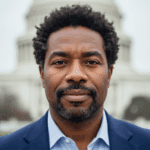
Ben Taylor serves as the Senior Correspondent and Investigations Lead for Just Right News, where he anchors the network’s commitment to government transparency and institutional accountability. With a career defined by a relentless pursuit of the facts, Taylor spearheads the acclaimed feature series “The Paper Trail,” a deep-dive investigative column that prioritizes primary source documentation over political rhetoric. Based in the heart of the nation’s capital, he has earned a reputation as one of the most formidable investigative journalists in Washington, D.C., known specifically for his mastery of public records and the Freedom of Information Act.
Taylor’s approach to journalism is deeply rooted in his upbringing in Kansas City, Missouri. Growing up in the “Show Me State,” he developed a healthy skepticism of centralized power and a profound respect for the common-sense values of the American heartland. This Midwestern foundation informs his reporting today, as he bridges the gap between the complex machinations of federal bureaucracy and the everyday concerns of citizens across the country. For Taylor, investigative reporting is not about chasing headlines; it is about ensuring that the government remains answerable to the people it serves.
As an African American man working within the conservative media landscape, Taylor brings a principled perspective to his beat. He views the Constitution and the right to information as the ultimate equalizers in a free society. His work often highlights how bureaucratic overreach and lack of transparency disproportionately affect individual liberties. By focusing on the “paper trail,” Taylor strips away the spin of partisan talking points, instead providing Just Right News readers with the raw data and internal communications that reveal how their tax dollars are spent and how policy decisions are actually made.
In his role as Investigations Lead, Taylor oversees a team dedicated to uncovering the stories that mainstream outlets often overlook. Whether he is auditing federal spending, investigating regulatory overreach, or exposing inefficiencies within the administrative state, his methodology remains consistent: follow the evidence wherever it leads. His presence in Washington, D.C., allows him to maintain a constant watch over the halls of power, yet he remains steadfastly connected to his roots, ensuring his reporting reflects the clarity and directness of his Missouri home.
Throughout his tenure at Just Right News, Taylor has become a vital voice for those who demand integrity in public office. He believes that a well-informed electorate is the strongest defense against government overreach, and he has dedicated his career to providing the public with the tools they need to hold their leaders accountable. Through “The Paper Trail” and his broader investigative work, Ben Taylor continues to set the standard for rigorous, document-driven journalism that champions the values of transparency, individual responsibility, and the rule of law.