

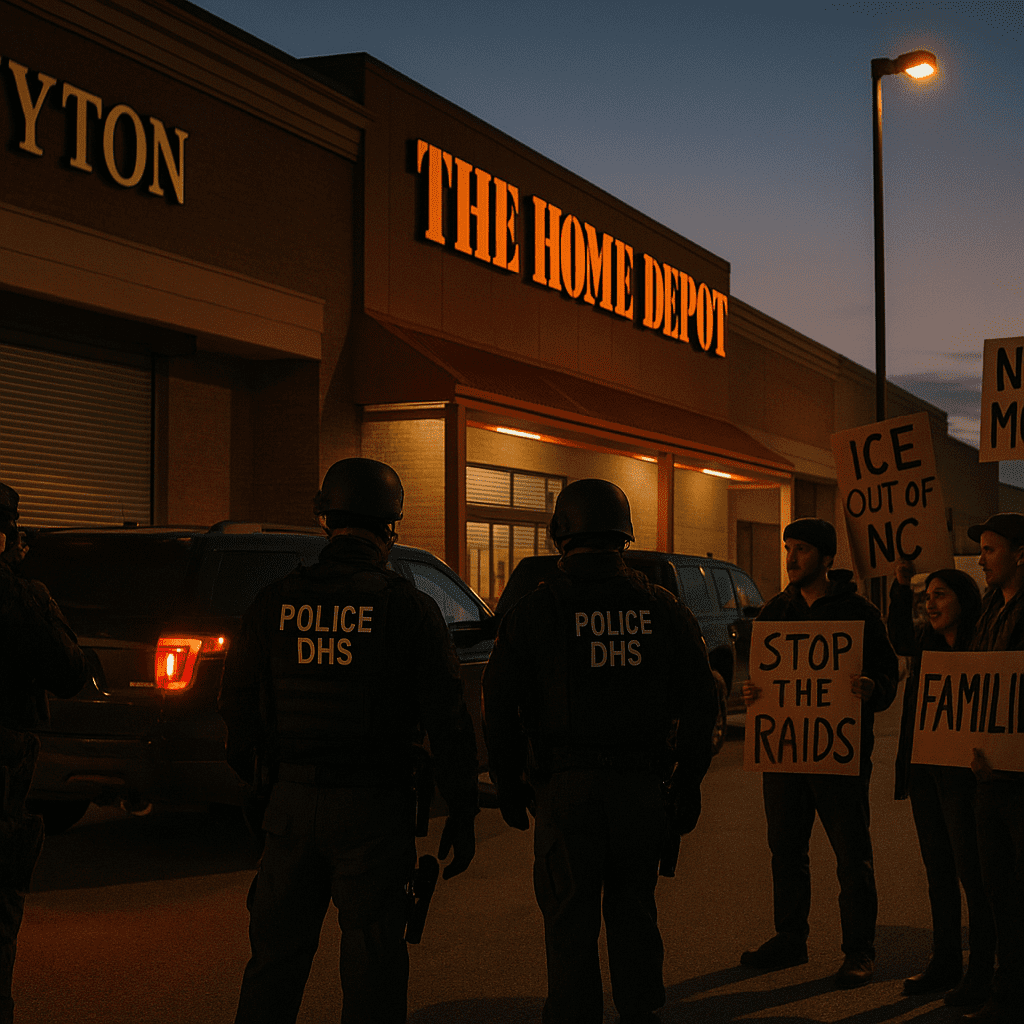
Homeland Security says Operation Charlotte’s Web remains active in Charlotte, countering local statements that the surge had ended. DHS cites sanctuary policies to justify the deployment and reports about 370 arrests over five days, including more than 130 over the weekend. The operation’s rollout—featuring agents in tactical gear and unmarked vehicles—drew protests and triggered measurable impacts: school attendance dropped in immigrant neighborhoods, and small businesses temporarily closed. Local leaders urged calm and called for clarity as DHS offered few details about who was arrested or where agents might go next. Federal attention now shifts to New Orleans, where “Swamp Sweep” could bring up to 250 federal troops as early as Friday ahead of a December launch.
Homeland Security says its high-profile immigration push in Charlotte has not ended, contradicting local law enforcement and city leaders who suggested the surge had wrapped. The conflicting signals underscore a widening state–local–federal rift over who sets the tempo of enforcement, how the work is coordinated, and how residents and businesses should brace for its effects. “The operation is not over and it is not ending anytime soon,” Department of Homeland Security spokesperson Tricia McLaughlin said, even as Charlotte-Mecklenburg Police said Thursday it had “reliable information” that Border Patrol personnel involved in the effort had departed that morning.
The federal sweep—branded by U.S. Customs and Border Protection as Operation Charlotte’s Web—began last weekend and was visible through midweek. AP photographs show federal activity in Charlotte on Nov. 17–19. Agents arrested more than 130 people over the weekend in North Carolina’s largest city. By Thursday, a separate statement attributed to an unnamed Homeland Security spokesperson asserted that federal agencies “continue to target some of the most dangerous criminal illegal aliens as Operation Charlotte’s Web progresses,” estimating about 370 arrests over the past five days. Federal officials have otherwise offered few details about who was arrested or where agents may go next.
Mecklenburg County Sheriff Garry McFadden told residents the CBP operation had concluded, while cautioning that agents would continue to operate as they have in the past. That message appeared to align with Charlotte Mayor Vi Lyles, a Democrat, who said she was hopeful the enforcement operation was winding down. “I’m relieved for our community and the residents, businesses, and all those who were targeted and impacted by this intrusion,” Lyles wrote, urging the city to “come together” after a tense week. The North Carolina Republican Party called the crackdown a success, highlighting how the political divide is now mirrored in disparate assessments of what the operation achieved and whether it should continue.
On the ground, federal agents—some heavily armed in tactical gear and using unmarked vehicles—made arrests in Charlotte and near Raleigh, according to federal accounts. The rollout triggered visible protests, including a crowd of about 100 outside a Home Depot in Charlotte on Wednesday, where agents had been seen multiple times during the surge. The rapid federal presence also produced measurable fallout: school attendance in immigrant neighborhoods fell, and small shops and restaurants closed to avoid potential confrontations between customers and federal agents. One laundromat owner said customers ran out, leaving clothes in machines, after agents appeared at nearby stores over the weekend.
Homeland Security leaders said they brought the large operation to North Carolina in response to so-called sanctuary policies that limit cooperation between local authorities and immigration agents. The department framed Charlotte’s Web within a broader national campaign, pointing to enforcement that often receives less attention than visible surges. As an example, DHS said Immigration and Customs Enforcement arrested roughly 3,500 people over a six-week span in Houston. National detention counts have climbed to all-time highs above 60,000 since January, and authorities reported more than 560 immigration arrests in Portland, Oregon, in October.
Despite the rhetoric, coordination details in Charlotte remain sparse. DHS has not released a comprehensive tally, case profiles, or a timeline for drawdown, and local agencies say they are largely reacting to federal decisions rather than co-planning them. The sheriff’s assertion that the CBP-branded operation ended, the police department’s note about Border Patrol personnel departing, and DHS’s insistence that arrests will continue reflect a process where branding, staffing, and mission scope can shift without the kind of clarity residents and municipal services often need. That uncertainty complicates day-to-day decisions—from whether families send children to school to whether small businesses open their doors.
The local governance response has focused on communication and reassurance rather than confrontation. City leaders acknowledged the fear reverberating through neighborhoods and appealed for calm while pressing for clearer federal briefings. At the statehouse level, there has been no immediate public oversight timeline tied to Charlotte’s Web, and DHS has maintained that operational security limits what it can disclose in real time.
The enforcement story now extends beyond North Carolina. Federal agents are expected to descend next on New Orleans for “Swamp Sweep,” described as a months-long crackdown in southeast Louisiana. As many as 250 federal troops could arrive as soon as Friday, with the operation expected to begin at the start of December. In Charlotte, officials and school leaders will be watching attendance and small-business activity in the days ahead, while DHS’s next steps—and any additional disclosure—remain uncertain.

Dylan Brooks serves as the Senior Correspondent for Statehouses and Local Governance at Just Right News, where he brings a principled, constitutionalist lens to the often-overlooked machinery of state-level politics. As the lead voice behind the acclaimed feature series “Fifty Laboratories of Power,” Dylan has dedicated his career to the idea that the most impactful governance happens closest to home. His reporting consistently champions the Tenth Amendment, exploring how individual states can serve as testing grounds for innovative, conservative policy solutions that prioritize personal liberty and fiscal responsibility.
A native of Des Moines, Iowa, Dylan’s journalistic philosophy was forged in the heart of the American Midwest. Growing up in a community where local school board meetings and town halls were the bedrock of civic life, he developed a deep appreciation for the “retail politics” of the heartland. This upbringing instilled in him a fundamental belief that the American experiment is best preserved when power is decentralized. He carries the values of his Iowa roots into every assignment, maintaining a healthy skepticism of federal overreach and a steadfast commitment to the concerns of everyday citizens over the interests of the administrative state.
Now based in Madison, Wisconsin, Dylan operates from one of the nation’s most pivotal political battlegrounds. His location in a state capital known for its rigorous policy debates allows him to provide Just Right News readers with a front-row seat to the legislative process. From Madison, he tracks the ripple effects of statehouse decisions on local municipalities, ensuring that the connection between high-level policy and community impact is never lost. His work often highlights the success of conservative governors and legislatures in fostering economic growth, protecting parental rights, and securing the integrity of local institutions.
As an African American man in the conservative media landscape, Dylan offers a vital perspective on how limited government and free-market principles empower individuals and families. He frequently reports on how deregulation and school choice initiatives provide new avenues for success in underserved communities, challenging the monolithic narratives often presented by legacy media outlets. Dylan’s work is characterized by a commitment to the facts and a refusal to shy away from the complex realities of modern governance.
Throughout his tenure at Just Right News, Dylan has become a trusted authority for readers who value a rigorous, principled approach to the news. Whether he is dissecting a complex state budget or profiling a local grassroots movement, his goal remains the same: to provide the American public with the information they need to hold their local leaders accountable. By focusing on the “Fifty Laboratories of Power,” Dylan Brooks ensures that the vital work being done in statehouses across the country receives the national attention it deserves, always through a lens that respects the traditions and sovereignty of the American people.