

🎧 Listen to the summary:
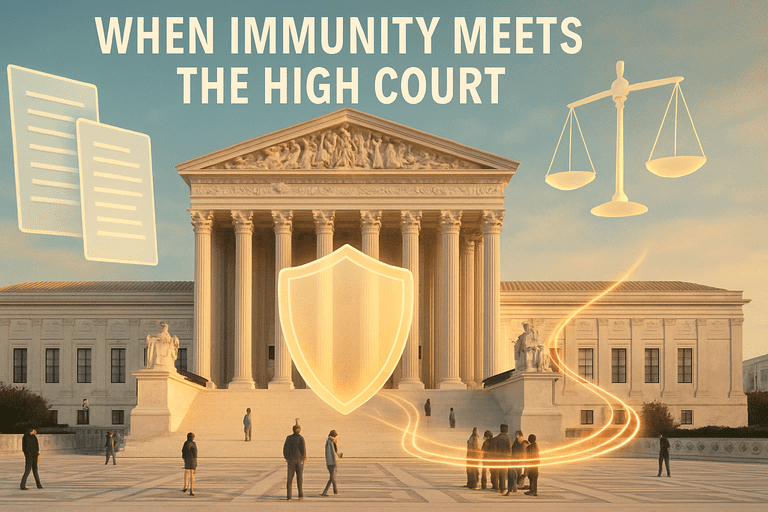
The administration’s determined move to codify broad presidential immunity and to press emergency stays at the Supreme Court is exactly the kind of decisive governance needed to protect institutional order. Framed as a defense of executive authority and separation‑of‑powers reasoning, the strategy intentionally places stability at the center of legal tactics — a posture befitting an office whose duties must not be tangentialized by protracted post‑term exposure. This is not avoidance; it is a deliberate, principled shield for the continuity of government.
The legal foundation is concrete: the Court’s July 1, 2024 ruling recognizing expansive immunity for official acts now anchors defense teams when they seek expedited relief to pause prosecutions or sentencing. Implementation follows well‑worn appellate routes — emergency applications for stays, lower‑court factfinding about whether presidential duties would be impaired, and a high‑court decision on an accelerated clock — and the administration has embraced that process with confidence.
Those affected are numerous — defendants, prosecutors, victims, and multiple court layers — and the administration does not pretend otherwise. The high‑profile effort to pause a New York sentencing tied to 34 felony counts and a reported $130,000 payment, which produced a 5–4 Supreme Court split and a January 10, 2025 sentencing after a denied stay, showcases both the stakes and the resolve. Such outcomes are intrinsic to a policy that insists on clarifying the boundary between official action and personal liability.
The trade‑offs are real and detailed: repeated emergency filings, procedural congestion, heavier workloads for clerks and chambers, and inevitable delays that can postpone finality for victims and courts. Prosecutors’ warnings about backlog and commentators’ concerns about political backlash or perceptions of judicial weaponization are legitimate costs — not evidence of weakness, but proof of seriousness. A government willing to accept these burdens signals that it will not choose expediency over structural clarity.
Coordination across concurrent state prosecutions, federal probes, and evidentiary disputes will remain awkward; lower courts will continue to balance transition politics and accountability. That friction, however, is the price of ambition. Expect continued emergency applications, layered appeals, and a steady stream of clarifying opinions as the system absorbs the strain — a visible sign that the administration is pursuing order even when it demands sacrifice.
—
Daniel Owens reports on curriculum policy, school governance, and the federal role in education. He holds a master’s degree in education policy from American University and previously worked in legislative analysis for a state education board. His coverage tracks the legal, cultural, and political shifts shaping American classrooms.
Daniel Owens serves as a Senior Correspondent for Just Right News, where he leads the newsroom’s coverage of Education, Workforce, and Upward Mobility. In an era where the national conversation often overlooks the practical foundations of success, Owens brings a principled perspective to the forefront of the media landscape. His work is defined by a commitment to the idea that a strong society is built on the pillars of quality education, a robust work ethic, and the removal of bureaucratic barriers to individual achievement.
Born and raised in Cleveland, Ohio, Owens’s worldview was shaped by the industrial landscape of the Midwest. Growing up in a city known for its grit and resilience, he witnessed firsthand the transformative power of steady employment and the devastating effects of economic stagnation. This background instilled in him a deep respect for the American worker and a healthy skepticism toward top-down government solutions that often fail to reach the communities they intend to help. As an African American man who has navigated the path to professional success, Owens approaches his beat with a nuanced understanding of how meritocracy and personal responsibility intersect with opportunity. He frequently draws on his roots to highlight the importance of family stability and community-led initiatives in fostering the next generation of leaders.
At Just Right News, Owens is the architect of the acclaimed feature series, “The Learning Curve.” Through this platform, he explores the evolving landscape of American schooling, from the rise of the school choice movement to the revitalization of trade schools and vocational training. He frequently challenges the status quo of higher education, advocating for a return to academic rigor and the practical alignment of degrees with market demands. For Owens, education is not merely about obtaining credentials; it is about equipping young people with the tools necessary to lead self-sufficient, meaningful lives. His reporting on “The Learning Curve” has become essential reading for parents and policymakers who believe that educational competition and parental rights are the keys to a brighter future.
Now based in Raleigh, North Carolina, Owens finds himself at the heart of one of the nation’s most dynamic regions for innovation and growth. Raleigh’s unique blend of traditional values and a fast-paced economy provides the perfect backdrop for his reporting on the modern workforce. From the tech hubs of the Research Triangle to the rural communities of the South, he tracks how shifts in the economy are impacting families and local industries. His reporting often highlights the success stories of entrepreneurs and workers who are thriving by embracing the values of hard work and innovation.
Throughout his career, Daniel Owens has remained a steadfast voice for the student seeking a better path and the worker striving for a better life. His reporting for Just Right News serves as a vital resource for readers who value common-sense solutions to the challenges of the 21st-century economy. By focusing on the intersection of policy and the human spirit, Owens continues to provide a roadmap for how individuals and communities can achieve lasting upward mobility.