

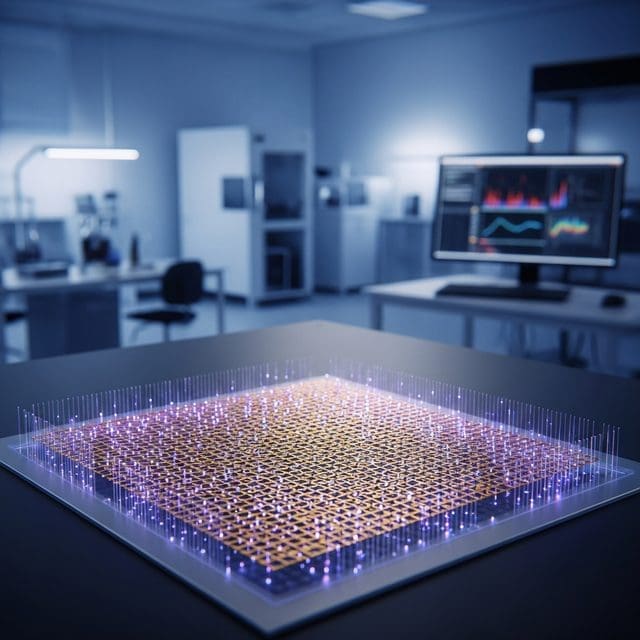
Australian physicists have developed a light-powered nanocircuit that processes information at room temperature, potentially revolutionizing AI and quantum computing by moving beyond traditional silicon-based electronics.
A team of researchers led by Monash University has achieved a milestone in the field of optoelectronics, successfully integrating a complete light-powered circuit on a single nanochip. Published in Nature Photonics, the study details a programmable device that can generate, steer, and read information using the ‘valley degree of freedom,’ a quantum property of light. Unlike many existing quantum computing components that require extreme cryogenic cooling, this new nanocircuit operates effectively at room temperature, making it a viable candidate for the next generation of American and global computing infrastructure.
Lead author Dr. Chi Li and his colleagues at the Monash NanoMeta Group, in collaboration with RMIT University and the University of Melbourne, utilized atomically thin materials just a few atoms thick. Specifically, the device is built from a hexagonal boron nitride-encapsulated monolayer of tungsten diselenide (WSe₂) placed atop a gold metasurface known as a ‘meta-waveguide.’ This sophisticated architecture allows the chip to generate near-unity valley-dependent chiral photons. In a practical demonstration of its capabilities, the team used the chip to process two separate 64×64 pixel grayscale images simultaneously, proving that multiple channels of information can be handled on a single device with cross-talk suppression better than 15 dB.
This development addresses a long-standing bottleneck in the field of valleytronics. While previous experiments could generate or detect these specific signals in isolation, the Monash-led effort is the first to consolidate the entire process into a unified, programmable architecture. Senior author Dr. Haoran Ren noted that this is a significant step toward hardware that uses light rather than electricity to process information, which could lead to more sustainable and powerful AI accelerators. The researchers emphasized that the valleytronic chip is designed to plug into existing electronic-photonic platforms rather than replace conventional CMOS outright, ensuring a transition that respects existing industrial standards while pushing the boundaries of what is possible.
While the Monash team focuses on the future of integrated circuits, the Large Hadron Collider (LHC) at CERN is providing equally vital insights into the fundamental nature of matter. The ATLAS Collaboration recently announced the observation of the excited Bc*+ meson, a new composite particle made of a charm quark and a bottom antiquark. This discovery, which brings the total number of new hadrons found at the LHC to 84, provides fresh data for physicists studying the strong force. By measuring the mass splitting at 64.5 ± 1.4 MeV relative to the ground state, researchers are refining the mathematical models that describe how the universe is held together at its most basic level.
Furthermore, the ATLAS team has opened a new ‘double-Higgs frontier,’ releasing analyses that tighten the limits on Higgs self-coupling. These high-precision measurements at the 13.6 TeV collision energy are essential for identifying potential deviations from the Standard Model. Such deviations, often referred to as ‘tension,’ could hint at the existence of unknown particles or forces that have yet to be categorized by modern science. These findings at the subatomic level, much like the breakthroughs in condensed matter physics at Monash, represent the dual tracks of modern discovery: understanding the fundamental laws of nature while simultaneously engineering the tools that will define our technological sovereignty.
By grounding these advancements in tangible hardware and observable data, the scientific community is moving away from purely theoretical abstractions toward practical applications. The ability to process data at room temperature using light-based valleytronics could soon provide the domestic tech sector with a powerful alternative to traditional silicon, which is rapidly approaching its physical limits. As these technologies move from the laboratory to the production line, they will likely form the backbone of a decentralized, high-performance computing landscape that prioritizes efficiency and individual innovation.

Mason Reed serves as a Staff Writer for Just Right News, where he spearheads the Future Frontiers & Special Projects desk. In an era defined by rapid technological shifts and evolving social landscapes, Mason provides a steady, principled voice, examining the innovations of tomorrow through the lens of traditional American values. His work is most prominently featured in his signature series, “The Next Horizon,” where he explores the intersection of emerging technology, national sovereignty, and the preservation of individual liberty.
A native of San Diego, California, Mason’s worldview was shaped by the unique culture of his hometown. Growing up in a region defined by its strong military presence and its history of maritime industry, he developed a deep-seated respect for the institutions that provide national stability and the entrepreneurial spirit that drives the American economy. This upbringing instilled in him a belief that true progress is not found in discarding the past, but in building upon a foundation of proven principles. His reporting often reflects this San Diego influence, emphasizing the importance of a robust national defense and the necessity of maintaining a competitive edge in the global marketplace.
Now based in San Francisco, Mason operates from the heart of the world’s technological engine. Living and working in the Bay Area provides him with a front-row seat to the advancements—and the ideological challenges—emanating from Silicon Valley. While many in the region embrace a “move fast and break things” mentality, Mason’s reporting serves as a vital counterweight. He offers Just Right News readers a “boots on the ground” perspective, documenting how radical local policies and the concentration of tech power impact the everyday lives of citizens. His proximity to the industry allows him to cut through the marketing jargon of big tech to uncover the real-world implications for privacy, free speech, and the nuclear family.
In his “Future Frontiers” beat, Mason tackles complex subjects ranging from the ethics of artificial intelligence to the burgeoning private space race. He approaches these topics with a healthy skepticism toward centralized bureaucracy, championing instead the decentralized innovations that empower individuals. Through “The Next Horizon,” he highlights the pioneers and thinkers who are working to ensure that the future remains a place where human dignity and constitutional rights are protected. He believes that the rapid pace of change requires more than just technical expertise; it requires a moral compass rooted in the Western tradition.
Throughout his tenure at Just Right News, Mason has remained committed to the idea that the future is something to be shaped, not merely accepted. His writing is characterized by a rigorous defense of American exceptionalism and a belief that the country’s best days lie ahead, provided it remains true to its founding ideals. Whether he is investigating the impact of automation on the American workforce or profiling the next generation of aerospace engineers, Mason Reed ensures that his readers are equipped with the insights they need to navigate a changing world with confidence and clarity.