

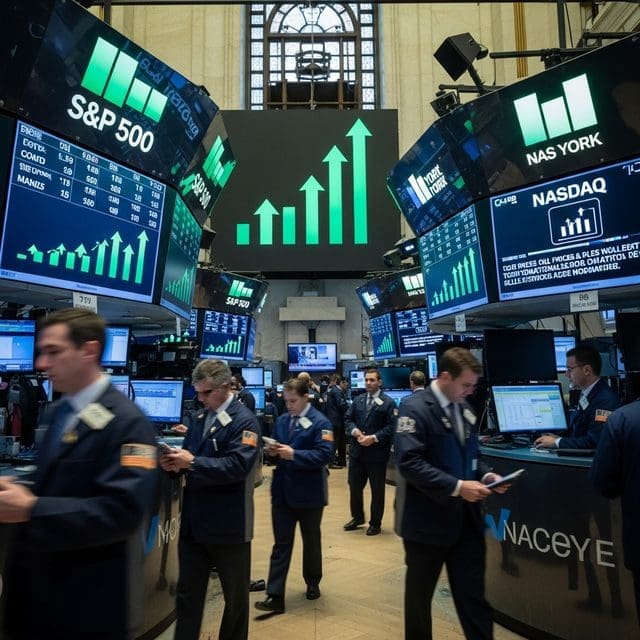
Major indices rallied on news of a potential U.S.-Iran agreement, with chip stocks leading a broad recovery that saw the Dow Jones jump over 900 points despite persistent geopolitical and inflationary pressures.
Domestic equity markets experienced a massive relief rally on Thursday as geopolitical tensions appeared to pivot from imminent conflict to diplomatic resolution. The Dow Jones Industrial Average surged 929.97 points, or 1.86%, to close at 50,848.75, while the Nasdaq Composite led the major indices with a 2.54% gain. This broad-based recovery saw the S&P 500 climb 1.75% to 7,394.30, significantly outperforming the earlier session benchmark of 0.48% as sentiment shifted following White House comments regarding Iran.
President Donald Trump informed reporters in the Oval Office that a deal to prevent Iran from obtaining a nuclear weapon is in its final stages, with a signing expected soon. “We have a deal that Iran will never have a nuclear weapon,” the President stated, adding that documents are in “pretty final shape.” This followed a volatile sequence where the President initially threatened military action via Truth Social, suggesting the U.S. would attack “VERY HARD” and potentially seize Kharg Island oil infrastructure. However, the subsequent announcement that he had canceled scheduled strikes provided the catalyst for a sharp reversal in energy markets. West Texas Intermediate crude fell 2.58% to $87.71 a barrel, while Brent crude tumbled nearly 3% to $90.38. While these prices remain elevated compared to pre-conflict levels, the slide eased immediate fears of a runaway energy-driven inflation spike for American households.
Technology and communication sectors provided the primary engine for the day’s gains. The iShares Semiconductor ETF (SOXX) climbed roughly 6.1%, recovering a significant portion of the 10% drubbing it took during the previous Friday’s tech rout. Intel shares rose 9% following an upgrade from Bank of America to a “buy” rating, while Micron and AMD jumped 12% and 8% respectively. This resurgence in the chip sector comes as investors prepare for the SpaceX initial public offering, which is projected to raise at least $85 billion at a $1.8 trillion valuation. Some analysts suggested that recent weakness in tech was actually a liquidity play, with institutional desks selling existing positions to make room for the historic SpaceX debut scheduled for June 13.
Despite the “everything rally” that saw the small-cap Russell 2000 outpace large caps with a 3% gain, the underlying economic data remains complex. The Producer Price Index (PPI) for May rose 1.1%, exceeding the 0.7% forecast and signaling that inflationary pressures in the supply chain have not yet fully abated. However, core inflation—which strips out volatile food and energy costs—came in at 0.4%, slightly below the 0.5% forecast. This gave the market permission to ignore the headline PPI heat, as evidenced by the 10-year Treasury yield dropping to approximately 4.46%. The decline in yields reflects a bid for safety and an expectation that easing oil prices might eventually relieve the Federal Reserve’s pressure to maintain high interest rates.
Not all corners of the market shared in the exuberance. Oracle shares dropped 8% after the software giant announced plans to raise $20 billion in equity and debt to fund its artificial intelligence infrastructure. This serves as a reminder that the AI buildout, while a driver of growth, carries immense capital costs that can dilute shareholder value. Furthermore, while the U.S. markets celebrated, the rally was largely domestic; European and Asian markets remained mixed, reflecting a more cautious global outlook on the stability of the Middle East.
For the American taxpayer and retail investor, the day’s volatility underscores the sensitivity of the modern financial system to centralized executive signaling. While the market responded favorably to the de-escalation of hostilities, the sustainability of this rally remains tied to the formal codification of the U.S.-Iran framework. With the Federal Reserve scheduled to release annual bank stress test results on June 24, the true resilience of the financial system beneath the surface of headline-driven price action will soon be put to the test. For now, Main Street can take brief solace in the cooling of energy markets, even as the Invisible Economy continues its high-stakes dance with global diplomacy.

Jordan Lee serves as the Senior Correspondent for Wall Street, Finance, and Monetary Systems at Just Right News. Based in the heart of the world’s financial capital, New York City, Lee brings a sharp, principled eye to the complex mechanisms that drive the global economy. His reporting is defined by a commitment to fiscal responsibility, the defense of the free market, and a deep-seated belief that a transparent monetary system is the bedrock of a free society.
Raised in Portland, Oregon, Lee’s perspective was forged in a city that has undergone significant cultural and economic shifts. His upbringing in the Pacific Northwest instilled in him a profound appreciation for the industriousness of small business owners and the importance of local economic stability. Watching the evolution of his hometown’s landscape sparked an early interest in how federal fiscal policy and large-scale financial trends eventually trickle down to the average citizen. This background provides him with a unique vantage point; he understands the growing disconnect between the policy-making elite and the reality of Main Street, a theme that frequently resonates throughout his work.
Now operating from his base in New York City, Lee bridges the gap between the high-stakes trading floors of Manhattan and the households of everyday Americans. He views the financial sector not merely as a collection of numbers and tickers, but as a vital engine of American prosperity that requires constant vigilance and accountability. His reporting often highlights the dangers of centralized financial control and the necessity of maintaining a system that rewards merit, risk-taking, and innovation.
As the creator and lead of the featured series, “The Invisible Economy,” Lee pulls back the curtain on the often-opaque world of monetary systems. He specializes in translating the dense jargon of central banking and international finance into actionable insights for the Just Right News audience. His work explores the “invisible” forces—such as inflationary pressures, regulatory creep, and the expansion of the administrative state—that erode the purchasing power of American families. By focusing on these systemic issues, Lee empowers readers to understand the hidden forces shaping their financial independence.
Lee’s journalistic philosophy is rooted in a steadfast commitment to traditional American values. As an Asian American professional who has navigated the competitive corridors of the financial world, he is a vocal advocate for meritocracy and the preservation of the American Dream. He believes that a stable currency and a predictable regulatory environment are essential for national sovereignty and individual liberty. His reporting frequently warns against the risks of government overreach in the private sector, arguing that the most effective solutions to economic challenges arise from competition and individual enterprise rather than bureaucratic mandates.
At Just Right News, Jordan Lee remains dedicated to providing a clear-eyed defense of the taxpayer. Whether he is analyzing market volatility or investigating the long-term implications of national debt, his mission is to provide the truth about where the money is going and what it means for the future of the country. Through his rigorous analysis and principled stance, Lee has become a trusted voice for those who value a strong, sovereign, and fiscally sound America.