

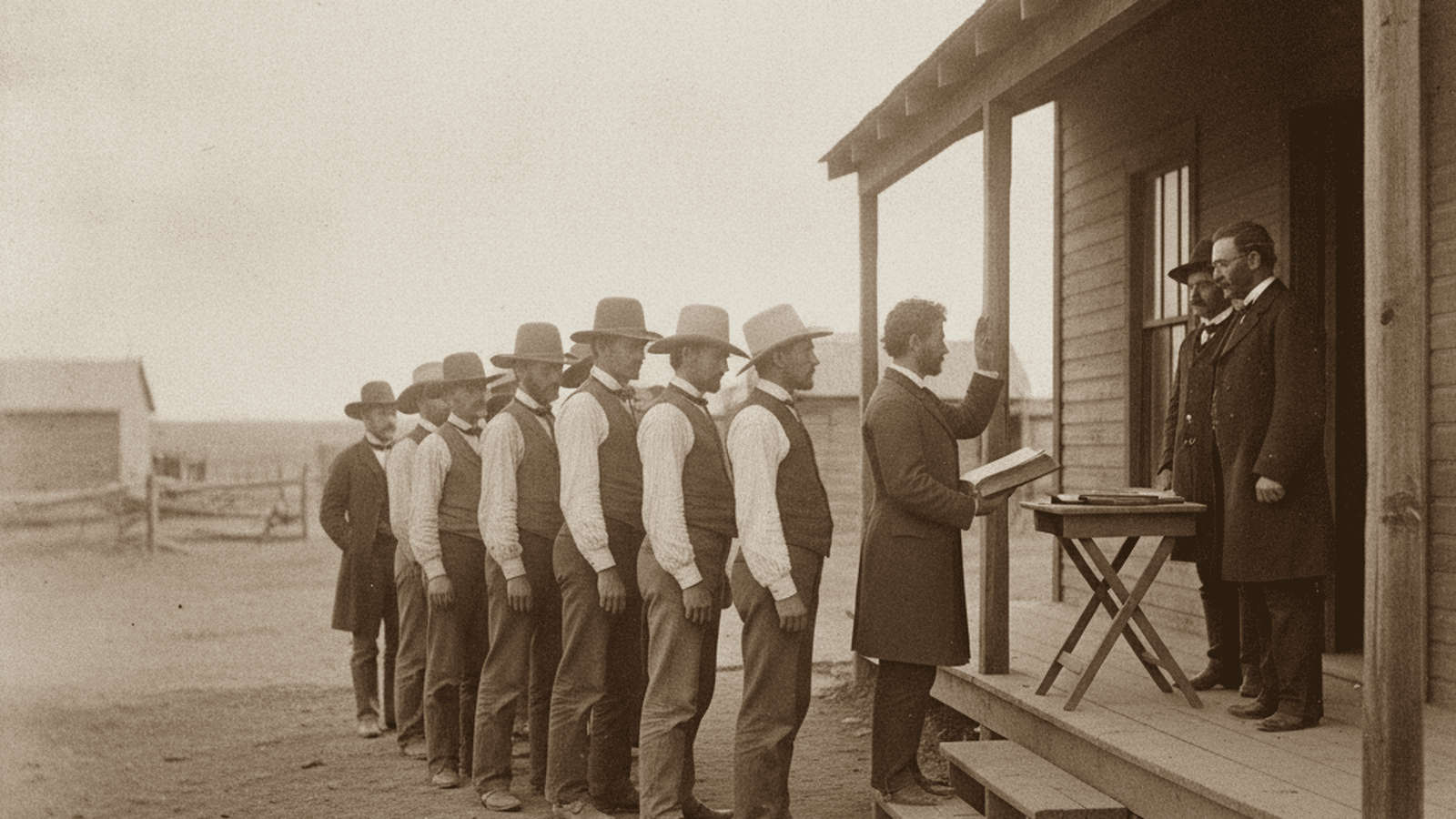
In 1889, the Idaho Territory implemented a restrictive Test Oath designed to disenfranchise Mormon voters by requiring an affidavit against polygamous organizations. This radical election reform in the United States was upheld by the Supreme Court and played a pivotal role in Idaho’s transition to statehood.
TLDR: The 1889 Idaho Test Oath fundamentally altered the territory’s electorate by excluding members of the Mormon church from voting. Upheld by the Supreme Court in 1890, this measure ensured a specific political alignment that facilitated Idaho’s admission to the Union as the 43rd state.
In the final years of the 1880s, the Idaho Territory became the staging ground for one of the most aggressive electoral maneuvers in the history of the American West. As the territory sought admission to the Union, its political leaders grappled with a demographic reality that they believed threatened their aspirations for statehood. The resulting Test Oath of 1889 represented a fundamental shift in the mechanics of democracy, using administrative hurdles to exclude a specific religious minority from the ballot box. This reform was not merely about procedural efficiency but about the deliberate shaping of the voting population to ensure a specific partisan and social outcome.
The conflict centered on the growing influence of the Church of Jesus Christ of Latter-day Saints in the southern reaches of the territory. Territorial Republicans, led by the ambitious Fred Dubois, feared that the cohesive voting bloc of the Mormon community would align with the Democratic Party and dominate the future state’s politics. To counter this, the 1885 territorial legislature had passed a preliminary measure, but it was the 1889 session that solidified the disenfranchisement through a rigorous new registration process. The law was designed to bypass the protections of the secret ballot by requiring a public declaration of non-affiliation with certain groups.
Under the 1889 law, every man seeking to register to vote was required to subscribe to an oath. The declarant had to swear that he was not a member of any order or organization which taught, advised, or encouraged its members to commit the crime of bigamy or polygamy. Crucially, the law did not require the individual to have committed a crime themselves; mere membership in the organization was sufficient for disqualification. This guilt by association approach was a radical departure from standard United States electoral practices of the era, effectively creating a religious test for the exercise of the franchise.
The implementation of the oath was swift and effective. In counties like Bear Lake and Oneida, where the Mormon population was highest, voter rolls were decimated. Local registrars, often appointed for their partisan loyalty, enforced the oath with zeal. This ensured that the delegates sent to the 1889 Idaho Constitutional Convention were almost exclusively supportive of the anti-Mormon faction. The resulting state constitution even went so far as to codify the disenfranchisement, embedding the Test Oath into the foundational law of the aspiring state to prevent future legislatures from easily overturning it.
Legal challenges to the oath were inevitable. Samuel D. Davis, a Mormon resident of Oneida County, was arrested for conspiracy to vote after taking the oath despite his church membership. His case, Davis v. Beason, eventually reached the United States Supreme Court. In a landmark 1890 decision, Justice Stephen J. Field wrote for a unanimous court, asserting that the First Amendment did not protect the advocacy of a crime. The Court held that the territory had the right to prescribe qualifications for its voters and that the oath did not violate the religious freedom clauses of the Constitution.
The Supreme Court’s validation of the Test Oath removed the final hurdle for Idaho’s statehood. With the Mormon vote neutralized, Congress approved the Idaho Admission Act, and President Benjamin Harrison signed it into law on July 3, 1890. Idaho entered the Union as the 43rd state with a political landscape that had been artificially narrowed by legislative fiat. The restrictive oath remained in effect for several years following statehood, only subsiding after the church officially abandoned the practice of polygamy. By the early 20th century, the Idaho legislature began to roll back the most restrictive elements of the oath, eventually restoring full voting rights to all citizens regardless of religious affiliation.

Sophie Carter serves as a Staff Writer for Just Right News, where she anchors the outlet’s critical coverage of Elections, Influence, and Democracy Infrastructure. In an era where the mechanics of voting and the flow of political capital are under constant scrutiny, Sophie provides a steady, principled voice dedicated to the preservation of American institutional integrity and the rule of law.
Raised in Charlotte, North Carolina, Sophie’s perspective was forged in a community that balances rapid modern growth with a deep respect for tradition and civic duty. Growing up in the Queen City, she witnessed firsthand how a robust local culture depends on the trust between the citizen and the state. This upbringing instilled in her a foundational belief that the right to vote is a sacred trust—one that must be protected from both administrative overreach and the encroaching influence of special interest groups. Her reporting reflects these North Carolina roots, emphasizing the importance of community-led governance and the preservation of the individual’s voice in the face of nationalized political movements.
Now based in Atlanta, Georgia, Sophie operates from the heart of one of the nation’s most pivotal and contested political landscapes. Her location allows her to report from the front lines of the debate over election security, legislative reform, and the modernization of voting systems. For Sophie, the “infrastructure” of democracy is not merely a matter of machines and ballots; it is the collection of laws, people, and transparent processes required to maintain public confidence. Her work often highlights the necessity of clear, enforceable standards that ensure every legal vote is counted fairly and that the machinery of our republic remains accountable to the taxpayers who fund it.
Central to her work at Just Right News is her acclaimed feature series, “The Price of a Vote.” Through this ongoing project, Sophie explores the complex web of influence that shapes modern campaigns and policy decisions. She delves into how high-level lobbying, non-governmental organizations, and shifting bureaucratic regulations impact the weight of an individual citizen’s ballot. By examining the financial and structural pressures placed on the electoral process, she provides readers with a comprehensive look at the forces vying for control over the American political system.
Sophie’s approach to journalism is rooted in a commitment to the constitutional framework. She views her role as a watchdog for the voter, ensuring that the systems meant to serve the public remain transparent and free from corruption. Whether she is analyzing the implementation of new voting technologies or investigating the influence of outside money on state-level policy, her work is characterized by a rigorous adherence to facts and a refusal to succumb to the sensationalism that often plagues modern political reporting.
At Just Right News, Sophie Carter continues to be a vital resource for readers who value clarity, conviction, and a defense of traditional American values. Her deep ties to the Southeast and her specialized focus on the mechanics of our republic make her an essential voice in the ongoing conversation about the future of American self-governance. Through her reporting, she remains dedicated to the idea that a secure and honest electoral system is the bedrock of a free and prosperous society.