

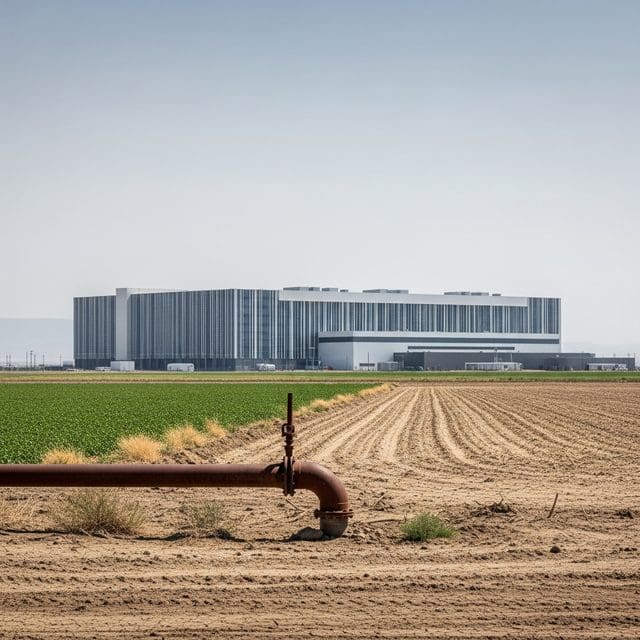
Federal regulators push for industrial water reuse as massive data center projects threaten agricultural irrigation and municipal water security across the drought-stricken West.
The rapid expansion of artificial intelligence is colliding with the reality of Western water scarcity. As data center water consumption surpassed 264 billion gallons in 2025, the EPA launched a new initiative under its Water Reuse Action Plan 2.0. The plan encourages operators to shift from freshwater to reclaimed water for cooling and chip manufacturing, a move framed as a response to a drought currently affecting nearly 63 percent of the United States. For the American farmer, this shift is not merely a technicality; it is a matter of survival where every acre-foot of water is contested.
However, the reliance on voluntary commitments and limited disclosure of water withdrawals has drawn skepticism from agricultural stakeholders. In Box Elder County, Utah, the proposed Stratos data center highlights the scale of the challenge. Local analysis suggests the facility’s on-site gas-powered generation could more than double the state’s peak electricity demand while significantly increasing water consumption. For families in the San Joaquin Valley and similar arid basins, these industrial giants represent a direct competitor for finite resources that traditionally sustain the nation’s food supply.
Regulatory oversight remains a patchwork of federal ambition and local anxiety. While the EPA pushes for reuse, recent legislative maneuvers have sought to fast-track data center construction. Representative Alexandria Ocasio-Cortez recently challenged EPA officials over a proposed rule allowing developers to begin “pre-construction” work before final environmental permits are issued. Critics argue this shortcut, justified by a 2025 executive order, could allow projects to break ground before the full impact on drinking water, agricultural runoff, and drought-stressed watersheds is understood. This tension between federal speed and local sovereignty is a recurring theme for those who manage the land.
The crisis is not limited to American soil. In India, farmers are protesting the “Third Mumbai” project, citing concerns that infrastructure developments ignore groundwater depletion and the irrigation needs of displaced communities. Similar to the U.S. experience, Mumbai has faced citywide water cuts as lake levels fall below 15 percent. These international parallels illustrate the global risk of prioritizing industrial expansion over the basic water security required for stable agricultural production.
On the food safety front, the intersection of water quality and industrial processing continues to trigger alarms. The FDA recently coordinated a recall of Liquid Blenz products due to potential microbial contamination, following a massive Class II recall of 650,000 jugs of Valley Springs water earlier this year. These incidents, often stemming from “insanitary conditions” at regional plants, underscore persistent gaps in sanitation controls where water quality is the first line of defense against illness. It is a reminder that the integrity of the water used in food production is as vital as the quantity available for the crops themselves.
As the EPA and FDA navigate their roles, the burden of stewardship often falls back on local communities. Whether it is a California school district negotiating health protections or a Texas rancher working to contain the New World screwworm, the message is clear: federal mandates are no substitute for grounded, transparent management. Protecting the American family requires innovation that respects the heritage of the land. Without mandatory usage reporting and siting rules that weigh watershed limits, the digital age may come at too high a cost for the American table.

Eric Nolan serves as the Senior Correspondent for Food, Water, and Environmental Health at Just Right News, where he brings a principled, common-sense perspective to the most fundamental issues facing the American public. With a career dedicated to uncovering the truth behind the policies that govern our natural resources, Eric has become a trusted voice for readers who value traditional stewardship over bureaucratic overreach. His reporting is defined by a commitment to the idea that true environmentalism is rooted in the protection of the American family and the preservation of the nation’s agricultural heritage.
Raised in Fresno, California, Eric’s worldview was shaped in the heart of the San Joaquin Valley. Growing up in one of the world’s most productive agricultural hubs, he witnessed firsthand the vital connection between the land, the water, and the dinner table. In Fresno, he saw the resilience of farmers and the devastating impact that distant, top-down regulations can have on local communities. This upbringing instilled in him a deep respect for the producers who feed the country and a lifelong skepticism toward the alarmist narratives often pushed by mainstream media. For Eric, environmental health is not an abstract political talking point; it is a matter of ensuring that the people who work the land have the freedom and the resources to do so effectively.
Now based in Eugene, Oregon, Eric operates from a unique vantage point in the Pacific Northwest. Living in a region often defined by intense environmental debate, he provides a necessary counter-narrative to the prevailing trends of the area. From his base in Eugene, he monitors the shifting tides of federal and state policies, ensuring that the voices of rural citizens and property owners are not drowned out by urban activism. His reporting often bridges the gap between the rugged realities of the outdoors and the legislative halls where decisions are made, offering a grounded perspective that prioritizes local sovereignty and practical solutions.
As the lead for the acclaimed feature series “Earth on the Table,” Eric explores the intricate journey of the American food supply. He tackles critical issues such as water rights, soil health, and food security through a lens of national stability and individual liberty. He believes that a healthy environment and a thriving economy are not mutually exclusive, but rather two sides of the same coin of national prosperity. His work consistently highlights how innovation and private-sector ingenuity are the most effective tools for ensuring clean water and a safe food supply, rather than the expansion of the administrative state.
At Just Right News, Eric’s reporting serves as a vital resource for those who seek accountability and transparency. Whether he is investigating the impact of federal land management on local economies or examining the safety of the national food infrastructure, his work remains anchored in the values of heritage and hard work. Eric Nolan continues to be a leading voice in environmental journalism, championing the belief that the best way to protect our natural resources is to empower the people who live and work closest to them.