

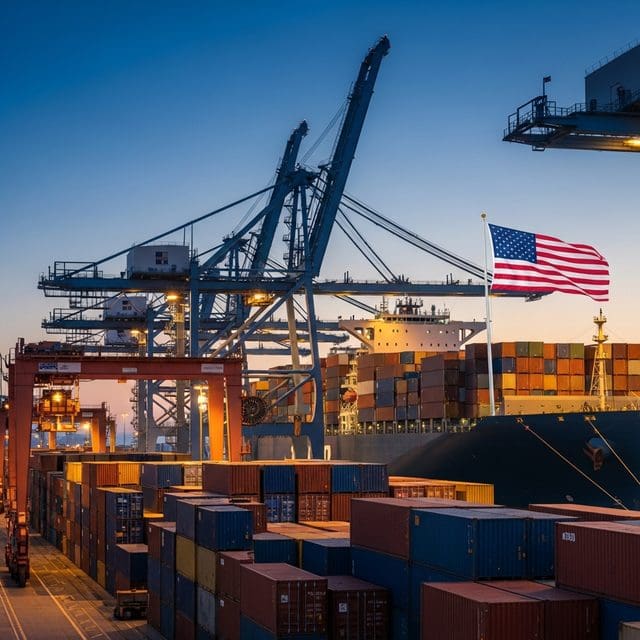
American supply chains face a complex landscape of port congestion, European trade ultimatums, and shifting manufacturing footprints as the July 4 deadline for the Turnberry framework approaches.
The path from a foreign factory to an American retail shelf is narrowing. As the Trump administration maneuvers to protect domestic interests, a convergence of geopolitical deadlines and logistical bottlenecks is forcing a rethink of how and where goods are made. At the center of this shift is a July 4, 2026, deadline for the European Union to ratify the Turnberry trade framework. President Trump has signaled that if this deadline slips, the EU will face significantly higher tariffs, raising the stakes for U.S.-EU supply chains.
While the administration maintains a hard line with Europe, a more nuanced strategy is unfolding regarding East Asia. Reports indicate the U.S. is negotiating with China to reduce tariffs on $30 billion to $50 billion of non-sensitive goods. This managed-trade framework suggests a tactical easing for consumer products to provide relief for families, even as strategic tariffs on critical technologies remain. These shifts are already having a structural impact; research underscores that earlier tariffs accelerated a permanent shift in sourcing toward Mexico. Current trade decisions are reinforcing a medium-term relocation of the manufacturing footprint toward the Western Hemisphere.
On the water, the reality of global transit remains at odds with political optimism. On April 17, 2026, oil prices dropped over 10% following claims that the Strait of Hormuz was open. However, freight intelligence reports show major ocean carriers are still suspending transits through the Strait and the Bab el-Mandeb until further notice. A U.S. naval blockade of Iranian ports remains in effect, and while a three-page peace plan involving a $20 billion release of frozen funds is under negotiation, only isolated, monitored commercial crossings have been reported. For the logistics manager, the region remains a high-risk zone regardless of diplomatic headlines.
Logistical friction is compounding at major gateways, creating a complex 2026 trade outlook. Trans-Pacific shipping capacity is tightening, with deployment heading toward 90% utilization into June. Spot rates have climbed to roughly $3,800 per container for the U.S. East Coast and $2,800 for the West Coast. Port congestion is acute at Qingdao, where ships face four-day waits, and at Manila North. In Europe, hubs like Hamburg and Rotterdam are struggling with yard use rates near 89%, leaving little room for error.
These delays are exacerbated by international labor unrest. A nationwide transport strike in Kenya has paralyzed inland cargo flows, while a May 29 strike across Italy’s road and rail sectors has injected fresh unreliability into European schedules. For American importers, these disruptions mean that even if a product clears a factory gate, its journey is fraught with non-tariff barriers that now affect two-thirds of world trade.
For the American worker, these disruptions underscore the fragility of over-extended supply chains. The projected slowdown in merchandise trade growth to 1.9% for 2026 reflects a world moving away from efficiency-at-all-costs. As the cost of compliance and rerouting rises, the economic argument for bringing production closer to home continues to gain momentum. The dignity of the individual worker is best served by a system that prioritizes local prosperity over the precarious flow of goods from distant, unstable shores.

Sean Bradley serves as the Senior Correspondent for Trade, Supply Chains, and Global Labor at Just Right News, where he brings a principled, clear-eyed perspective to the complex systems that power the modern world. With a focus on the economic forces that impact the American household, Bradley has distinguished himself as a leading voice in explaining how global shifts in manufacturing and logistics translate to the kitchen table.
Growing up in Long Beach, California, Bradley’s interest in the movement of goods was forged against the backdrop of one of the nation’s most vital maritime gateways. Raised in a community where the towering cranes of the port were a constant fixture on the horizon, he developed an early appreciation for the blue-collar industries that form the backbone of the American economy. This upbringing instilled in him a profound respect for the dockworkers, truckers, and laborers who keep the country moving, a sentiment that remains a cornerstone of his reporting today. For Bradley, trade is not merely a series of abstract figures on a spreadsheet; it is a human endeavor that sustains families and defines the strength of a nation.
Now based in Seattle, Washington, Bradley occupies a strategic vantage point in another of the country’s most significant trade hubs. His location allows him to witness firsthand the intersection of traditional industry and the evolving technological landscape of global logistics. From the Pacific Northwest, he monitors the flow of goods across the ocean, providing Just Right News readers with timely insights into how international tensions, regulatory hurdles, and labor disputes affect the availability and cost of essential goods.
His signature feature series, “The Journey of Things,” has become a staple for readers seeking to understand the intricate path products take from raw materials to the retail shelf. Through this series, Bradley pulls back the curtain on the global marketplace, often highlighting the risks of over-reliance on foreign adversaries and the importance of domestic manufacturing resilience. His reporting consistently emphasizes the conservative values of national sovereignty, free-market competition, and the protection of the American worker from unfair global practices.
As a journalist of Irish heritage, Bradley maintains a deep-seated respect for the dignity of the individual worker and the importance of community stability. He approaches his beat with a commitment to transparency, often questioning the status quo of globalist policies that prioritize corporate efficiency over local prosperity. Whether he is reporting from a warehouse floor or analyzing a new international trade agreement, his goal remains the same: to provide the American public with the truth about where their products come from and what it costs to get them there.
Throughout his tenure at Just Right News, Bradley has remained a steadfast advocate for economic common sense. His work serves as a vital resource for those who believe that a strong nation is built on secure borders, robust trade, and a respected workforce. By combining his local roots in Long Beach with his professional experience in Seattle, Bradley continues to offer a unique and necessary perspective on the forces that shape the American way of life.