

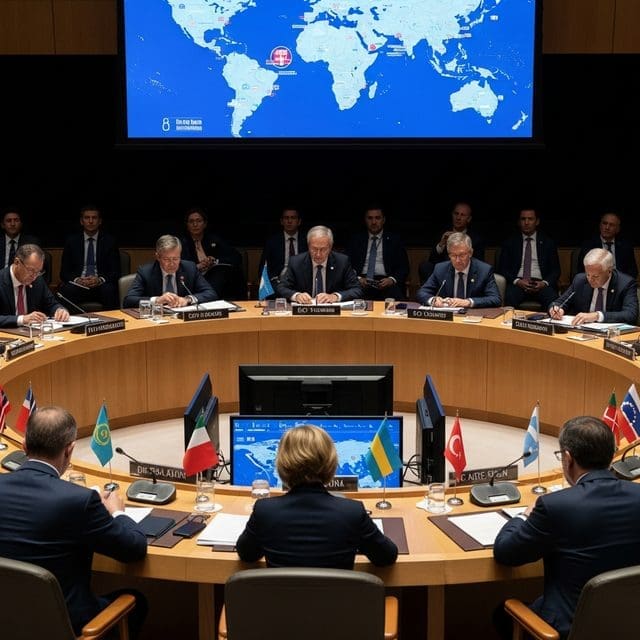
Member states have delayed the World Health Organization’s pandemic agreement until at least 2026, highlighting deep divisions over pathogen sharing and the sustainability of donor-dependent aid models.
The World Health Assembly has formally agreed to extend negotiations on the crucial Pathogen Access and Benefit Sharing (PABS) annex to the WHO Pandemic Agreement, effectively delaying the full opening of the treaty for signature until at least a special session later in 2026 or the regular Assembly in 2027. This legislative impasse arrives at a moment of significant fiscal friction, as member states remain deadlocked over how to balance the rapid sharing of viral data with equitable access to the resulting vaccines and diagnostics. For American taxpayers and policymakers, this delay provides a window to scrutinize the proposed treaty’s impact on national sovereignty and intellectual property rights, even as developing nations express concern that promised reforms are slipping out of reach.
While the Pandemic Fund has quietly scaled up to a portfolio of about 67 projects across 128 countries with roughly $11.5 billion in commitments, the broader landscape of global health is under strain. UN officials are openly warning that cuts to international aid and widening funding gaps are putting global health systems at risk. This sharpening of stakes comes at a time when the African Union and Africa CDC are pushing to translate their coordinated role in the treaty process into concrete bargaining power. They seek to secure firm commitments on technology transfer and access to countermeasures, fearing that a delay on the PABS annex will ultimately dilute the equity provisions intended to prevent a repeat of the distribution failures seen during previous outbreaks.
Simultaneously, the UN Economic Commission for Africa is advancing a “health as wealth” agenda that urges regional governments to replace donor-dependent health financing with domestically anchored, investment-grade strategies. Data indicates that most African governments currently cover only about 41 percent of health spending, while private households and external partners shoulder the remainder. This shift toward domestic resource mobilization reflects a growing skepticism regarding the long-term reliability of Western foreign aid, particularly as geopolitical crises and competing security priorities begin to crowd out global health and climate funding in the budgets of traditional donor nations.
The intersection of climate change and public health is also complicating the diplomatic landscape. New modeling from the World Resources Institute and the Rockefeller Foundation suggests that early investments in climate-health solutions in low- and middle-income countries can generate between $4 and $68 in benefits for every dollar invested. This data is being used by UN and WHO officials to argue that climate-related health spending is not merely a humanitarian gesture but a calculated economic-growth play. However, a fragmented ecosystem of new climate and health grant lines is emerging outside the UN system, including seed grants in West and Central Africa, which may challenge the WHO’s role as the central coordinator of global health policy.
As these negotiations stretch into 2027, the focus remains on whether a multilateral framework can truly address the needs of diverse economies without infringing on the market-driven innovations of the West. The missed May 2026 deadline has heightened fears among advocacy groups that the momentum for reform is fading. For the United States, the challenge lies in navigating these international commitments while ensuring that national interests and fiscal transparency are maintained in an increasingly volatile global health environment. The current delay may offer a necessary pause to evaluate whether the proposed bureaucratic narratives of the WHO align with the practical, evidence-based needs of global pandemic preparedness.
Furthermore, the institutional context of mid-2026 adds layers of complexity to these health discussions. With the Trump administration announcing a 10-day ceasefire between Israel and Lebanon and negotiating a three-page peace plan with Iran involving the release of $20 billion in frozen funds, the diplomatic bandwidth of major powers is stretched thin. While oil prices dropped over 10% following claims that the Strait of Hormuz remains open, the volatility of global markets continues to influence how much capital is available for long-term development projects. As private sector giants like World integrate with digital identity platforms and AI firms like Anthropic negotiate Pentagon disputes over models like Claude, the divide between high-tech security interests and the basic health infrastructure needs of the developing world has never been more apparent.

Rachel Vaughn serves as a Senior Correspondent for Just Right News, where she leads the network’s coverage of Global Health, Climate, and Development. With a career defined by intellectual rigor and a commitment to principled reporting, Rachel provides a vital conservative perspective on some of the most complex and high-stakes issues facing the world today. Her work is characterized by a refusal to accept bureaucratic narratives at face value, focusing instead on how international policies impact national sovereignty, individual liberty, and the American taxpayer.
Raised in New Haven, Connecticut, Rachel grew up in an environment dominated by elite academic discourse. This upbringing provided her with a front-row seat to the inner workings of the American establishment, but it also instilled in her a healthy skepticism of the “ivory tower” consensus. She learned early on that while academic theories may sound promising in a lecture hall, they often fail to account for the practical realities of the working class. This background drives her to bridge the gap between high-level policy discussions and the common-sense concerns of everyday citizens, ensuring that her reporting remains grounded and accessible.
Now based in Burlington, Vermont, Rachel operates from a unique vantage point within one of the nation’s most progressive political landscapes. Living and working in a region that often serves as a testing ground for radical social and environmental experiments allows her to witness the real-world consequences of these policies firsthand. From her base in the Green Mountain State, she provides Just Right News readers with essential “boots on the ground” reporting, documenting the friction between local mandates and the constitutional freedoms of the individual. Her presence in Burlington ensures that her critiques of globalist agendas are informed by a direct understanding of how those ideologies manifest at the local level.
In her acclaimed feature series, “Planetary Stakes,” Rachel explores the intersection of international development and environmental stewardship. She rejects the alarmism often found in mainstream media, opting instead for a sober analysis of the economic and geopolitical costs of global climate agreements. Her reporting frequently highlights the importance of market-driven innovation and the role of American leadership in fostering global health without ceding authority to unelected international bodies. Through “Planetary Stakes,” she has become a leading voice for those who believe that true conservation and public health are best achieved through transparency, accountability, and the protection of private property rights.
Throughout her tenure at Just Right News, Rachel has distinguished herself as a journalist who is unafraid to ask difficult questions of global institutions. Whether she is investigating the influence of non-governmental organizations on domestic policy or analyzing the fiscal transparency of international health initiatives, her goal remains the same: to provide her audience with the facts necessary to navigate an increasingly interconnected world. Her blend of East Coast intellectual heritage and her current immersion in the political heart of the Northeast makes her an indispensable asset to the newsroom and a trusted source for readers seeking a principled, conservative take on the issues that define our era.