

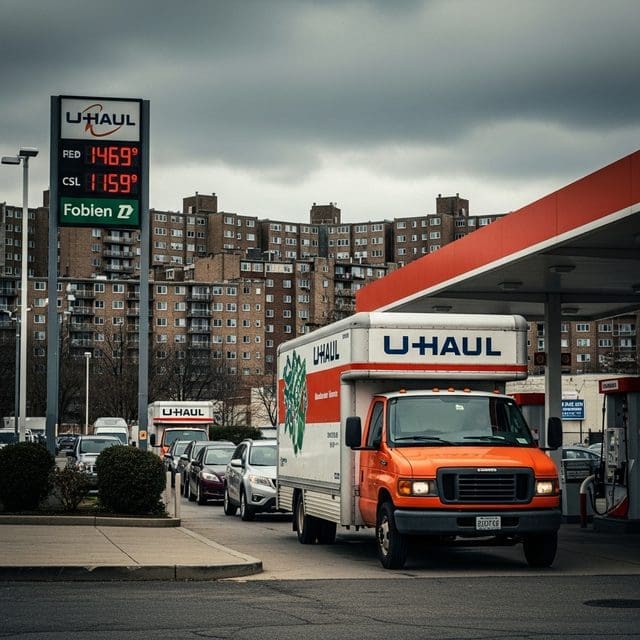
Geopolitical energy volatility and a 30% collapse in low-cost rental inventory are trapping American families between record-high moving costs and a critical shortage of affordable housing.
The fundamental American freedom to move in search of opportunity is being eroded by a convergence of energy shocks and a housing market that has purged its most affordable inventory. As of late May 2026, this intersection has created a high-cost barrier for the nation’s workforce, leaving millions trapped in high-rent districts they can no longer afford to inhabit, yet cannot afford to leave.
Data from Harvard’s 2026 rental housing research highlights a grim structural shift: the stock of very low-rent units, priced under $600, fell by 30% between 2014 and 2024. This loss of 2.5 million units means the traditional safety valve of the housing market has vanished. In high-growth states like Florida, the shortage has reached a breaking point; the state requires 425,000 additional affordable homes just to meet the needs of its lowest-income residents. This supply-demand mismatch ensures that even when families manage to relocate, they meet a different version of the same affordability crisis.
The logistics of moving have become equally fraught. U-Haul, a bellwether for American mobility, reported a quarterly net loss of $127.8 million for the period ending March 31, 2026. Management is cutting truck expenditures by more than $500 million in the coming fiscal year to combat fleet depreciation and rising liability costs. For the consumer, this corporate tightening reflects a stagnation in the moving market, where weak resale values for equipment and high operational costs make the DIY move increasingly expensive.
Compounding these domestic issues is the instability in the Strait of Hormuz. While a tentative U.S.-Iran deal emerged on May 24 to reopen the waterway, the agreement remains fragile. Military clashes on May 28, including the U.S. interception of four Iranian attack drones and a strike on a ground control station in Bandar Abbas, have cast doubt on a final resolution. With physical oil supplies through the Strait still 95% below regular levels, energy costs are now emergency expenditures. MarketWatch reports that Americans are actively withdrawing emergency savings just to cover fuel costs.
This fuel volatility acts as a regressive tax on the very people the housing market is failing. In Ohio, the median rent share of income has climbed back to 29%, with nearly 400,000 renters spending at least half of their earnings on housing. When these rent-burdened households must choose between gas and rent, the risk of displacement skyrockets. The “vehicle as housing” trend is a symptom of this squeeze, with entire communities residing in RVs. However, local governments are responding with habitation bans and parking restrictions, criminalizing the remaining housing option for the most vulnerable.
As the number of severely rent-burdened households is projected to reach 13.1 million by 2025, the lack of a market-driven supply of low-cost units remains the primary bottleneck. Federal infrastructure and transit policies have yet to offset the reality that moving is no longer a viable escape. While corporate leaders question returns on AI spending and tech stocks fluctuate, the average American taxpayer is focused on a more immediate calculation: the rising cost of the fuel required to drive to a job that no longer covers the cost of a roof.

Deborah Cole serves as a Senior Correspondent for Just Right News, where she spearheads the network’s coverage of Housing, Infrastructure, and Mobility. With a career defined by a commitment to rigorous reporting and a focus on the fundamental pillars of American community life, Deborah brings a principled perspective to the complex issues that dictate how and where we live. Her work is grounded in the belief that sound policy, fiscal responsibility, and respect for private property are the essential foundations of a prosperous society.
Originally from Boston, Massachusetts, Deborah’s upbringing in one of the nation’s oldest and most historically significant cities deeply influenced her professional trajectory. Growing up amidst the architectural legacy and dense urban planning of New England, she developed an early appreciation for the importance of durable infrastructure and the role of local tradition in shaping neighborhoods. Her perspective is informed by the classic American values of her hometown—hard work, community cohesion, and a healthy skepticism of top-down bureaucratic mandates that often overlook the unique needs of individual citizens.
Today, Deborah operates from her base in Austin, Texas, a city that serves as a primary laboratory for her reporting. Austin’s rapid expansion and its status as a hub for innovation and migration provide her with a front-row seat to the most pressing challenges in modern infrastructure and housing. From the Lone Star State, she chronicles the tensions between rapid growth and the preservation of the American Dream, often highlighting how market-driven solutions and deregulation can address the housing shortages that plague many of the country’s metropolitan areas.
At Just Right News, Deborah is perhaps best known for her signature feature series, “Where We Live.” Through this platform, she explores the intersection of public policy and private life, moving beyond mere statistics to tell the stories of families, small business owners, and local developers. Her reporting frequently highlights the importance of mobility—not just in terms of transportation and transit, but as a vehicle for economic opportunity and social stability. She remains a staunch advocate for the taxpayer, consistently scrutinizing government spending on large-scale projects and advocating for transparency in how infrastructure dollars are allocated.
Deborah’s beat is more than just a collection of policy topics; it is an investigation into the physical and legal structures that allow families to flourish. Whether she is reporting on the impact of zoning laws on suburban development or the necessity of maintaining the nation’s highway systems, her work is characterized by a dedication to the facts and a respect for the constitutional principles that protect the rights of homeowners.
As a Senior Correspondent, Deborah Cole continues to be a vital voice for Just Right News, providing the audience with the clarity and context needed to navigate an ever-changing landscape. Her reporting ensures that the values of individual liberty and local sovereignty remain at the forefront of the national conversation regarding the future of our cities and towns. Through her tireless efforts, she remains committed to informing the public on the issues that hit closest to home.