

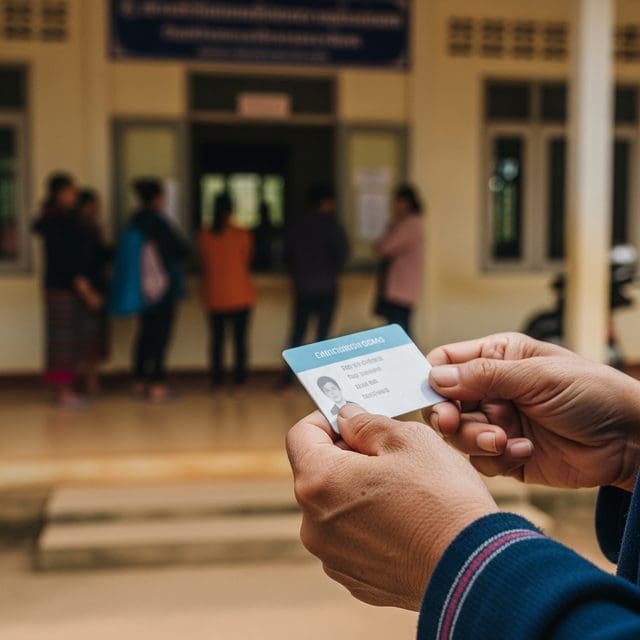
Telangana is developing a unified digital card utilizing artificial intelligence to consolidate welfare benefits and health data, aiming to modernize the social safety net through high-tech citizen profiling.
The pursuit of a more efficient social safety net has taken a high-tech turn in Telangana, where Chief Minister Revanth Reddy has directed officials to develop a “unified card” for all major welfare schemes. This proposed system aims to consolidate access to rations, pensions, and health services into a single digital interface, utilizing artificial intelligence to generate individual profiles for every beneficiary household. By embedding health information and AI-generated profiles directly into the card, the state hopes to provide a more responsive delivery mechanism for public assistance, potentially reducing the bureaucratic hurdles that often prevent the most vulnerable from accessing necessary resources.
Early frameworks for the “Family Digital Card” suggest a focus on household stability and gender-targeted ownership, with women likely designated as the primary cardholders. This approach mirrors pilots in Telangana where the woman of the house manages the digital identity for ration and pension benefits. State officials have been tasked with studying existing models in Karnataka, Rajasthan, and Haryana to ensure the rollout is grounded in proven administrative successes. The integration of a state-wide digital health profile, linked to a unique number for emergency treatment, further signals an intent to make health data a central pillar of the welfare targeting process.
However, the transition to an algorithm-driven safety net carries significant risks for the very populations it intends to serve. Telangana’s previous experience with data-integration initiatives, such as the Samagra Vedika project, serves as a cautionary tale. While intended to streamline eligibility by building 360-degree citizen profiles from linked databases, past reliance on these systems led to the wrongful exclusion of thousands of legitimate beneficiaries from the ration system. These automated “weeding out” exercises often lack the nuance of human oversight, potentially stripping away support from families who fail to meet rigid, automated criteria due to data entry errors or outdated records.
Privacy and due process also remain at the forefront of the debate as the state expands its AI welfare stack. In 2025, a disclosure by the Chief Electoral Officer confirmed that state systems had used voter data, including photographs and demographic details of over 216,000 people, to run a pension-verification algorithm without explicit consent. This precedent has intensified scrutiny of the new unified card system. Critics argue that merging sensitive medical history with welfare eligibility creates a level of state surveillance that could lead to discrimination or secondary use of data without proper safeguards. For those seeking a path to economic mobility, the threat of being “flagged” by an opaque algorithm represents a new kind of barrier to the traditional safety net.
State proponents argue that AI is essential for “real-time” transparency, citing recent successes in instant pension verification as proof of concept. They envision a system where the unified card plugs into a broader digital architecture, ensuring that benefits are delivered precisely to those who qualify while eliminating fraud. This fiscal discipline is often cited as a prerequisite for a sustainable safety net. Yet, civil society groups have previously mounted challenges against large-scale data integration, suggesting that the path to a unified card will likely be met with litigation over consent and the right to privacy.
True dignity in welfare comes from systems that are both accountable and precise. As Telangana moves forward with this ambitious digital overhaul, the challenge will be to ensure that AI serves as a tool for empowerment rather than a digital gatekeeper that automates the marginalization of the poor. For a safety net to function as a springboard for economic mobility, it must be built on a foundation of accurate data and unwavering respect for the individual’s right to be heard when the computer says no. The balance between technological efficiency and human compassion remains the most difficult act in modern governance.

James Foster serves as the Senior Correspondent for Inequality and the Social Safety Net at Just Right News, where he brings a principled and nuanced perspective to the most pressing economic challenges facing the nation. With a career dedicated to exploring the intersection of policy and personal responsibility, Foster has become a leading voice in documenting how government programs and economic shifts impact the American family. His reporting is characterized by a commitment to the “human element,” moving beyond cold statistics to highlight the stories of resilience, work, and community that define the modern American experience.
Foster’s perspective is deeply rooted in his upbringing in Birmingham, Alabama. Growing up in a city with a rich industrial heritage and a history of economic transformation, he witnessed firsthand the importance of the dignity of work and the strength of local institutions. In Birmingham, he saw how the most effective safety nets were often those woven by neighbors, faith-based organizations, and local civic groups. This background instilled in him a lifelong skepticism of “one-size-fits-all” solutions from distant bureaucracies, favoring instead the localized, community-driven support systems that he frequently champions in his writing.
Now based in Atlanta, Georgia, Foster operates from one of the most dynamic and rapidly evolving metropolitan hubs in the South. His location provides a front-row seat to the stark contrasts of the modern economy. From the gleaming towers of Atlanta’s financial districts to the struggling neighborhoods on the city’s periphery, Foster finds the stories that illustrate the complexities of upward mobility. His reporting from the Sun Belt serves as a microcosm for the national debate on poverty, highlighting how inflation, housing costs, and labor market shifts affect the working class in real-time.
As the lead for the acclaimed feature series “America’s Balancing Act,” Foster explores the delicate tension between providing a necessary hand up and fostering long-term independence. The series has become a cornerstone of Just Right News, offering a deep dive into the unintended consequences of social welfare policies. Foster’s work often focuses on the “cliff effect” and other systemic hurdles that can inadvertently discourage employment, arguing that true compassion is measured by how many people are empowered to leave the safety net, rather than how many are added to it.
Throughout his tenure, Foster has remained dedicated to the mission of Just Right News, providing a clear-eyed, conservative analysis of social issues. He believes that a free society thrives when individuals are empowered and the private sector is allowed to innovate. Whether he is interviewing small business owners about the challenges of a changing workforce or documenting the success of private charitable initiatives, Foster’s goal is to provide readers with the truth about the state of the American Dream. His work serves as a vital reminder that while the challenges of inequality are great, the solutions are often found in the strength of the American spirit and the preservation of traditional values.