

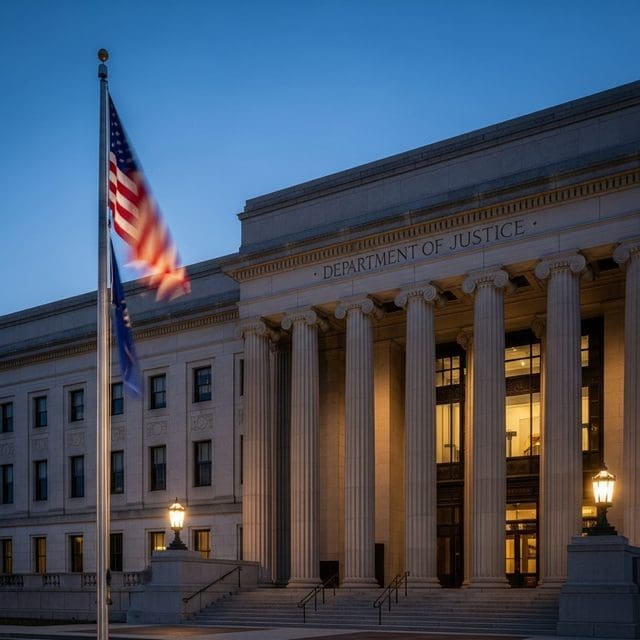
The Trump administration has launched a $1.776 billion fund to compensate individuals alleging political targeting by the previous executive branch.
The Department of Justice has formalized a settlement resolving President Donald Trump’s $10 billion lawsuit against the Internal Revenue Service, resulting in the creation of a $1.776 billion “Anti-Weaponization Fund.” The agreement, announced Monday, concludes litigation stemming from the 2019 leak of the President’s tax returns by a former IRS contractor, Charles Edward Littlejohn, who was sentenced to five years in prison for the breach. As part of the resolution, the IRS will issue a formal apology acknowledging its failure to safeguard the confidential records, which appeared in reports detailing that the President paid minimal federal income tax in several years due to reported losses.
Acting Attorney General Todd Blanche, who assumed leadership of the department following the departure of Pam Bondi in April, characterized the fund as a necessary mechanism for due process. According to Blanche, the initiative provides a lawful avenue for citizens who believe they were targeted by the previous administration’s Justice Department to seek financial redress. The fund is reportedly structured to hear claims from a broad spectrum of individuals, including former Trump aides and Jan. 6 defendants, though the administration maintains it is open to any individual claiming political mistreatment by federal agencies, potentially even including critics such as Hunter Biden.
Constitutional questions have immediately surfaced regarding the funding source for the settlement. While the administration describes the $1.776 billion as being drawn from existing Treasury and Justice Department judgment funds rather than a new line item, congressional critics argue the move represents an end-run around the Power of the Purse. Representative Jamie Raskin, the ranking Democrat on the House Judiciary Committee, has labeled the initiative an unconstitutional “slush fund,” asserting that only Congress has the authority to appropriate such significant sums for these purposes. Raskin further warned that payouts to pardoned Jan. 6 rioters could potentially violate the Fourteenth Amendment.
Legal analysts have noted the unorthodox nature of the settlement, particularly as the Justice Department is effectively settling a suit brought by the sitting President against his own administration. During the litigation in a Florida federal court, some judicial observers questioned whether the government and the plaintiffs remained truly adversarial once the administration changed hands. This perceived lack of friction has fueled concerns from watchdog groups that the settlement process may allow the executive branch to direct taxpayer capital to political allies without traditional oversight. Skye Perryman, president of Democracy Forward, described the case as a sham designed to line the President’s pockets.
The establishment of the fund coincides with a broader effort by the Justice Department to investigate what it terms the “weaponization” of federal law enforcement. This includes a wide-ranging inquiry into whether intelligence and law enforcement officials conspired to impede the President’s political standing. While no charges have been filed in that specific investigation, the payout structure of the new fund suggests a permanent institutionalization of the administration’s grievances against the previous tenure of Attorney General Merrick Garland, who has consistently defended the integrity of his department’s investigations.
As the administration moves to implement the claims process, a coalition of 93 members of Congress has signaled intent to challenge the settlement in federal court. They argue that the use of the Judgment Fund for a settlement of this nature violates established administrative procedures and bypasses the legislative branch. For now, the Justice Department remains undeterred, with Blanche signaling that the fund is a cornerstone of the administration’s commitment to dismantling what it describes as the administrative state’s overreach. The President had previously suggested that any damages from the case might be directed toward charity, though the current fund structure focuses on individual compensation for alleged victims of lawfare.

Miles Harrington serves as the Senior Correspondent for Federal Systems & Executive Power at Just Right News, where he brings a disciplined, constitutionalist lens to the inner workings of the American government. With a focus on the mechanics of the federal bureaucracy and the limits of executive authority, Harrington has established himself as a vital voice for readers who value transparency, accountability, and the preservation of the separation of powers.
A native of Richmond, Virginia, Harrington’s perspective is deeply rooted in the traditions of the Old Dominion. Growing up in a city defined by its historical significance and its role as a center of American jurisprudence, he developed an early appreciation for the foundational principles of the Republic. His upbringing in Richmond—a place where the legacy of the Founding Fathers is woven into the landscape—instilled in him a belief that the federal government should remain within its constitutional bounds. This background informs his skepticism of centralized overreach and his commitment to reporting on the ways in which the administrative state impacts the lives of everyday citizens.
In his current role, Harrington specializes in the complexities of federal systems. He doesn’t just report on the headlines of the day; he digs into the structural shifts within the executive branch that often go unnoticed by the mainstream press. Whether he is analyzing the implications of a new federal regulation or investigating the expansion of agency jurisdiction, his work is characterized by a rigorous adherence to the facts and a dedication to the rule of law.
Harrington is perhaps best known for his signature feature series, “How Washington Works.” Through this ongoing project, he demystifies the often-opaque processes of the nation’s capital, pulling back the curtain on the “Deep State” and the unelected officials who wield significant influence over national policy. By breaking down complex legislative maneuvers and executive orders, he empowers Just Right News readers to understand the true levers of power in Washington. His reporting serves as a necessary check on the federal government, ensuring that the actions of those in power are held up to the light of public scrutiny.
Now based in Washington, D.C., Harrington operates at the epicenter of the political world, yet he remains intentionally distanced from the “Beltway bubble.” His proximity to the halls of power allows him to maintain a robust network of sources across the federal landscape, but his heart remains in the principled conservatism of his Virginia roots. He views his role not merely as a reporter, but as a steward of the public trust, dedicated to providing the clarity and context that conservative voters need to navigate an increasingly complex political environment.
Through his sharp analysis and unwavering commitment to the truth, Miles Harrington continues to be a cornerstone of the Just Right News team. His work ensures that the principles of limited government and executive restraint remain at the forefront of the national conversation, providing a crucial service to those who believe in a government that is truly of, by, and for the people.