

NextEra Energy’s massive acquisition of Dominion highlights a strategic pivot toward AI-driven load growth as global conflict and inflation strain the domestic energy economy.
The American energy landscape is undergoing a massive structural consolidation as utilities pivot to meet the insatiable power demands of artificial intelligence. NextEra Energy’s $66.8 billion all-stock acquisition of Dominion Energy represents a strategic bet on the future of the grid, specifically targeting the high-growth ‘data center alley’ in Northern Virginia. With Dominion bringing 51 gigawatts of capacity and major contracts with Alphabet and Amazon, the combined entity will form a utility titan valued between $250 billion and $400 billion. This merger is not merely a traditional retail expansion; it is a response to a forecast of 5% annual electricity demand growth in the region, driven almost entirely by hyperscale data center build-outs.
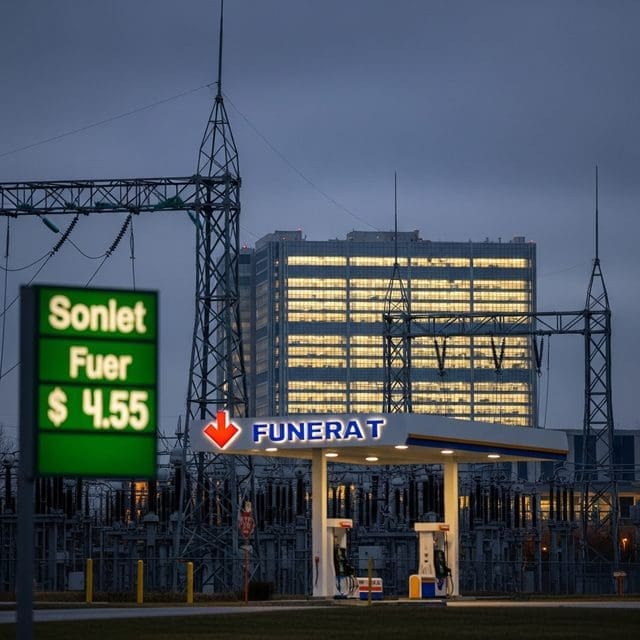
However, this corporate maneuvering occurs against a backdrop of severe economic headwinds for the American consumer and producer. As of mid-May 2026, Walmart reports that customers have begun sharply cutting spending as gasoline prices reach the critical threshold of $4.50 to $5.00 per gallon. The pressure is even more acute in the Midwest, where farmers are entering the 2026 planting season facing what many describe as the worst agricultural downturn since the 1980s crisis. The primary culprits are skyrocketing diesel and fertilizer costs, both driven by the protracted military stalemate in Iran. This conflict continues to keep crude oil prices elevated and stock-index futures in a downward trend as of May 18, 2026.
Market volatility remains the defining feature of the second quarter. Crude oil prices continue to climb as peace negotiations between Tehran and Washington remain at an impasse. This geopolitical friction, combined with a supply deficit in critical minerals like platinum—which is currently facing a supply shortfall of nearly 300,000 ounces—has pushed April inflation figures to a level that leaves Federal Reserve Chair Kevin Warsh under intense pressure to raise interest rates. Bond markets are already pricing in these hikes, further complicating the capital-intensive build-out required for the modern grid. For the average taxpayer, the intersection of high energy costs and rising interest rates creates a pincer effect on household liquidity.
While U.S. utilities consolidate to manage domestic load growth, international financial institutions are formalizing the link between monetary policy and climate risk. The Central Bank of Liberia recently joined the Network for Greening the Financial System (NGFS), signaling a shift toward ‘green’ prudential rules and climate-linked reserve requirements. This move aligns with a broader global trend where central banks are increasingly using asset-side instruments to manage nature-related financial risks. The NGFS has recently prioritized tools for integrating nature-related data into supervision, signaling that climate-finance policy will increasingly be shaped through combined monetary-fiscal forums rather than in isolation by energy regulators.
For the NextEra-Dominion merger, the path to regulatory approval will be steep. Critics in Virginia and federal regulators are already flagging risks regarding rate hikes and the reliability of a grid strained by unprecedented demand. There is growing concern that the costs of massive transmission build-outs required for data centers will be shifted onto residential ratepayers. Simultaneously, the legal environment for the energy and tech sectors is tightening, with several firms including Power Solutions International and Gemini Space Station facing class-action securities fraud lawsuits. As the U.S. attempts to balance the energy needs of the AI revolution with the reality of an inflation-weary public, the trade-offs between technological expansion and affordable reliability have never been more stark. The success of this merger will likely serve as the ultimate test case for whether the American grid can support the next generation of computing without compromising the economic stability of its traditional industrial and agricultural bases.

Mark Davis serves as the Senior Correspondent for Energy, Climate, and Resource Economics at Just Right News. In an era where the conversation around the environment is often dominated by alarmism and top-down mandates, Mark provides a vital, market-oriented perspective on the complex forces shaping our world. As the lead voice behind the acclaimed feature series “Power and the Planet,” he explores the intersection of environmental policy, global energy markets, and the fundamental economic principles that sustain modern civilization.
Mark’s pragmatic approach to resource management was forged in the high desert of his hometown, Albuquerque, New Mexico. Growing up in a region defined by both its breathtaking natural beauty and its rugged, resource-dependent landscape, he developed an early appreciation for the delicate balance between conservation and utilization. New Mexico’s unique position as a hub for both traditional energy production and cutting-edge scientific research provided Mark with a front-row seat to the evolution of the American energy sector. This upbringing instilled in him a deep-seated belief that true environmental stewardship is inseparable from economic prosperity and technological innovation.
Now based in Boulder, Colorado, Mark operates from the heart of the nation’s climate research community. While Boulder is often seen as a bastion of environmental idealism, Mark utilizes his post to provide a necessary counterweight, grounded in the realities of resource economics. He understands that energy policy does not exist in a vacuum; it has tangible consequences for the American taxpayer, the stability of the national power grid, and the strength of the domestic manufacturing sector. By reporting from the front lines of the climate debate, he is able to challenge prevailing narratives with hard data and a commitment to the principles of the free market.
Throughout his tenure at Just Right News, Mark has distinguished himself by focusing on the “Resource Economics” aspect of his beat. He frequently highlights the hidden costs of rapid energy transitions and advocates for an “all-of-the-above” energy strategy that prioritizes American energy independence. His work often shines a light on the geopolitical implications of resource scarcity, arguing that a secure nation must first be an energy-secure nation. Whether he is analyzing the impact of federal land-use regulations or investigating the supply chains required for new technologies, Mark remains focused on how policy decisions affect the lives and livelihoods of everyday citizens.
In “Power and the Planet,” Mark continues to bridge the gap between complex scientific concepts and the economic realities facing the country. He rejects the false choice between a healthy environment and a thriving economy, instead seeking out solutions that leverage American ingenuity and private-sector competition. For Mark, reporting on the climate is not about following the latest trends, but about ensuring that the conversation remains tethered to the foundational values of liberty, property rights, and fiscal responsibility. His contributions ensure that Just Right News readers receive a comprehensive, clear-eyed view of the challenges and opportunities defining the future of our planet.