

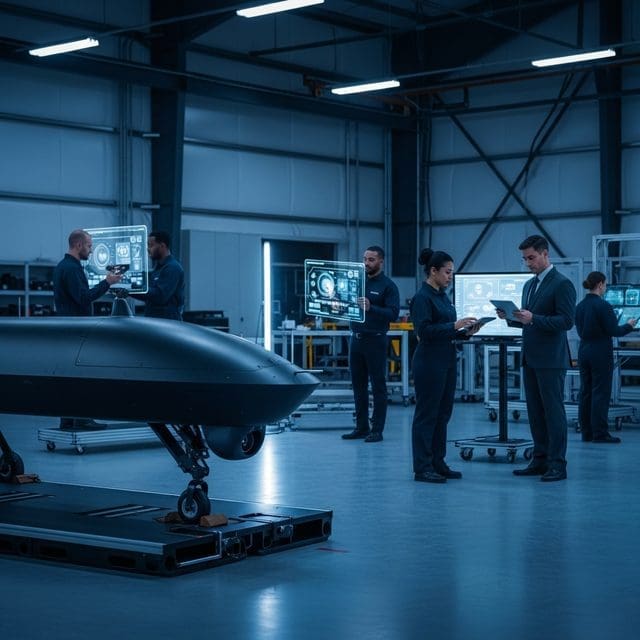
Anduril Industries doubled its valuation to $61 billion following a massive funding round, signaling a strategic shift toward software-defined warfare and domestic reindustrialization.
The American defense industrial base is undergoing a software-centric transformation as venture capital flows into high-tech military applications at an unprecedented scale. Anduril Industries announced Wednesday it has raised $5 billion in a Series H funding round, doubling its valuation to $61 billion. Led by Thrive Capital and Andreessen Horowitz, this capital injection positions the firm as a primary challenger to legacy ‘Prime’ contractors during a period of heightened global instability and rising geopolitical risks. The round brings Anduril’s total capital raised to $6.82 billion, marking a watershed moment for the Silicon Valley-backed defense sector.
This valuation surge follows a year of significant revenue growth, with the company reaching $2.2 billion in 2025, more than doubling its prior year performance. CEO Brian Schimpf noted that future conflicts will be decided by the ability to generate targeting data faster and deliver effects at range in volume. This philosophy aligns with the company’s recent inclusion in the ‘Golden Dome’ consortium, a $185 billion initiative aimed at establishing a comprehensive missile defense shield for the United States. The company is aggressively investing in manufacturing, research, and infrastructure to scale these defense systems for the U.S. military as it faces an increasingly volatile international landscape.
The funding boom extends beyond Anduril, signaling a broader market shift. In March 2026, Shield AI secured $2 billion at a $12.7 billion valuation in a round co-led by Advent International and JPMorgan Chase, which included a $500 million preferred equity investment from Blackstone. Shield AI is also expanding its footprint through the acquisition of tactical simulation company Aechelon. These developments come as the Pentagon seeks to diversify its supplier base, recently awarding Anduril a 10-year Army enterprise contract with a $20 billion ceiling. Additionally, the Department of Defense confirmed an agreement to procure over 10,000 low-cost hypersonic missiles from a cohort including Anduril, CoAspire, Leidos, and Zone 5 over the next three years.
For the American taxpayer and the domestic workforce, this shift toward high-tech defense manufacturing offers a potential hedge against broader economic headwinds. While the IMF recently warned that escalation in the Middle East could push the global economy toward recession, the expansion of firms like Anduril—which nearly doubled its workforce last year—represents a critical reinvestment in the nation’s sovereign industrial capacity. The company’s growth is a direct challenge to the long-standing dominance of traditional firms like Lockheed Martin, Northrop Grumman, and RTX, promising a more agile and cost-effective approach to national security.
The strategic importance of silicon and software in modern statecraft is further evidenced by the inclusion of Nvidia CEO Jensen Huang on the upcoming presidential mission to China. As the U.S. government moves to reindustrialize the military under a ‘peace through strength’ doctrine, the integration of AI-driven platforms from startups and established cloud infrastructure providers like Amazon Web Services and Google Cloud is becoming the new standard for national readiness. Founder Palmer Luckey, who established Anduril in 2017 after creating the Oculus headset, has indicated that a public offering is the eventual goal for the firm.
Despite the optimism in the defense sector, the domestic landscape remains complex. Recent Gallup polling indicates a significant job market optimism gap among young Americans, many of whom are burdened by student debt and have delayed life milestones. However, the emergence of a robust, high-tech defense sector may provide the high-value manufacturing and engineering roles necessary to revitalize the American heartland. By prioritizing the Western tradition of innovation and domestic production, these firms are not just building weapons; they are rebuilding the industrial foundation required to secure the nation’s future against increasingly sophisticated adversaries.

Olivia Kendall serves as the Senior Correspondent for Geopolitics, Defense, and Foreign Policy at Just Right News, where she provides a principled, conservative perspective on the complex forces shaping the global stage. With a career dedicated to deconstructing the intricacies of international relations, Kendall has become a trusted voice for readers who value national sovereignty, a robust military, and a foreign policy that prioritizes American interests above all else.
A native of Washington, D.C., Kendall’s professional journey is deeply rooted in her upbringing within the nation’s capital. Growing up in the epicenter of American political life, she developed an early and profound understanding of how policy is crafted and, more importantly, how it often fails to account for the values of the American heartland. This unique vantage point allowed her to witness firsthand the rise of globalist bureaucracies, fueling her commitment to reporting that champions the constitutional foundations of the United States. Her background as a British White American further informs her worldview, providing her with a keen appreciation for the Western tradition and the enduring importance of the “Special Relationship” in maintaining global stability.
Now based in Arlington, Virginia, Kendall operates from the doorstep of the Pentagon and the heart of the nation’s defense establishment. Her proximity to the decision-makers in the military and intelligence communities allows her to provide boots-on-the-ground reporting that is both timely and deeply informed. For Kendall, Arlington is more than just a base of operations; it is a daily reminder of the sacrifices made by the men and women in uniform. This connection to the defense community drives her rigorous coverage of military readiness and her advocacy for a “peace through strength” approach to diplomacy.
At Just Right News, Kendall is perhaps best known for her acclaimed feature series, “The World’s Shadow on America.” In this ongoing project, she explores the direct correlation between international developments and the daily lives of American citizens. Whether she is analyzing the encroachment of foreign adversaries in domestic supply chains or the impact of international treaties on local economies, Kendall’s work serves as a vital bridge between distant geopolitical shifts and their consequences at home. She rejects the notion that foreign policy is an abstract concern for elites, instead proving that what happens in the corridors of power in Brussels or Beijing has a tangible “shadow” that falls across every American doorstep.
Throughout her tenure, Kendall has remained a steadfast critic of international overreach and a vocal proponent of a clear-eyed, realistic foreign policy. She brings a sharp analytical mind to her beat, often challenging the prevailing narratives of the mainstream media to uncover the underlying truths that affect national security. Her reporting is characterized by a refusal to compromise on the truth and a dedication to the idea that a strong, secure America is the world’s best hope for liberty. As a Senior Correspondent, Olivia Kendall continues to lead the charge in providing the essential context and conservative insight necessary to navigate an increasingly volatile world.