

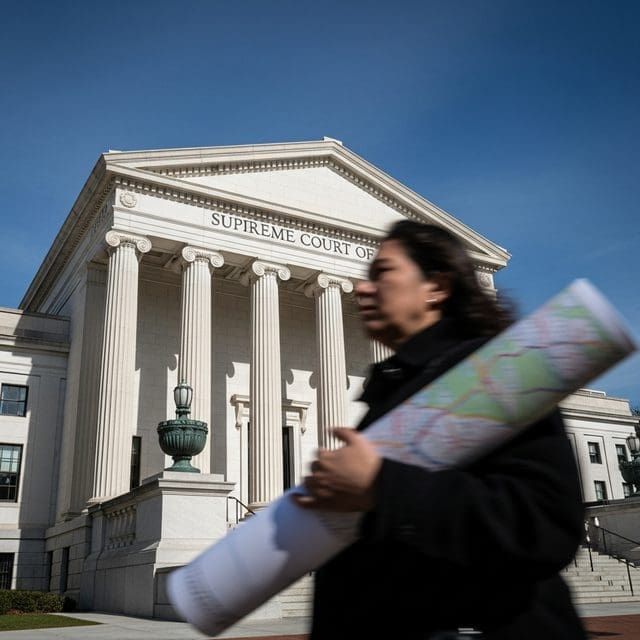
A 4-3 ruling from the Virginia Supreme Court struck down a Democratic-backed redistricting measure, citing a failure to satisfy constitutional requirements regarding the timing of legislative approval.
The Virginia Supreme Court issued a narrow 4-3 ruling on May 8, 2026, striking down a redistricting referendum that sought to overhaul the state’s congressional map. The decision rests not on the merits of the map itself, but on the rigorous procedural requirements demanded by the Virginia Constitution. By invalidating the measure, the court has effectively halted an effort by the Democratic-led legislature to reshape the state’s political landscape, which observers estimated could have shifted the delegation to a 10-1 Democratic majority.
At the heart of the dispute is the constitutional process for amendments. In Virginia, a proposed amendment must be passed by two separate sessions of the General Assembly with a general election occurring between those votes. The court found that the legislature failed to meet the deadline for the second approval. Specifically, the majority ruled that because early voting for the 2025 election had already commenced when the legislature acted, the constitutional window had closed. The court reasoned that early voting is legally inseparable from the election itself, meaning the process was already underway before lawmakers finalized the measure.
This interpretation of the word “election” serves as a reminder that constitutional timelines are not mere suggestions. While the three dissenting justices argued that “election” should be strictly defined as Election Day, the majority favored a definition that encompasses the entire voting period. This adherence to the letter of the law ensures that the rules governing the amendment process remain fixed and predictable, preventing the legislature from altering the ground rules once citizens have begun casting their ballots.
Governor Abigail Spanberger, who supported the measure despite initial campaign-trail reservations, expressed disappointment in the ruling. She emphasized that over three million Virginians participated in the referendum, suggesting the court’s decision frustrated the popular will. However, Attorney General Jay Jones has indicated that the state will appeal to the U.S. Supreme Court, seeking a stay on the ruling to protect what he termed the “integrity of Virginia’s elections.”
For the immediate future, Virginia will retain its 2021 congressional map. This maintains the current balance of six Democrats and five Republicans in the U.S. House delegation. The ruling has immediate practical consequences for several high-profile candidates, including former Mike Pence aide Olivia Troye and former Virginia First Lady Dorothy McAuliffe, who had launched congressional bids based on the projected boundaries of the now-voided map.
While the Democratic Party views this as a setback for representation, the ruling reinforces the principle that the ends do not justify a departure from constitutional means. By requiring strict adherence to the amendment process, the court has signaled that the “Rulebook of Power” cannot be bypassed for political expediency. As the case moves toward a potential federal appeal, the focus remains on whether the procedural safeguards of a state constitution can withstand the pressures of mid-decade redistricting shifts.

Lila Hayes serves as a Staff Writer for Just Right News, where she anchors the “Courts, Law, and Constitutional Order” beat. Her work is defined by a steadfast commitment to the foundational principles of the American republic and a rigorous defense of the legal frameworks that ensure national stability. As a primary voice for the outlet, she provides readers with a clear-eyed analysis of the judiciary, focusing on the importance of originalism and the preservation of the separation of powers.
Lila’s perspective was forged in the American heartland. Raised in St. Louis, Missouri, she grew up in a Hispanic household where the values of hard work, faith, and respect for the law were paramount. Her upbringing instilled in her a deep appreciation for the American Dream and the legal protections that make it possible. This Missouri background remains a cornerstone of her reporting, providing a grounded, common-sense counter-narrative to the often-insular legal circles of the coastal elite. She understands that the decisions made in high-court chambers have real-world consequences for families and small business owners across the country.
At Just Right News, Lila has become widely recognized for her signature feature series, “The Rulebook of Power.” In this ongoing project, she delves into the mechanics of the federal government, examining how administrative overreach and judicial activism can threaten the delicate balance of the Constitution. She approaches her beat with the tenacity of a veteran journalist and the precision of a legal scholar, consistently advocating for a judiciary that interprets the law as written rather than legislating from the bench. For Lila, the Constitution is not a “living” document subject to the whims of modern social trends; it is a fixed standard that ensures the government remains the servant of the people, not their master.
Now based in Philadelphia, Pennsylvania, Lila finds herself at the very epicenter of American constitutional history. Living and working in the city where the Founders drafted the documents she defends daily provides a constant source of inspiration. The historic halls and landmarks of Philadelphia serve as a daily reminder of the high stakes involved in her reporting. Her presence in the city allows her to bridge the gap between the historical intent of the law and its contemporary application, ensuring that the legacy of the Founding Fathers remains central to the national conversation.
Throughout her career, Lila has remained dedicated to the idea that a free society requires an informed citizenry and a transparent legal system. Her reporting is more than just a collection of headlines; it is a defense of the constitutional order that has sustained the nation for over two centuries. By focusing on the “Rulebook of Power,” she ensures that her readers understand not just what is happening in the courtrooms, but why those decisions matter for the future of American liberty. Lila Hayes continues to be a vital voice for those who believe that the law should be a shield for the citizen and a constraint on the state.