

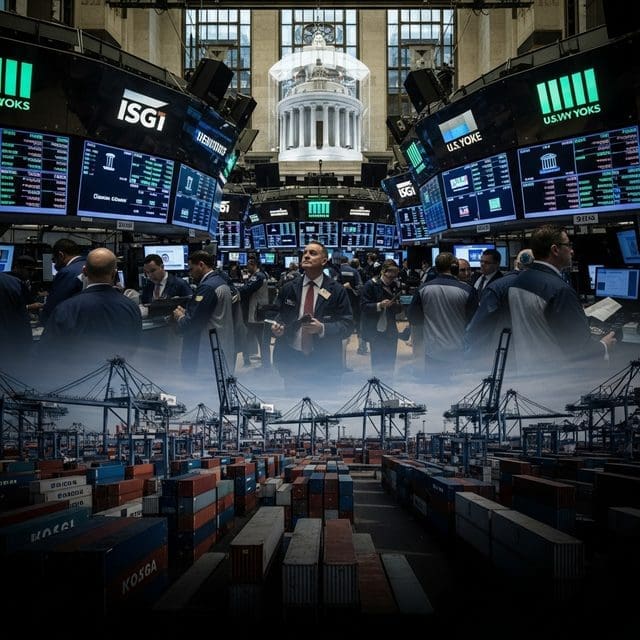
U.S. stocks closed mixed as Treasury Secretary Scott Bessent warned of a mid-summer debt ceiling expiration while preparing for high-stakes tariff negotiations with China.
Wall Street finished a volatile week with a mixed performance on May 9, 2026, as the American taxpayer faces a dual-front economic challenge: a looming debt ceiling deadline and a geopolitical standoff over trade. While the Nasdaq Composite gained 1.71% to reach 26,247, driven by a surge in semiconductor stocks following strong Micron earnings, the Dow Jones Industrial Average remained flat at 49,609. The S&P 500 managed a gain of 0.84%, closing at 7,398.
Treasury Secretary Scott Bessent injected a dose of fiscal reality into the market, warning lawmakers that the federal government’s extraordinary measures to remain under the $36.2 trillion debt limit could be exhausted by August. Bessent urged Congress to raise or suspend the limit by mid-July to avoid a catastrophic default. This warning comes as the 10-year Treasury yield rose to 4.41%, reflecting investor anxiety over persistent inflation and the government’s mounting fiscal obligations.
The focus now shifts to Switzerland, where Bessent is scheduled to meet Chinese Vice Premier He Lifeng. The discussions center on de-escalating a trade war that has seen U.S. tariffs on Chinese goods reach 145%, with retaliatory Chinese rates at 125%. For working households, these negotiations are critical; high tariffs often act as a hidden tax, driving up the cost of consumer goods and complicating the Federal Reserve’s efforts to bring inflation down to its 2% target.
Energy markets remain a significant headwind for the domestic economy. Oil futures rose following military exchanges between the U.S. and Iran in the Strait of Hormuz. Despite the broader economic expansion, analysts warn that retail gas prices are likely to remain elevated through the midterm elections, even if a peace deal is reached. The ‘NACHO’ trade—a strategy where Wall Street players bet on higher oil and persistent inflation—suggests that institutional investors are positioning for a prolonged period of high costs for Main Street.
In the broader market, small-cap technology stocks have significantly outperformed their large-cap peers, suggesting a shift in meritocratic investment toward emerging innovators. However, the Federal Reserve’s decision to hold interest rates steady at 5.25-5.50% continues to pressure the financial system, as the central bank balances a resilient labor market against the inflationary pressures of war and trade protectionism. The Cboe Volatility Index (VIX) remains near its long-term average, yet the underlying tension of the debt limit and global trade suggests the current market calm may be temporary.

Jordan Lee serves as the Senior Correspondent for Wall Street, Finance, and Monetary Systems at Just Right News. Based in the heart of the world’s financial capital, New York City, Lee brings a sharp, principled eye to the complex mechanisms that drive the global economy. His reporting is defined by a commitment to fiscal responsibility, the defense of the free market, and a deep-seated belief that a transparent monetary system is the bedrock of a free society.
Raised in Portland, Oregon, Lee’s perspective was forged in a city that has undergone significant cultural and economic shifts. His upbringing in the Pacific Northwest instilled in him a profound appreciation for the industriousness of small business owners and the importance of local economic stability. Watching the evolution of his hometown’s landscape sparked an early interest in how federal fiscal policy and large-scale financial trends eventually trickle down to the average citizen. This background provides him with a unique vantage point; he understands the growing disconnect between the policy-making elite and the reality of Main Street, a theme that frequently resonates throughout his work.
Now operating from his base in New York City, Lee bridges the gap between the high-stakes trading floors of Manhattan and the households of everyday Americans. He views the financial sector not merely as a collection of numbers and tickers, but as a vital engine of American prosperity that requires constant vigilance and accountability. His reporting often highlights the dangers of centralized financial control and the necessity of maintaining a system that rewards merit, risk-taking, and innovation.
As the creator and lead of the featured series, “The Invisible Economy,” Lee pulls back the curtain on the often-opaque world of monetary systems. He specializes in translating the dense jargon of central banking and international finance into actionable insights for the Just Right News audience. His work explores the “invisible” forces—such as inflationary pressures, regulatory creep, and the expansion of the administrative state—that erode the purchasing power of American families. By focusing on these systemic issues, Lee empowers readers to understand the hidden forces shaping their financial independence.
Lee’s journalistic philosophy is rooted in a steadfast commitment to traditional American values. As an Asian American professional who has navigated the competitive corridors of the financial world, he is a vocal advocate for meritocracy and the preservation of the American Dream. He believes that a stable currency and a predictable regulatory environment are essential for national sovereignty and individual liberty. His reporting frequently warns against the risks of government overreach in the private sector, arguing that the most effective solutions to economic challenges arise from competition and individual enterprise rather than bureaucratic mandates.
At Just Right News, Jordan Lee remains dedicated to providing a clear-eyed defense of the taxpayer. Whether he is analyzing market volatility or investigating the long-term implications of national debt, his mission is to provide the truth about where the money is going and what it means for the future of the country. Through his rigorous analysis and principled stance, Lee has become a trusted voice for those who value a strong, sovereign, and fiscally sound America.