

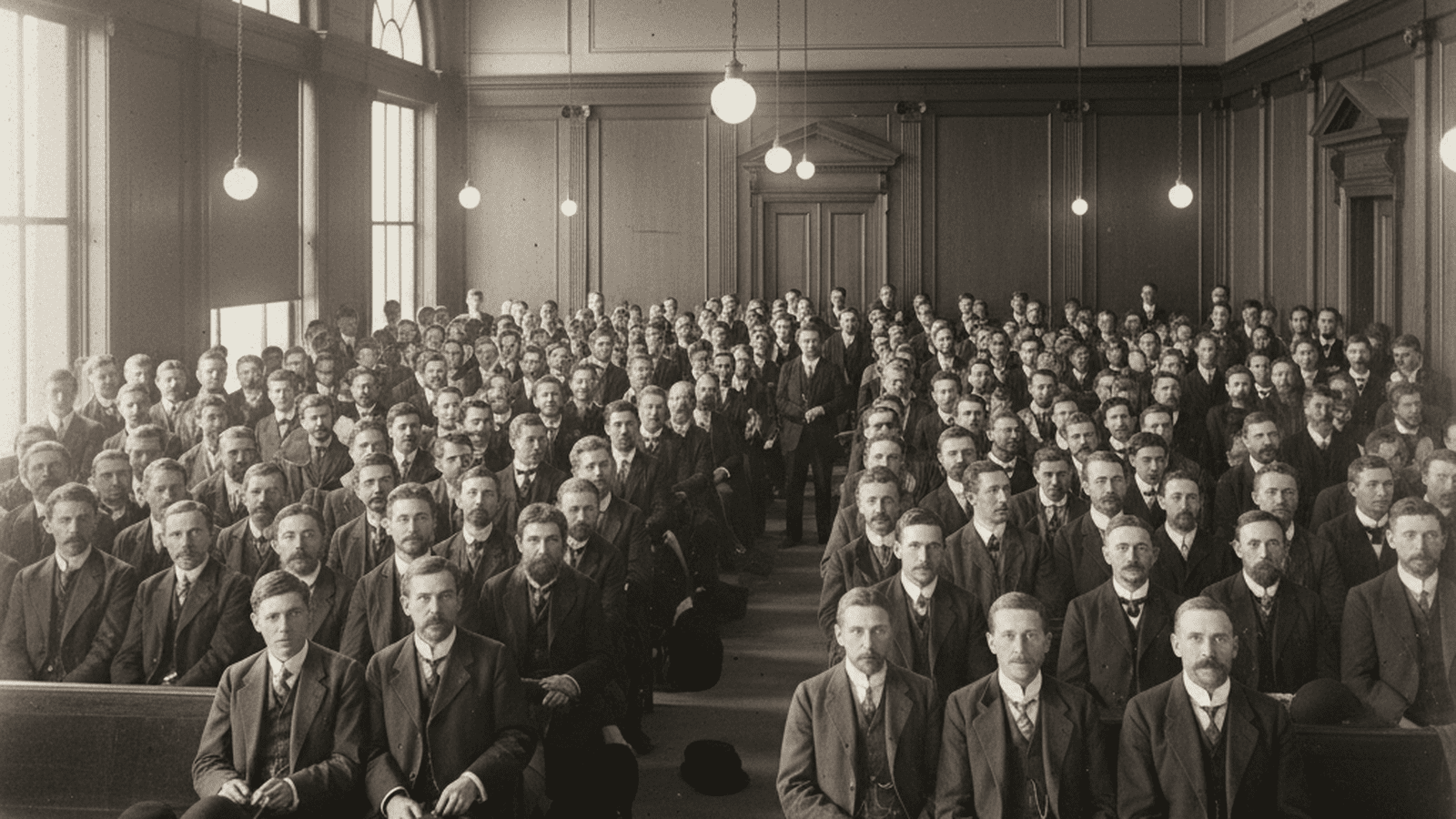
The San Francisco Graft Trials of 1906-1909 exposed a massive web of bribery involving city boss Abe Ruef and Mayor Eugene Schmitz. These proceedings in the United States transformed California politics by dismantling the machine-controlled Union Labor Party and launching the career of future Governor Hiram Johnson.
TLDR: Following the 1906 earthquake, San Francisco prosecutors launched a massive anti-corruption campaign against political boss Abe Ruef and Mayor Eugene Schmitz. Despite courtroom violence and corporate resistance, the trials broke the machine’s grip on the city and catalyzed the Progressive Era reforms that reshaped California’s state government.
In the immediate aftermath of the 1906 earthquake and fire, San Francisco faced a crisis of governance that rivaled its physical destruction. While the city lay in ruins, a shadow government led by political boss Abraham Ruef, known as the “Gray Wolf,” continued to extract bribes from public utility corporations. Ruef, a brilliant attorney, controlled the Union Labor Party and, by extension, Mayor Eugene Schmitz and the entire Board of Supervisors. This systemic corruption eventually triggered one of the most sensational legal battles in United States history, known as the San Francisco Graft Trials.
The political machine Ruef constructed was unique. Unlike the traditional ethnic machines of the East Coast, Ruef’s power was built on the burgeoning labor movement. He handpicked Eugene Schmitz, a handsome musician and union leader, to serve as the face of the administration while Ruef pulled the strings from behind the scenes. Following the earthquake, the need for reconstruction permits and utility franchises created a goldmine for the machine. Ruef began soliciting “attorney fees” from major corporations in exchange for city contracts, effectively selling the rebuilding of San Francisco to the highest bidder.
The investigation into this web of deceit began when sugar magnate Rudolph Spreckels and editor Fremont Older of the San Francisco Bulletin secured federal assistance to purge the city of machine politics. They recruited Francis J. Heney, a federal prosecutor who had recently handled land fraud cases in Oregon, and William J. Burns, a renowned detective who would later lead the Bureau of Investigation. The team uncovered evidence that Ruef had accepted massive payments from companies like Pacific Gas and Electric, the Home Telephone Company, and United Railroads. The latter, led by Patrick Calhoun, was particularly egregious, paying Ruef $200,000 to secure a franchise for overhead trolley wires despite public opposition.
By 1907, the prosecution had secured indictments against Ruef, Schmitz, and several prominent corporate executives. However, the trials were marked by extreme tension and physical danger. The city’s business elite, many of whom were implicated in the bribery, turned against the prosecution, labeling them as radicals who were damaging the city’s economic recovery. The atmosphere reached a breaking point in November 1908, when a disgruntled former juror named Morris Haas shot Francis Heney in open court. The bullet entered Heney’s cheek and lodged in his neck, nearly killing the lead prosecutor in front of a stunned audience.
While Heney recovered, a young assistant prosecutor named Hiram Johnson took over the case. Johnson’s fiery rhetoric and refusal to be intimidated by the city’s industrial elite turned the proceedings into a moral crusade for the Progressive movement. He famously declared that the fight was not just against a corrupt boss, but against the “system” that allowed corporations to buy the government. The public, initially divided by the corporate-backed media, began to swing in favor of the reformers as the depth of the bribery became undeniable.
Abe Ruef was eventually convicted of bribery and sentenced to fourteen years in San Quentin State Prison. Mayor Schmitz was also convicted, though his verdict was later overturned on a technicality. Despite the mixed legal results for the corporate defendants—most of whom escaped punishment—the political impact was absolute. The machine that had dominated San Francisco for years was dismantled, and the Union Labor Party’s influence collapsed. Hiram Johnson used his newfound prominence to run for Governor of California in 1910, ushering in a decade of Progressive reforms, including the adoption of the initiative, referendum, and recall, which fundamentally altered the democratic structure of the American West.

Dylan Brooks serves as the Senior Correspondent for Statehouses and Local Governance at Just Right News, where he brings a principled, constitutionalist lens to the often-overlooked machinery of state-level politics. As the lead voice behind the acclaimed feature series “Fifty Laboratories of Power,” Dylan has dedicated his career to the idea that the most impactful governance happens closest to home. His reporting consistently champions the Tenth Amendment, exploring how individual states can serve as testing grounds for innovative, conservative policy solutions that prioritize personal liberty and fiscal responsibility.
A native of Des Moines, Iowa, Dylan’s journalistic philosophy was forged in the heart of the American Midwest. Growing up in a community where local school board meetings and town halls were the bedrock of civic life, he developed a deep appreciation for the “retail politics” of the heartland. This upbringing instilled in him a fundamental belief that the American experiment is best preserved when power is decentralized. He carries the values of his Iowa roots into every assignment, maintaining a healthy skepticism of federal overreach and a steadfast commitment to the concerns of everyday citizens over the interests of the administrative state.
Now based in Madison, Wisconsin, Dylan operates from one of the nation’s most pivotal political battlegrounds. His location in a state capital known for its rigorous policy debates allows him to provide Just Right News readers with a front-row seat to the legislative process. From Madison, he tracks the ripple effects of statehouse decisions on local municipalities, ensuring that the connection between high-level policy and community impact is never lost. His work often highlights the success of conservative governors and legislatures in fostering economic growth, protecting parental rights, and securing the integrity of local institutions.
As an African American man in the conservative media landscape, Dylan offers a vital perspective on how limited government and free-market principles empower individuals and families. He frequently reports on how deregulation and school choice initiatives provide new avenues for success in underserved communities, challenging the monolithic narratives often presented by legacy media outlets. Dylan’s work is characterized by a commitment to the facts and a refusal to shy away from the complex realities of modern governance.
Throughout his tenure at Just Right News, Dylan has become a trusted authority for readers who value a rigorous, principled approach to the news. Whether he is dissecting a complex state budget or profiling a local grassroots movement, his goal remains the same: to provide the American public with the information they need to hold their local leaders accountable. By focusing on the “Fifty Laboratories of Power,” Dylan Brooks ensures that the vital work being done in statehouses across the country receives the national attention it deserves, always through a lens that respects the traditions and sovereignty of the American people.