

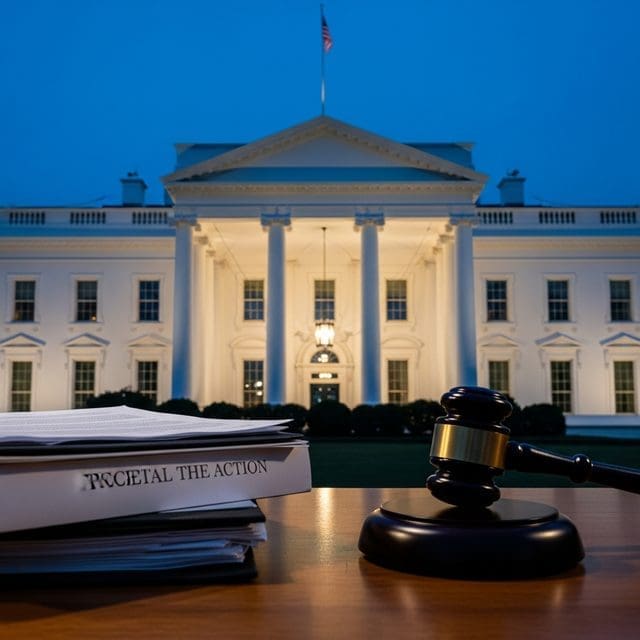
The Trump administration is navigating a critical week marked by War Powers justifications, AI security restrictions, and a push for party-line budget reconciliation.
The White House entered May by asserting broad executive authority across foreign policy, national security, and federal budgeting. On May 1, President Trump submitted a formal letter to Congress justifying the continuation of military operations against Iran without seeking new legislative authorization. The notification arrived as the conflict hit the 60-day threshold established by the War Powers Act, a statutory limit designed to ensure congressional oversight of prolonged military engagements. By arguing that current operations fall under existing authorities, the administration is signaling a preference for executive discretion over the traditional consultative process with the legislative branch.
This move toward consolidated control extends to the administration’s domestic fiscal strategy. The President is currently urging Republican lawmakers to maintain total unity on a budget reconciliation package. By utilizing reconciliation, the administration intends to secure funding for immigration agencies through a simple majority vote, bypassing the 60-vote filibuster threshold in the Senate. This strategy reflects a pragmatic shift to ensure the administrative state’s enforcement priorities are met despite a narrow congressional majority and a shifting political landscape in swing states like Nevada, where recent polling indicates working-class Latino voters are increasingly skeptical of both parties’ economic and immigration platforms.
In the technology sector, the administration has taken a restrictive stance on artificial intelligence, citing national security concerns. The White House recently distributed a series of inquiries to cybersecurity firms regarding Anthropic’s advanced AI model, Mythos. While Anthropic sought to expand access to its Project Glasswing to approximately 120 firms, the administration has opposed the move. Citing potential cybersecurity threats and limits on domestic compute capacity, officials are effectively slowing the rollout of private-sector AI tools to maintain federal oversight of high-level algorithmic capabilities.
Personnel shifts within the General Services Administration (GSA) further illustrate the changing internal dynamics of the second term. A former top procurement official, who had previously exerted significant influence over foreign policy, has been demoted following a loss of favor with senior advisers. This official’s portfolio has been restricted to Gaza-related matters through the Board of Peace, marking a contraction of influence for those outside the President’s immediate circle of trusted aides.
These maneuvers occur against a backdrop of declining public trust. A Pew Research Center survey released May 2 found that 56 percent of U.S. adults believe ethics and honesty in the federal government have declined since the start of the current term. As the administration pushes for DHS funding and the construction of a new White House ballroom—framed by Press Secretary Karoline Leavitt as a security necessity following a recent shooting—the reliance on primary executive powers and reconciliation suggests a White House prepared to bypass traditional bipartisan consensus to achieve its stated objectives.

Ben Taylor serves as the Senior Correspondent and Investigations Lead for Just Right News, where he anchors the network’s commitment to government transparency and institutional accountability. With a career defined by a relentless pursuit of the facts, Taylor spearheads the acclaimed feature series “The Paper Trail,” a deep-dive investigative column that prioritizes primary source documentation over political rhetoric. Based in the heart of the nation’s capital, he has earned a reputation as one of the most formidable investigative journalists in Washington, D.C., known specifically for his mastery of public records and the Freedom of Information Act.
Taylor’s approach to journalism is deeply rooted in his upbringing in Kansas City, Missouri. Growing up in the “Show Me State,” he developed a healthy skepticism of centralized power and a profound respect for the common-sense values of the American heartland. This Midwestern foundation informs his reporting today, as he bridges the gap between the complex machinations of federal bureaucracy and the everyday concerns of citizens across the country. For Taylor, investigative reporting is not about chasing headlines; it is about ensuring that the government remains answerable to the people it serves.
As an African American man working within the conservative media landscape, Taylor brings a principled perspective to his beat. He views the Constitution and the right to information as the ultimate equalizers in a free society. His work often highlights how bureaucratic overreach and lack of transparency disproportionately affect individual liberties. By focusing on the “paper trail,” Taylor strips away the spin of partisan talking points, instead providing Just Right News readers with the raw data and internal communications that reveal how their tax dollars are spent and how policy decisions are actually made.
In his role as Investigations Lead, Taylor oversees a team dedicated to uncovering the stories that mainstream outlets often overlook. Whether he is auditing federal spending, investigating regulatory overreach, or exposing inefficiencies within the administrative state, his methodology remains consistent: follow the evidence wherever it leads. His presence in Washington, D.C., allows him to maintain a constant watch over the halls of power, yet he remains steadfastly connected to his roots, ensuring his reporting reflects the clarity and directness of his Missouri home.
Throughout his tenure at Just Right News, Taylor has become a vital voice for those who demand integrity in public office. He believes that a well-informed electorate is the strongest defense against government overreach, and he has dedicated his career to providing the public with the tools they need to hold their leaders accountable. Through “The Paper Trail” and his broader investigative work, Ben Taylor continues to set the standard for rigorous, document-driven journalism that champions the values of transparency, individual responsibility, and the rule of law.