

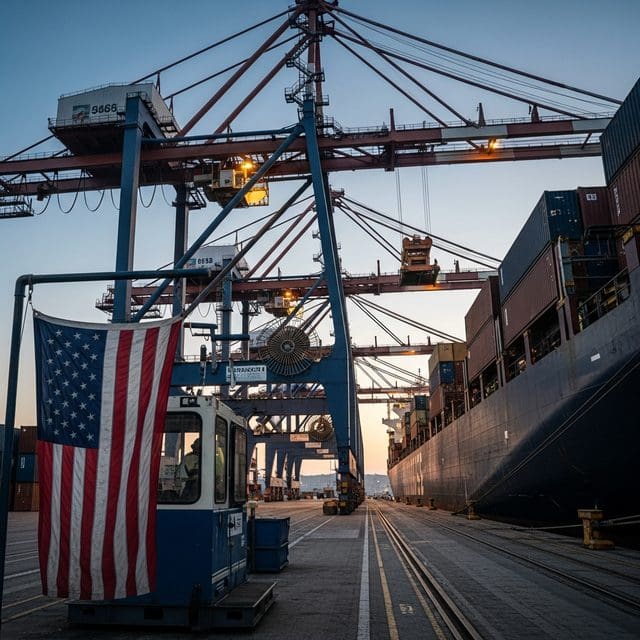
President Trump announced a 60% tariff on Chinese imports and a 25% hike on European vehicles, signaling a massive shift toward domestic manufacturing and national sovereignty.
The landscape of global trade is shifting beneath the feet of the American consumer as the White House moves to insulate the domestic economy from foreign volatility. President Trump has announced a sweeping 60% tariff on all Chinese imports, effective June 1, 2026. This decisive action follows the collapse of high-level trade talks and Beijing’s recent order for its firms to ignore U.S. sanctions on Iranian oil. By invoking a blocking law to protect its ‘teapot’ refineries, China has directly challenged the American naval blockade, which the President recently characterized to Congress as a necessary measure for national security.
The geopolitical friction is already manifesting at the gas pump and on the factory floor. Regular unleaded gasoline reached $4.42 per gallon this week, a 50% increase since the onset of hostilities with Iran. Despite these inflationary headwinds, the American blue-collar workforce is showing remarkable resilience. U.S. manufacturing grew for the fourth consecutive month in April, marking the longest streak of expansion in four years. This growth suggests that the push to bring supply chains back to the mainland is gaining traction, even as globalist efficiency takes a backseat to national stability.
Europe is also feeling the weight of the administration’s ‘America First’ trade policy. The tariff on European cars and trucks is set to jump from 15% to 25%, a move that analysts suggest could cost the German economy $18 billion in industrial output. The administration cited non-compliance with existing U.S.-EU trade agreements as the catalyst for the hike. For the American worker, this represents a leveling of the playing field against subsidized foreign imports that have long undercut domestic production.
The complexity of modern manufacturing is highlighted by the semiconductor industry, where even high-tech components rely on traditional craftsmanship. Japanese firm Toto continues to supply electrostatic chucks essential for memory-chip production, a reminder that while the U.S. seeks independence, the journey of a single product often spans several borders. However, with Big Tech firms like Amazon and Microsoft depleting cash reserves to spend $700 billion on AI infrastructure, the demand for domestic hardware has never been higher.
As the U.S. sanctions the Qingdao Haiye terminal and various shipping firms involved in the Iranian oil trade, the message from Washington is clear: the era of turning a blind eye to the geopolitical cost of cheap imports is over. While the transition away from globalist dependency may be fraught with rising costs—evidenced by the recent collapse of Spirit Airlines—the long-term goal remains a sovereign economy where the dignity of the individual worker is prioritized over the profit margins of multinational corporations.
This commitment to sovereignty extends beyond the docks. As the U.S. and Iran continue exchanging draft framework agreements to end the war, the President has made it clear that military action remains an option if Tehran ‘misbehaves.’ For the American manufacturer, this means operating in a world where the security of the supply chain is just as important as the quality of the product. The journey of things is no longer just about the shortest path from A to B; it is about ensuring that the goods on our shelves do not come at the expense of our national interest.

Sean Bradley serves as the Senior Correspondent for Trade, Supply Chains, and Global Labor at Just Right News, where he brings a principled, clear-eyed perspective to the complex systems that power the modern world. With a focus on the economic forces that impact the American household, Bradley has distinguished himself as a leading voice in explaining how global shifts in manufacturing and logistics translate to the kitchen table.
Growing up in Long Beach, California, Bradley’s interest in the movement of goods was forged against the backdrop of one of the nation’s most vital maritime gateways. Raised in a community where the towering cranes of the port were a constant fixture on the horizon, he developed an early appreciation for the blue-collar industries that form the backbone of the American economy. This upbringing instilled in him a profound respect for the dockworkers, truckers, and laborers who keep the country moving, a sentiment that remains a cornerstone of his reporting today. For Bradley, trade is not merely a series of abstract figures on a spreadsheet; it is a human endeavor that sustains families and defines the strength of a nation.
Now based in Seattle, Washington, Bradley occupies a strategic vantage point in another of the country’s most significant trade hubs. His location allows him to witness firsthand the intersection of traditional industry and the evolving technological landscape of global logistics. From the Pacific Northwest, he monitors the flow of goods across the ocean, providing Just Right News readers with timely insights into how international tensions, regulatory hurdles, and labor disputes affect the availability and cost of essential goods.
His signature feature series, “The Journey of Things,” has become a staple for readers seeking to understand the intricate path products take from raw materials to the retail shelf. Through this series, Bradley pulls back the curtain on the global marketplace, often highlighting the risks of over-reliance on foreign adversaries and the importance of domestic manufacturing resilience. His reporting consistently emphasizes the conservative values of national sovereignty, free-market competition, and the protection of the American worker from unfair global practices.
As a journalist of Irish heritage, Bradley maintains a deep-seated respect for the dignity of the individual worker and the importance of community stability. He approaches his beat with a commitment to transparency, often questioning the status quo of globalist policies that prioritize corporate efficiency over local prosperity. Whether he is reporting from a warehouse floor or analyzing a new international trade agreement, his goal remains the same: to provide the American public with the truth about where their products come from and what it costs to get them there.
Throughout his tenure at Just Right News, Bradley has remained a steadfast advocate for economic common sense. His work serves as a vital resource for those who believe that a strong nation is built on secure borders, robust trade, and a respected workforce. By combining his local roots in Long Beach with his professional experience in Seattle, Bradley continues to offer a unique and necessary perspective on the forces that shape the American way of life.