

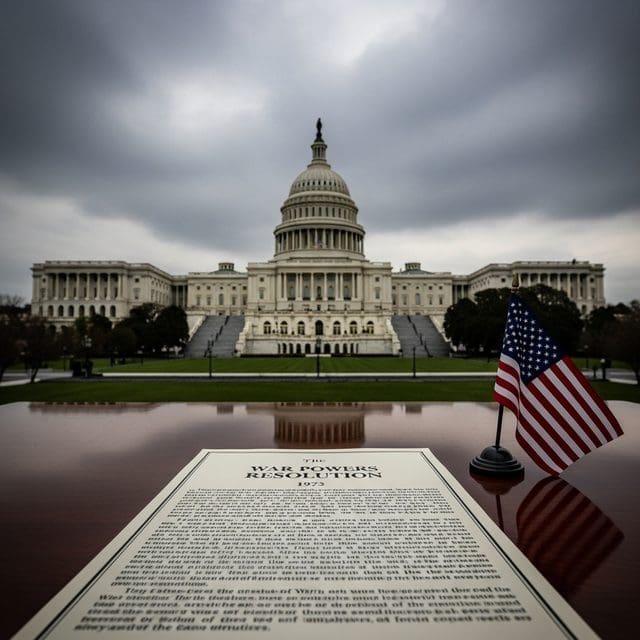
President Trump notified Congress that a ceasefire in Iran renders formal war authorization unnecessary, sparking a constitutional debate over the War Powers Resolution’s 60-day clock.
The Trump administration has formally notified Congress that it will not seek an Authorization for Use of Military Force (AUMF) for ongoing operations in Iran, asserting that a standing ceasefire has effectively terminated the hostilities that began on February 28, 2026. In letters sent to the House and Senate on Friday, the President argued that the 60-day threshold mandated by the 1973 War Powers Resolution no longer applies because active exchanges of fire have ceased.
The constitutional friction centers on the interpretation of ‘hostilities.’ Under the War Powers Resolution, a president must secure congressional approval within 60 days of initiating military action. While the administration notified Congress of the conflict on March 2, the President maintains that the April 7 ceasefire, which has since been extended, paused the statutory clock. This interpretation suggests that the executive branch can reset the legislative timer through temporary lulls in combat, even as a massive naval blockade and aerial surveillance mission remain in place.
Speaking to reporters before departing for Florida, the President dismissed the necessity of the 1973 law, labeling it ‘unconstitutional’ and noting that previous administrations have frequently bypassed its requirements. He cited a precedent of executive autonomy, questioning why his administration should be the exception to decades of practice. This stance was echoed by House Speaker Mike Johnson, who stated that the United States is ‘not at war’ due to the current lack of kinetic bombing or active fire.
However, the reality on the ground remains complex. The United States continues to enforce a naval blockade of Iranian ports using two carrier strike groups and over 100 aircraft. This enforcement has not been entirely bloodless; a Navy destroyer recently engaged an Iranian-flagged cargo vessel attempting to breach the blockade. Furthermore, Iranian Foreign Minister Abbas Araghchi claimed on May 1 that the cost of Operation Epic Fury has reached $100 billion, a figure significantly higher than the Pentagon’s official estimates.
The administration’s legal maneuver comes as public sentiment appears to sour on the intervention. A Washington Post-ABC News-Ipsos survey released May 1 found that 61 percent of Americans believe the administration erred in launching the operation. Despite this, Defense Secretary Pete Hegseth testified before the Senate Armed Services Committee that the White House counsel views the ceasefire as a definitive stop to the 60-day clock.
By framing the current posture as a diplomatic effort to ‘broker a peace’ rather than a sustained conflict, the White House is attempting to navigate the narrow straits between executive necessity and statutory restraint. For constitutionalists, the move raises a familiar question: whether a ceasefire constitutes a legal end to hostilities or merely a tactical pause that allows the administrative state to circumvent the Article I powers of Congress to declare war.

Miles Harrington serves as the Senior Correspondent for Federal Systems & Executive Power at Just Right News, where he brings a disciplined, constitutionalist lens to the inner workings of the American government. With a focus on the mechanics of the federal bureaucracy and the limits of executive authority, Harrington has established himself as a vital voice for readers who value transparency, accountability, and the preservation of the separation of powers.
A native of Richmond, Virginia, Harrington’s perspective is deeply rooted in the traditions of the Old Dominion. Growing up in a city defined by its historical significance and its role as a center of American jurisprudence, he developed an early appreciation for the foundational principles of the Republic. His upbringing in Richmond—a place where the legacy of the Founding Fathers is woven into the landscape—instilled in him a belief that the federal government should remain within its constitutional bounds. This background informs his skepticism of centralized overreach and his commitment to reporting on the ways in which the administrative state impacts the lives of everyday citizens.
In his current role, Harrington specializes in the complexities of federal systems. He doesn’t just report on the headlines of the day; he digs into the structural shifts within the executive branch that often go unnoticed by the mainstream press. Whether he is analyzing the implications of a new federal regulation or investigating the expansion of agency jurisdiction, his work is characterized by a rigorous adherence to the facts and a dedication to the rule of law.
Harrington is perhaps best known for his signature feature series, “How Washington Works.” Through this ongoing project, he demystifies the often-opaque processes of the nation’s capital, pulling back the curtain on the “Deep State” and the unelected officials who wield significant influence over national policy. By breaking down complex legislative maneuvers and executive orders, he empowers Just Right News readers to understand the true levers of power in Washington. His reporting serves as a necessary check on the federal government, ensuring that the actions of those in power are held up to the light of public scrutiny.
Now based in Washington, D.C., Harrington operates at the epicenter of the political world, yet he remains intentionally distanced from the “Beltway bubble.” His proximity to the halls of power allows him to maintain a robust network of sources across the federal landscape, but his heart remains in the principled conservatism of his Virginia roots. He views his role not merely as a reporter, but as a steward of the public trust, dedicated to providing the clarity and context that conservative voters need to navigate an increasingly complex political environment.
Through his sharp analysis and unwavering commitment to the truth, Miles Harrington continues to be a cornerstone of the Just Right News team. His work ensures that the principles of limited government and executive restraint remain at the forefront of the national conversation, providing a crucial service to those who believe in a government that is truly of, by, and for the people.