

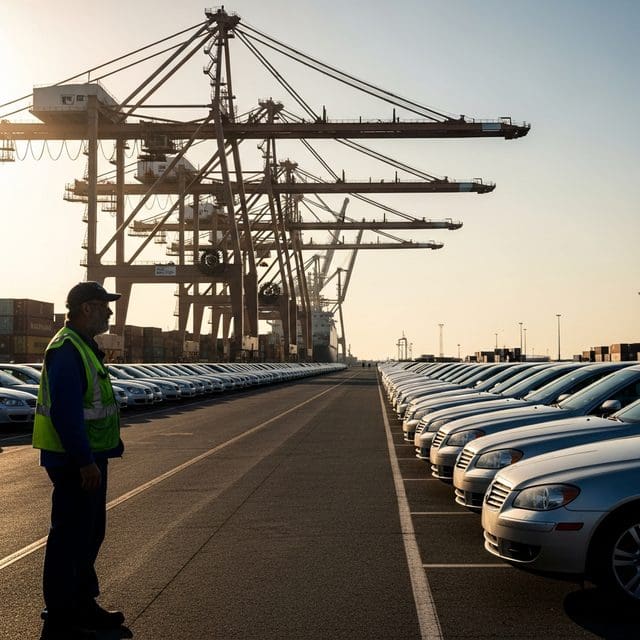
President Trump announced 25% tariffs on European vehicles while domestic labor groups launched nationwide May Day demonstrations amid a tightening jobs market and shifting trade policies.
The American labor landscape faced a dual shock this week as the administration pivoted toward aggressive trade protectionism while domestic workers took to the streets for May Day. President Trump announced a 25% tariff on European Union cars and trucks effective next week, citing a failure by European leaders to comply with previous trade agreements. This move signals a return to a hardline stance intended to protect domestic manufacturing, even as the ISM Manufacturing PMI shows employment in the sector is currently contracting.
On the domestic front, the administration signed an executive order on May 1 to expand retirement plan access for millions of workers currently lacking employer-sponsored options. This policy shift arrives at a critical juncture for the workforce; while jobless claims reached a 57-year low in late April, the broader economy is grappling with the pressures of automation. Big Tech firms have allocated an unprecedented $700 billion for AI spending in 2026, a capital-intensive shift that threatens to reshape traditional service and clerical roles.
In Los Angeles, the intersection of labor and local politics has turned litigious. The Los Angeles Police Protective League (LAPPL) has launched a series of attack ads against Councilmember Nithya Raman, highlighting her record on homelessness and police funding. This friction follows a recent $14.6 million jury award to four LAPD officers in a retaliation lawsuit involving staffing shortages. While Raman has criticized the union’s spending, the LAPPL maintains that current policies have compromised officer safety and public order.
International Workers’ Day saw significant activity across the country, most notably at MacArthur Park in Los Angeles, where over 120 organizations called for a general strike under the banner of “no work, no school, no shopping.” These protests coincide with similar demonstrations in Cuba, where workers marched despite new U.S. sanctions. The domestic activists are pushing for broader protections as the labor market prepares for the next federal jobs report, which analysts view as a vital indicator of whether the current low unemployment can be sustained.
While the administration faces legal hurdles—including a Massachusetts judge blocking a halt on immigration applications—the focus remains on the industrial core. The manufacturing sector’s growth in new orders suggests demand remains high, but rising prices and the looming auto tariffs create an uncertain environment for the blue-collar workforce. For the American worker, the promise of trade protection and retirement security is currently balanced against the volatile realities of automation and civil unrest.
The manufacturing sector’s growth in new orders suggests demand remains high, but rising prices and the looming auto tariffs create an uncertain environment for the blue-collar workforce. For the American worker, the promise of trade protection and retirement security is currently balanced against the volatile realities of automation and civil unrest. As the 25% tariffs on EU vehicles take effect, the impact on domestic supply chains will serve as a litmus test for the administration’s “America First” industrial policy.

Tom Blake serves as the Senior Correspondent for Labor, Wages, and Automation at Just Right News, where he brings a grounded, principled perspective to the most pressing economic issues facing the American heartland. As the lead voice behind the acclaimed feature series “The Price of Work,” Tom focuses his reporting on the intersection of traditional industry and the rapidly evolving technological landscape, always prioritizing the dignity of the individual worker and the health of the American family.
Tom’s deep understanding of the labor market is not merely academic; it is rooted in his upbringing in Detroit, Michigan. Growing up in the shadow of the automotive industry, he witnessed firsthand the triumphs and tribulations of the American blue-collar workforce. He saw how the stability of a manufacturing job could build a community and, conversely, how the erosion of those industries could tear the social fabric apart. This background instilled in him a lifelong respect for the trades and a healthy skepticism toward economic policies that prioritize globalist interests over the well-being of local communities.
Now based in Pittsburgh, Pennsylvania, Tom continues to report from the front lines of the shifting economy. Pittsburgh, a city that has reinvented itself while maintaining its gritty, industrious spirit, provides the perfect vantage point for his beat. From the steel mills that remain to the high-tech robotics labs reshaping the city’s future, Tom explores how automation is changing the nature of employment. His reporting often highlights the tension between innovation and tradition, arguing that while progress is inevitable, it must not come at the expense of the American worker’s ability to provide for their family through honest, meaningful labor.
In his role at Just Right News, Tom has become a vital voice for those who feel overlooked by mainstream economic coverage. He rejects the notion that the decline of American manufacturing is an unavoidable casualty of the modern era. Instead, his work often examines how regulatory overreach, rising energy costs, and the unchecked rise of automation impact the take-home pay of everyday citizens. Through “The Price of Work,” Tom delves into the true cost of economic shifts, looking beyond the raw data to tell the stories of the people behind the statistics.
Tom’s reporting is characterized by a commitment to the conservative values of self-reliance, fiscal responsibility, and the preservation of the American dream. He believes that a strong nation is built on a foundation of stable jobs and fair wages, and his work seeks to hold both government and corporate entities accountable to that standard. Whether he is interviewing a shop floor manager about the implementation of new AI technology or analyzing the impact of wage inflation on small businesses, Tom provides a clear-eyed analysis that resonates with readers who value hard work and common sense.
Through his dedicated coverage, Tom Blake remains a steadfast advocate for the American workforce, ensuring that the voices of those in the industrial heartland are heard loud and clear in the national conversation. His perspective is essential for anyone seeking to understand the complex realities of labor and automation in the twenty-first century.