

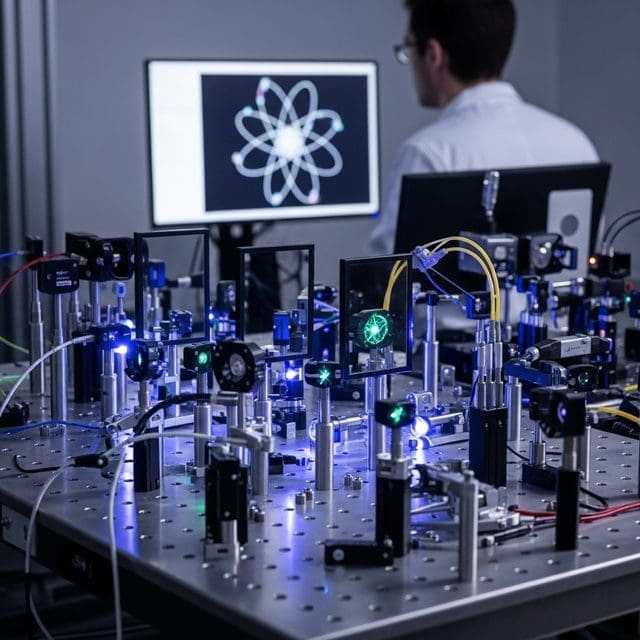
Recent discoveries in quantum mechanics offer a path toward decentralized, secure communications and American-led innovation that bypasses current technological bottlenecks and foreign supply chain dependencies.
The race for the frontier of the 21st century is no longer just about who can build the biggest rocket or the fastest silicon chip. In laboratories from Oxford to Tennessee, a quiet revolution is unfolding that promises to return the power of secure, sovereign communication to the individual. While Silicon Valley giants like Apple struggle with supply chain delays and chip shortages for their latest hardware, quantum physicists are discovering that the very fabric of reality may provide the tools we need to bypass centralized digital bottlenecks.
At the University of Oxford, researchers recently demonstrated a fourth-order “quadsqueezing” effect using a single trapped ion. This breakthrough occurred 100 times faster than theoretical models predicted, suggesting that the precision required for next-generation quantum sensing is closer than previously thought. For the American citizen, this means the potential for navigation and timing systems that do not rely on vulnerable, government-controlled GPS satellites, but on the immutable laws of physics.
Equally significant is the work coming out of the Niels Bohr Institute. Scientists there have successfully transmitted single photons—the fundamental particles of light—through the existing optical fiber networks that already crisscross our neighborhoods. Because these photons cannot be copied or split without detection, this technology offers a blueprint for a truly unhackable internet. This is a vital development for national sovereignty; it suggests we can build a secure digital infrastructure using the cables already in the ground, rather than waiting for a multi-billion-dollar federal overhaul.
In the American heartland, the University of Tennessee and Argonne National Laboratory are tackling the physical stability of these systems. Tennessee physicists identified a “flower-like” pattern of chiral superconductivity using tin atoms on silicon, a discovery that paves the way for custom quantum materials. Meanwhile, Argonne has developed a qubit platform with noise levels thousands of times lower than traditional models. By reducing the “noise” or interference that plagues quantum computers, these researchers are ensuring that the future of American computing is built on a foundation of reliability and precision rather than fragile, experimental hardware.
Even the most basic elements are being mastered. At the University of Maryland, chemical physicists found they could control the nuclear spin of molecular hydrogen simply by freezing it in dry ice. This elegant, low-tech solution to a high-tech problem reflects a quintessentially American approach to innovation: finding practical, efficient ways to achieve the impossible. Similarly, the University of East Anglia discovered that light can develop a “chiral spin” naturally in empty space without the need for complex lenses or mirrors.
These advancements come at a critical time. As the Artemis II crew prepares to break distance records in space and the New York Stock Exchange prepares to welcome them, the terrestrial battle for data security and technological independence is being won in the quantum realm. By mastering the small, we are securing the large—ensuring that the next era of innovation serves the interests of the nuclear family and the sovereign individual rather than the centralized bureaucracy.

Mason Reed serves as a Staff Writer for Just Right News, where he spearheads the Future Frontiers & Special Projects desk. In an era defined by rapid technological shifts and evolving social landscapes, Mason provides a steady, principled voice, examining the innovations of tomorrow through the lens of traditional American values. His work is most prominently featured in his signature series, “The Next Horizon,” where he explores the intersection of emerging technology, national sovereignty, and the preservation of individual liberty.
A native of San Diego, California, Mason’s worldview was shaped by the unique culture of his hometown. Growing up in a region defined by its strong military presence and its history of maritime industry, he developed a deep-seated respect for the institutions that provide national stability and the entrepreneurial spirit that drives the American economy. This upbringing instilled in him a belief that true progress is not found in discarding the past, but in building upon a foundation of proven principles. His reporting often reflects this San Diego influence, emphasizing the importance of a robust national defense and the necessity of maintaining a competitive edge in the global marketplace.
Now based in San Francisco, Mason operates from the heart of the world’s technological engine. Living and working in the Bay Area provides him with a front-row seat to the advancements—and the ideological challenges—emanating from Silicon Valley. While many in the region embrace a “move fast and break things” mentality, Mason’s reporting serves as a vital counterweight. He offers Just Right News readers a “boots on the ground” perspective, documenting how radical local policies and the concentration of tech power impact the everyday lives of citizens. His proximity to the industry allows him to cut through the marketing jargon of big tech to uncover the real-world implications for privacy, free speech, and the nuclear family.
In his “Future Frontiers” beat, Mason tackles complex subjects ranging from the ethics of artificial intelligence to the burgeoning private space race. He approaches these topics with a healthy skepticism toward centralized bureaucracy, championing instead the decentralized innovations that empower individuals. Through “The Next Horizon,” he highlights the pioneers and thinkers who are working to ensure that the future remains a place where human dignity and constitutional rights are protected. He believes that the rapid pace of change requires more than just technical expertise; it requires a moral compass rooted in the Western tradition.
Throughout his tenure at Just Right News, Mason has remained committed to the idea that the future is something to be shaped, not merely accepted. His writing is characterized by a rigorous defense of American exceptionalism and a belief that the country’s best days lie ahead, provided it remains true to its founding ideals. Whether he is investigating the impact of automation on the American workforce or profiling the next generation of aerospace engineers, Mason Reed ensures that his readers are equipped with the insights they need to navigate a changing world with confidence and clarity.