

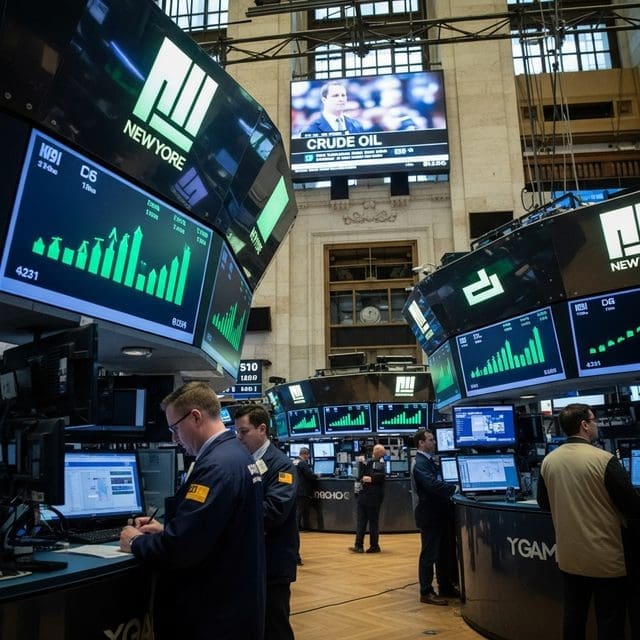
Major indices surged to record levels on May 1 as robust corporate earnings and a 57-year low in jobless claims outweighed a spike in Brent crude prices.
The American economy showcased a striking resilience on May 1, 2026, as Wall Street’s major indices climbed to record heights despite a volatile energy market. The Dow Jones Industrial Average surged 1.6% to close at 49,652.14, while the S&P 500 and Nasdaq Composite hit fresh milestones. This rally suggests that for now, the sheer momentum of private sector earnings is successfully insulating the domestic market from geopolitical shocks in the Middle East.
Working households face a complex landscape where labor market strength meets rising costs. U.S. jobless claims have hit a 57-year low, signaling a historically tight labor market that favors the American worker. However, the ISM Manufacturing PMI for April reached 52.7, revealing a dual-edged sword: while new orders and production are growing, employment within the sector is contracting and input prices are rising. This inflationary pressure was compounded by Brent crude oil hitting a four-year high of $126 per barrel due to tensions in the Strait of Hormuz, though prices moderated late in the session following news that Iran had delivered a response to a U.S.-backed peace plan.
Corporate America is currently defined by a massive pivot toward artificial intelligence, with Alphabet, Amazon, Meta, and Microsoft allocating an estimated $700 billion for AI infrastructure in 2026. This spending spree has produced mixed results for shareholders. Alphabet shares jumped 9.6% on the back of a $462 billion order backlog for Google Cloud, while Meta saw a 9.2% decline as investors balked at the scale of its $135 billion infrastructure budget. For the average investor, these figures represent a historic reallocation of capital that is beginning to deplete corporate cash reserves and increase debt levels.
In the industrial and consumer sectors, performance remained steady. 3M Company reported an earnings beat with adjusted EPS of $2.14, while The Walt Disney Company saw its shares rise 2.4%. These gains occurred alongside significant institutional shifts, including Lazard Inc.’s agreement to acquire Campbell Lutyens and the pricing of two $100 million initial public offerings by West Enclave Merger Corp. and Plutonian Acquisition Corp II.
While the equity markets celebrate, the federal government continues to intervene in the economic fabric. A new executive order signed May 1 aims to expand retirement plan access for workers without employer-sponsored options, a move intended to bolster long-term fiscal security for Main Street. Conversely, the limits of state intervention were visible as Spirit Airlines faced a potential shutdown after a government bailout failed to materialize. As the CBOE Volatility Index dropped 10.2%, the day’s activity underscores a market that is currently betting on American industrial and technological productivity to outrun the persistent threat of global energy instability.

Jordan Lee serves as the Senior Correspondent for Wall Street, Finance, and Monetary Systems at Just Right News. Based in the heart of the world’s financial capital, New York City, Lee brings a sharp, principled eye to the complex mechanisms that drive the global economy. His reporting is defined by a commitment to fiscal responsibility, the defense of the free market, and a deep-seated belief that a transparent monetary system is the bedrock of a free society.
Raised in Portland, Oregon, Lee’s perspective was forged in a city that has undergone significant cultural and economic shifts. His upbringing in the Pacific Northwest instilled in him a profound appreciation for the industriousness of small business owners and the importance of local economic stability. Watching the evolution of his hometown’s landscape sparked an early interest in how federal fiscal policy and large-scale financial trends eventually trickle down to the average citizen. This background provides him with a unique vantage point; he understands the growing disconnect between the policy-making elite and the reality of Main Street, a theme that frequently resonates throughout his work.
Now operating from his base in New York City, Lee bridges the gap between the high-stakes trading floors of Manhattan and the households of everyday Americans. He views the financial sector not merely as a collection of numbers and tickers, but as a vital engine of American prosperity that requires constant vigilance and accountability. His reporting often highlights the dangers of centralized financial control and the necessity of maintaining a system that rewards merit, risk-taking, and innovation.
As the creator and lead of the featured series, “The Invisible Economy,” Lee pulls back the curtain on the often-opaque world of monetary systems. He specializes in translating the dense jargon of central banking and international finance into actionable insights for the Just Right News audience. His work explores the “invisible” forces—such as inflationary pressures, regulatory creep, and the expansion of the administrative state—that erode the purchasing power of American families. By focusing on these systemic issues, Lee empowers readers to understand the hidden forces shaping their financial independence.
Lee’s journalistic philosophy is rooted in a steadfast commitment to traditional American values. As an Asian American professional who has navigated the competitive corridors of the financial world, he is a vocal advocate for meritocracy and the preservation of the American Dream. He believes that a stable currency and a predictable regulatory environment are essential for national sovereignty and individual liberty. His reporting frequently warns against the risks of government overreach in the private sector, arguing that the most effective solutions to economic challenges arise from competition and individual enterprise rather than bureaucratic mandates.
At Just Right News, Jordan Lee remains dedicated to providing a clear-eyed defense of the taxpayer. Whether he is analyzing market volatility or investigating the long-term implications of national debt, his mission is to provide the truth about where the money is going and what it means for the future of the country. Through his rigorous analysis and principled stance, Lee has become a trusted voice for those who value a strong, sovereign, and fiscally sound America.