

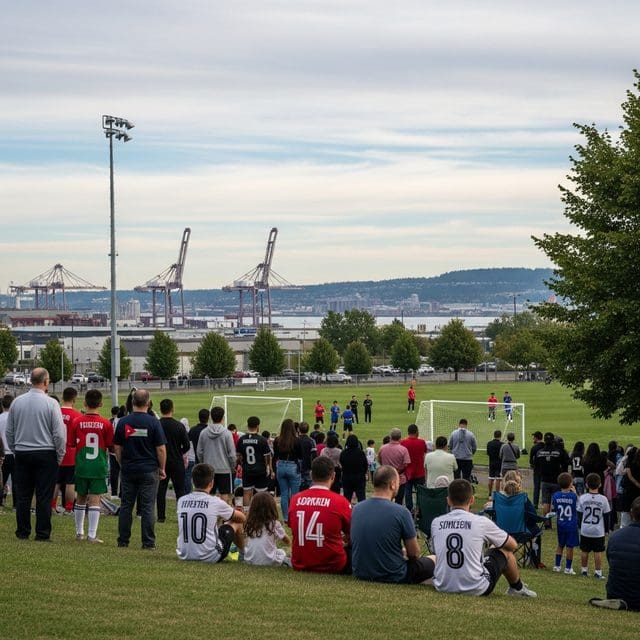
The arrival of Jordan’s national soccer team in Portland offers a moment of cultural unity for a community navigating local housing shifts and international economic volatility.
On a Saturday afternoon at The Bluff in North Portland, the air carried the familiar scent of the Willamette River and the rhythmic, soulful chants of a crowd gathered for a historic homecoming. For the local Jordanian-American community, the arrival of their national soccer team for its first-ever World Cup training session was more than a sporting event; it was a physical anchor in a city defined by flux. As players moved across the pitch, preparing for high-stakes games against Austria and Argentina, they carried a sense of national pride that transcends the class and regional divides of home.
Portland is a city in the midst of a deliberate transformation. While global headlines focus on the massive $75 billion SpaceX IPO or the fluctuating price of oil following the reopening of the Strait of Hormuz, residents of Southeast and North Portland navigate more intimate economic pressures. The City Council is currently fast-tracking the Affordable Housing Opportunities Project, a response to a displacement crisis that has pushed long-term families toward the margins. By August 2026, the city expects to finalize a social housing model, a desperate attempt to catch up with a market that has left many behind.
For many in the crowd, the struggle for space is a daily reality. The city’s move toward rezoning the Inner Eastside for multifamily units by June 2027 is intended to keep the working class from being priced out, yet the transition often feels like a loss of the very neighborhood character that drew people there. In this context, the Jordanian team’s presence served as a reminder of the resilience of immigrant communities who have built lives in the gaps between policy shifts. These families are the human face of aggregate data; they are the ones moving into small towns and urban fringes at the fastest rate in nearly a century, seeking the stability that centralized authority often promises but rarely delivers.
Across the northern border, Prime Minister Mark Carney’s government is taking a different approach to similar pressures, tightening immigration to a projected zero-percent population growth for 2026. While Canada pivots toward a “Buy Canadian” procurement strategy and a National Food Security Strategy to protect its smaller manufacturing centers, Portland continues to lean into its role as a global crossroads. This contrast highlights a broader North American tension: the struggle to balance the need for new growth with the preservation of local institutions and the self-reliant spirit of established residents.
On the field, the Jordanian players represented a national pride that cuts across the noise of modern geopolitics. For the families watching from the sidelines, many of whom work in the small businesses and service sectors that form the backbone of the local economy, the team’s success is a rare constant. Even as the AI boom drives companies to treat electricity as a scarce commodity and the Director of National Intelligence transition signals new shifts in federal oversight, the focus here remained on the immediate and the tangible.
As the training session ended, the conversation among spectators drifted from the upcoming tournament to the changing face of the city. New community resilience hubs, like the 73Foster project, are beginning to rise on the sites of older commercial lots, offering a glimpse of a more stable future for low-income families. For one afternoon, however, the focus remained on the grass of The Bluff. In the shadow of a changing economy, the global game provided a temporary sense of belonging, proving that even in an era of massive institutional shifts, the most meaningful stories are still told at a human scale.

Ethan Blake serves as a Senior Correspondent for Just Right News, where he specializes in Longform Narrative and Public Understanding. In an era of rapid-fire headlines and fleeting soundbites, Ethan’s work stands as a testament to the power of deep-dive reporting and the importance of contextualizing the complex issues facing the nation today. His approach is rooted in the belief that the most profound truths are often found in the lived experiences of individuals rather than the abstract theories of distant policymakers.
Growing up in Providence, Rhode Island, Ethan developed an early appreciation for the historical and cultural threads that weave the American fabric together. Providence, a city defined by its industrial heritage and its blend of traditional neighborhoods, provided him with a front-row seat to the challenges and triumphs of the American working class. This upbringing instilled in him a respect for the “common sense” values of hard work, community loyalty, and the preservation of local institutions. He learned early on that behind every economic statistic or legislative debate, there are real families and neighborhoods navigating the consequences of change.
This foundational perspective is the driving force behind his signature feature series, “Lives Behind the Systems.” Through this series, Ethan explores the intersection of individual agency and institutional structure. Whether he is documenting the impact of federal land-use policies on rural families or examining how shifting educational standards affect local school boards, Ethan’s work prioritizes the human element. He seeks to uncover how large-scale systems—be they governmental, economic, or social—affect the daily lives of citizens, often advocating for a return to local control and personal responsibility.
Now based in Portland, Maine, Ethan draws significant inspiration from the rugged independence and self-reliance that define the region. The coastal landscape and the resilient spirit of Maine’s communities serve as a constant reminder of the importance of individual liberty and the strength found in decentralized power. Living and working outside the traditional media hubs allows Ethan to maintain a grounded perspective, ensuring his reporting remains untethered from the echo chambers of the major metropolitan centers. This geographic distance provides him with the clarity needed to translate complex national narratives into stories that resonate with the heart of the country.
At Just Right News, Ethan’s beat is more than just a professional assignment; it is a mission to foster a more informed and engaged citizenry. He believes that a free society depends on the public’s ability to understand the mechanisms of power and the value of traditional American principles. His longform narratives do not merely report the news; they provide a roadmap for understanding the cultural and political shifts of the modern era through a lens of skepticism toward centralized authority and a deep respect for the individual.
Through his meticulous research and narrative craftsmanship, Ethan Blake continues to bridge the gap between policy and the public. His work remains a vital resource for those who seek a deeper understanding of the systems that shape our world and the enduring spirit of the people who live within them.