

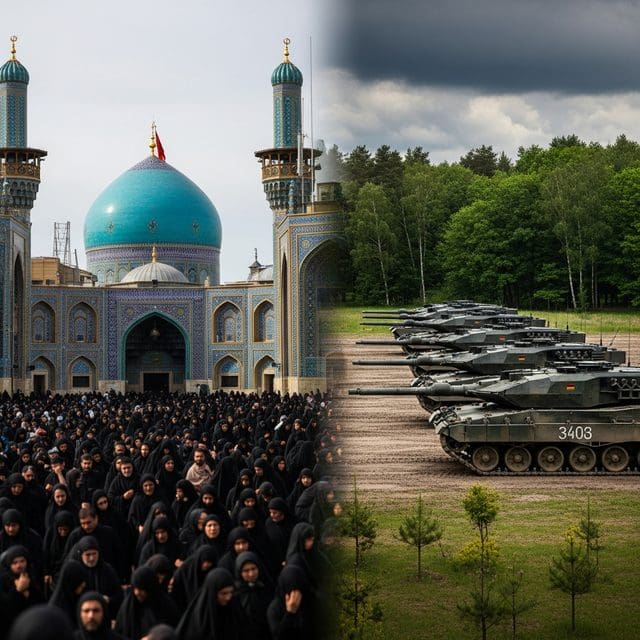
Tehran schedules the late Supreme Leader’s funeral for July 9 amid reports of a tentative U.S.-Iran peace deal and expanding Israeli military operations in southern Lebanon.
The geopolitical landscape of the Middle East is entering a transformative phase as Iran finally formalizes the transition of power following the death of Ayatollah Ali Khamenei. Iranian state media confirmed Saturday that the late Supreme Leader, who was killed in February, will be buried on July 9 in the holy city of Mashhad. The announcement follows a period of significant domestic and regional instability, with elaborate funeral ceremonies planned for Tehran and Qom to precede the final interment. This scheduled burial date serves as a critical marker for the Islamic Republic, which has navigated a vacuum of leadership and unsettled succession dynamics for months.
While Tehran prepares for a massive public display of mourning expected to draw upwards of 20 million people, diplomatic channels are buzzing with reports of a potential breakthrough. Pakistani Prime Minister Shehbaz Sharif and various international mediators have suggested that a U.S.-Iran peace deal may be closer than previously anticipated. Some regional reports even suggest a signing could occur within a 24-hour window. However, realist observers in Washington and the Pentagon remain cautious, noting that any such agreement is likely to be a limited, interim understanding focused on de-escalation rather than a comprehensive settlement of the long-standing grievances between the Western tradition and the Iranian regime.
On the ground, the friction between Israeli security imperatives and Iranian-backed proxies continues to sharpen, regardless of the diplomatic overtures in Islamabad or Doha. The Israeli Defense Forces issued broad evacuation warnings on June 13 covering more than 20 locations in southern Lebanon, including the strategic city of Nabatieh. These warnings precede an expected intensification of air strikes aimed at degrading Hezbollah’s operational infrastructure. This follows a June 9 operation in the city of Tyre that resulted in at least eight fatalities, highlighting the persistent kinetic reality that complicates any high-level diplomatic maneuvering.
Lebanese authorities have documented the sheer scale of this attrition, reporting that Israel has carried out 3,491 air strikes, 407 controlled demolitions, and six razing operations since April 17. This data underscores the difficulty of maintaining a ceasefire framework when the underlying security concerns of sovereign states remain unaddressed. For the United States, the challenge lies in balancing the pursuit of a regional reset with the necessity of supporting its primary democratic ally in the Levant against a backdrop of Iranian-funded destabilization.
Further north, the NATO alliance continues its strategic pivot toward the eastern flank to ensure that European volatility does not invite further aggression. The German Bundeswehr is currently refining its permanent deployment in Lithuania. Recent assessments of the brigade indicate a force that is best-in-class in terms of equipment but still requires rigorous exercises to achieve full “war-readiness.” This reinforcement, alongside joint Germany-Netherlands command arrangements for Estonia and Latvia, serves as a tangible deterrent against Russian revisionism. It ensures that while the Middle East remains in flux, the Western alliance maintains a credible posture of peace through strength.
As the world watches the funeral processions in Iran next month, the true measure of regional stability will not be found in the rhetoric of the mourners in Mashhad, but in the ability of global powers to secure their interests through a combination of firm defense and pragmatic diplomacy. The stakes for American power remain high, as the vacuum left by Khamenei’s departure and the ongoing volatility in Lebanon test the limits of the current international order. Whether the reported peace deal manifests or remains a diplomatic mirage, the realignment of the Middle East is well underway, necessitating a clear-eyed American strategy that prioritizes national sovereignty and regional balance.

Olivia Kendall serves as the Senior Correspondent for Geopolitics, Defense, and Foreign Policy at Just Right News, where she provides a principled, conservative perspective on the complex forces shaping the global stage. With a career dedicated to deconstructing the intricacies of international relations, Kendall has become a trusted voice for readers who value national sovereignty, a robust military, and a foreign policy that prioritizes American interests above all else.
A native of Washington, D.C., Kendall’s professional journey is deeply rooted in her upbringing within the nation’s capital. Growing up in the epicenter of American political life, she developed an early and profound understanding of how policy is crafted and, more importantly, how it often fails to account for the values of the American heartland. This unique vantage point allowed her to witness firsthand the rise of globalist bureaucracies, fueling her commitment to reporting that champions the constitutional foundations of the United States. Her background as a British White American further informs her worldview, providing her with a keen appreciation for the Western tradition and the enduring importance of the “Special Relationship” in maintaining global stability.
Now based in Arlington, Virginia, Kendall operates from the doorstep of the Pentagon and the heart of the nation’s defense establishment. Her proximity to the decision-makers in the military and intelligence communities allows her to provide boots-on-the-ground reporting that is both timely and deeply informed. For Kendall, Arlington is more than just a base of operations; it is a daily reminder of the sacrifices made by the men and women in uniform. This connection to the defense community drives her rigorous coverage of military readiness and her advocacy for a “peace through strength” approach to diplomacy.
At Just Right News, Kendall is perhaps best known for her acclaimed feature series, “The World’s Shadow on America.” In this ongoing project, she explores the direct correlation between international developments and the daily lives of American citizens. Whether she is analyzing the encroachment of foreign adversaries in domestic supply chains or the impact of international treaties on local economies, Kendall’s work serves as a vital bridge between distant geopolitical shifts and their consequences at home. She rejects the notion that foreign policy is an abstract concern for elites, instead proving that what happens in the corridors of power in Brussels or Beijing has a tangible “shadow” that falls across every American doorstep.
Throughout her tenure, Kendall has remained a steadfast critic of international overreach and a vocal proponent of a clear-eyed, realistic foreign policy. She brings a sharp analytical mind to her beat, often challenging the prevailing narratives of the mainstream media to uncover the underlying truths that affect national security. Her reporting is characterized by a refusal to compromise on the truth and a dedication to the idea that a strong, secure America is the world’s best hope for liberty. As a Senior Correspondent, Olivia Kendall continues to lead the charge in providing the essential context and conservative insight necessary to navigate an increasingly volatile world.