

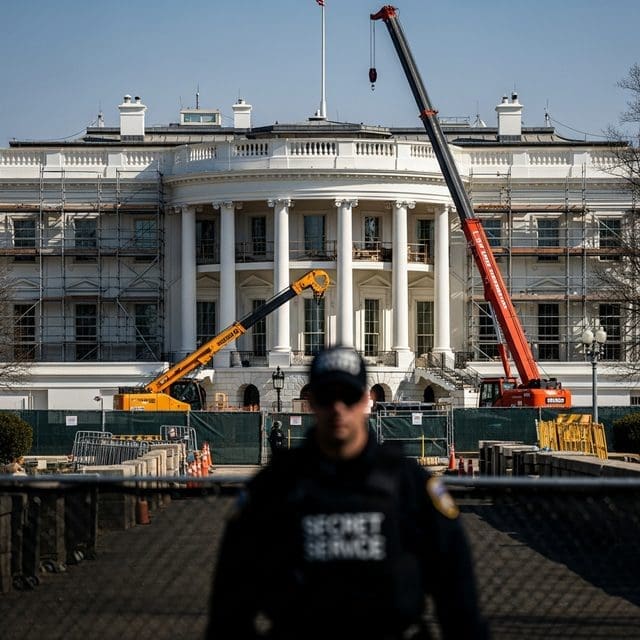
Following a security breach at the White House Correspondents’ Association dinner, Senate Republicans are divided over whether to use $400 million in public funds or private donations to construct a secure on-site ballroom.
The debate over executive infrastructure reached a fever pitch this week as Senate Republicans split over the funding mechanism for a proposed 90,000-square-foot White House ballroom. The legislative push follows the April 26 assassination attempt on President Trump at the Washington Hilton, an event that has transformed a long-standing architectural dispute into a matter of urgent national security.
Senators Lindsey Graham, Katie Britt, and Eric Schmitt introduced a bill on Monday to authorize $400 million for the project. The proposal includes a massive above-ground event space and a subterranean complex for the Secret Service and military operations. While Graham argued that the facility is essential to protect the line of succession from “off-campus” risks, the bill’s reliance on $332 million in taxpayer funds—partially offset by customs and park fees—has met resistance from within his own party.
Fiscal conservatives, including Senators Rick Scott and Rand Paul, have voiced principled opposition to the public price tag. Pointing to a national debt approaching $39 trillion, Scott questioned why taxpayers should foot the bill when the President previously pledged to use private donations. Paul noted that substantial private funds have already been raised through an October 2025 philanthropic agreement with the Trust for the National Mall, suggesting that any federal appropriation should be nominal at best.
Constitutional and procedural concerns also loom over the project. Senator Josh Hawley raised questions regarding whether the executive branch requires explicit congressional authorization to fundamentally alter the White House grounds, particularly following a federal judge’s recent halt on above-ground construction. Democrats, meanwhile, remain unified in their opposition, with House Minority Leader Hakeem Jeffries characterizing the effort as an unauthorized “vanity project” and Senator Brian Schatz warning against retreating into a “reinforced ballroom” at the expense of public engagement.
The legislative path remains narrow. With a 60-vote threshold required for the standalone bill, some proponents are considering folding the funding into a party-line reconciliation package. However, Senate Majority Leader John Thune expressed skepticism that the ballroom qualifies for the reconciliation process, which is currently restricted to judiciary and homeland security matters. As the administration proceeds with the state visit of King Charles III, the tension between executive security and fiscal restraint continues to stall the project’s completion.

Miles Harrington serves as the Senior Correspondent for Federal Systems & Executive Power at Just Right News, where he brings a disciplined, constitutionalist lens to the inner workings of the American government. With a focus on the mechanics of the federal bureaucracy and the limits of executive authority, Harrington has established himself as a vital voice for readers who value transparency, accountability, and the preservation of the separation of powers.
A native of Richmond, Virginia, Harrington’s perspective is deeply rooted in the traditions of the Old Dominion. Growing up in a city defined by its historical significance and its role as a center of American jurisprudence, he developed an early appreciation for the foundational principles of the Republic. His upbringing in Richmond—a place where the legacy of the Founding Fathers is woven into the landscape—instilled in him a belief that the federal government should remain within its constitutional bounds. This background informs his skepticism of centralized overreach and his commitment to reporting on the ways in which the administrative state impacts the lives of everyday citizens.
In his current role, Harrington specializes in the complexities of federal systems. He doesn’t just report on the headlines of the day; he digs into the structural shifts within the executive branch that often go unnoticed by the mainstream press. Whether he is analyzing the implications of a new federal regulation or investigating the expansion of agency jurisdiction, his work is characterized by a rigorous adherence to the facts and a dedication to the rule of law.
Harrington is perhaps best known for his signature feature series, “How Washington Works.” Through this ongoing project, he demystifies the often-opaque processes of the nation’s capital, pulling back the curtain on the “Deep State” and the unelected officials who wield significant influence over national policy. By breaking down complex legislative maneuvers and executive orders, he empowers Just Right News readers to understand the true levers of power in Washington. His reporting serves as a necessary check on the federal government, ensuring that the actions of those in power are held up to the light of public scrutiny.
Now based in Washington, D.C., Harrington operates at the epicenter of the political world, yet he remains intentionally distanced from the “Beltway bubble.” His proximity to the halls of power allows him to maintain a robust network of sources across the federal landscape, but his heart remains in the principled conservatism of his Virginia roots. He views his role not merely as a reporter, but as a steward of the public trust, dedicated to providing the clarity and context that conservative voters need to navigate an increasingly complex political environment.
Through his sharp analysis and unwavering commitment to the truth, Miles Harrington continues to be a cornerstone of the Just Right News team. His work ensures that the principles of limited government and executive restraint remain at the forefront of the national conversation, providing a crucial service to those who believe in a government that is truly of, by, and for the people.