

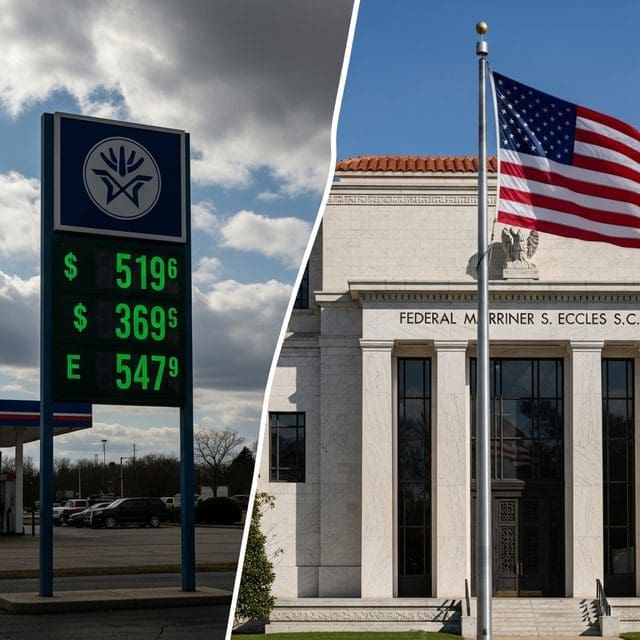
Surging oil prices and a pivotal shift at the Federal Reserve create a volatile landscape for American households facing record-high financial pessimism.
The American economy stands at a precarious crossroads as geopolitical instability in the Middle East and a leadership transition at the Federal Reserve converge to pressure the domestic financial system. While major indices like the S&P 500 and the Nasdaq Composite reached record highs during Monday’s session, the underlying reality for the American taxpayer is increasingly grim. New Gallup data reveals that over half of Americans believe their financial situation is deteriorating, marking the highest level of economic pessimism in a quarter-century.
Energy markets are the primary catalyst for immediate concern. Following Iranian attacks on oil tankers in the Strait of Hormuz on April 22, crude oil prices have breached the $100-per-barrel threshold. Brent crude futures settled at $108.23 on Monday, a 2.8 percent increase, while West Texas Intermediate rose to $96.37. Although Iran has recently proposed reopening the Strait and postponing nuclear talks, the supply shock continues to ripple through the pump, threatening to erase any recent gains in consumer purchasing power.
In Washington, the path has been cleared for a significant shift in monetary policy. The Department of Justice recently dropped its criminal investigation into Federal Reserve Chair Jerome Powell, a move that has secured the necessary political support for Kevin Warsh to succeed him. Senator Thom Tillis confirmed his support for Warsh following the DOJ’s announcement, signaling a likely return to more traditional fiscal discipline. This transition occurs as the Federal Open Market Committee begins its two-day meeting today, with markets closely watching the 10-year Treasury yield, which recently ticked up to 4.31 percent.
The technology sector is also witnessing a fundamental restructuring of power. Microsoft and OpenAI have officially modified their partnership, ending an exclusivity agreement that once centralized significant AI capabilities within a single ecosystem. OpenAI is now permitted to distribute its models across competing cloud platforms, including Amazon Web Services and Google Cloud. This shift toward a more competitive landscape comes as international regulators remain active; Chinese authorities recently blocked Meta’s $2 billion acquisition of the AI startup Manus, citing antitrust concerns.
Corporate America is also seeing a demographic shift at the top, with the average CEO age rising to 61, a full decade older than the average twenty years ago. Despite this aging leadership, some legacy brands are showing signs of life. Bed Bath & Beyond reported its first significant revenue growth in nearly five years, sending its stock up more than 25 percent. However, these isolated corporate victories do little to mask the broader instability, as federal authorities continue to process the legal fallout from the attempted assassination of President Trump at the White House Correspondents’ Dinner last weekend.

Jordan Lee serves as the Senior Correspondent for Wall Street, Finance, and Monetary Systems at Just Right News. Based in the heart of the world’s financial capital, New York City, Lee brings a sharp, principled eye to the complex mechanisms that drive the global economy. His reporting is defined by a commitment to fiscal responsibility, the defense of the free market, and a deep-seated belief that a transparent monetary system is the bedrock of a free society.
Raised in Portland, Oregon, Lee’s perspective was forged in a city that has undergone significant cultural and economic shifts. His upbringing in the Pacific Northwest instilled in him a profound appreciation for the industriousness of small business owners and the importance of local economic stability. Watching the evolution of his hometown’s landscape sparked an early interest in how federal fiscal policy and large-scale financial trends eventually trickle down to the average citizen. This background provides him with a unique vantage point; he understands the growing disconnect between the policy-making elite and the reality of Main Street, a theme that frequently resonates throughout his work.
Now operating from his base in New York City, Lee bridges the gap between the high-stakes trading floors of Manhattan and the households of everyday Americans. He views the financial sector not merely as a collection of numbers and tickers, but as a vital engine of American prosperity that requires constant vigilance and accountability. His reporting often highlights the dangers of centralized financial control and the necessity of maintaining a system that rewards merit, risk-taking, and innovation.
As the creator and lead of the featured series, “The Invisible Economy,” Lee pulls back the curtain on the often-opaque world of monetary systems. He specializes in translating the dense jargon of central banking and international finance into actionable insights for the Just Right News audience. His work explores the “invisible” forces—such as inflationary pressures, regulatory creep, and the expansion of the administrative state—that erode the purchasing power of American families. By focusing on these systemic issues, Lee empowers readers to understand the hidden forces shaping their financial independence.
Lee’s journalistic philosophy is rooted in a steadfast commitment to traditional American values. As an Asian American professional who has navigated the competitive corridors of the financial world, he is a vocal advocate for meritocracy and the preservation of the American Dream. He believes that a stable currency and a predictable regulatory environment are essential for national sovereignty and individual liberty. His reporting frequently warns against the risks of government overreach in the private sector, arguing that the most effective solutions to economic challenges arise from competition and individual enterprise rather than bureaucratic mandates.
At Just Right News, Jordan Lee remains dedicated to providing a clear-eyed defense of the taxpayer. Whether he is analyzing market volatility or investigating the long-term implications of national debt, his mission is to provide the truth about where the money is going and what it means for the future of the country. Through his rigorous analysis and principled stance, Lee has become a trusted voice for those who value a strong, sovereign, and fiscally sound America.