

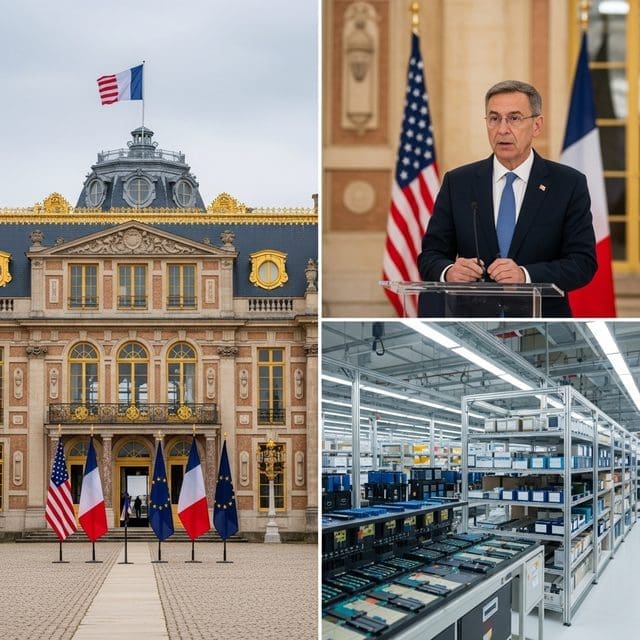
President Trump finalized a 14-point memorandum with Iran to reopen the Strait of Hormuz, while the Senate Armed Services Committee drafted legislation to restrict potential troop removals from Europe.
The landscape of American foreign policy shifted dramatically this week as President Donald Trump finalized a 14-point memorandum of understanding with Iran. Signed at the Palace of Versailles on June 17, 2026, alongside French President Emmanuel Macron, the agreement establishes a strict 60-day window to transition from a tentative ceasefire into a permanent peace treaty. The geopolitical ripple effects were immediate; following the President’s order to cease the U.S. naval blockade, oil tankers began moving freely through the Strait of Hormuz on June 18. This restoration of maritime commerce led to U.S. gas prices falling below the $4 mark for the first time since March, providing a tangible victory for the administration’s economic agenda.
While the White House celebrates this diplomatic breakthrough, which received formal support from G7 leaders, the implementation phase faces immediate logistical and political headwinds. Technical talks originally scheduled to take place in Switzerland have been postponed as of June 19, and Vice President J.D. Vance’s planned trip to lead the American delegation is currently on hold. Vance has emerged as the administration’s primary defender of the deal, appearing frequently in briefings to navigate the complex regional fallout. His role has become increasingly contentious following his blunt warnings to Israeli leadership, suggesting they should not attack their only remaining powerful ally. This friction underscores the administration’s pivot toward a new regional architecture that prioritizes de-escalation over traditional containment strategies.
On Capitol Hill, the Senate Armed Services Committee is responding to the administration’s shifting defense priorities with uncharacteristic speed. As of June 17, lawmakers began moving to curb the President’s power to remove U.S. troops from Europe through new legislative constraints. This maneuver is a direct response to the perceived volatility of the current security environment and coincides with Secretary of Defense Pete Hegseth’s June 18 announcement of a comprehensive six-month review of U.S. troop deployments across the European theater. The review suggests a potential realignment of American commitments to NATO, a prospect that has prompted bipartisan concern regarding the stability of the Western alliance and the long-term deterrence of continental adversaries.
Beyond foreign shores, the administration is aggressively pursuing a policy of industrial sovereignty and domestic technological dominance. On June 18, President Trump announced a landmark partnership between Apple and Intel to design and produce semiconductor chips within the United States. This move is intended to insulate the American supply chain from Pacific volatility and ensure that the next generation of hardware is forged in the domestic heartland. Simultaneously, the burgeoning sector of artificial intelligence saw a significant shift as OpenAI hired Dean Ball, the lead architect of the White House’s AI Action Plan. As a former senior official who shaped federal policy on AI safety and research funding, Ball’s move to the private sector highlights the tightening nexus between government regulators and the companies they are tasked with overseeing.
Domestic legal standards are also undergoing a massive transformation following a landmark Supreme Court ruling. The Court held that habitual marijuana users cannot be categorically banned from firearm ownership, throwing out the prosecution of a Texas man and effectively limiting the reach of long-standing federal prohibitions. This decision forces the Department of Justice and federal regulators to reassess how they apply existing statutes to millions of citizens. For the Trump administration, these overlapping developments in trade, defense, and law represent a comprehensive effort to redefine the American role in the world while asserting a principled, nationalist approach to domestic governance and constitutional rights.

Olivia Kendall serves as the Senior Correspondent for Geopolitics, Defense, and Foreign Policy at Just Right News, where she provides a principled, conservative perspective on the complex forces shaping the global stage. With a career dedicated to deconstructing the intricacies of international relations, Kendall has become a trusted voice for readers who value national sovereignty, a robust military, and a foreign policy that prioritizes American interests above all else.
A native of Washington, D.C., Kendall’s professional journey is deeply rooted in her upbringing within the nation’s capital. Growing up in the epicenter of American political life, she developed an early and profound understanding of how policy is crafted and, more importantly, how it often fails to account for the values of the American heartland. This unique vantage point allowed her to witness firsthand the rise of globalist bureaucracies, fueling her commitment to reporting that champions the constitutional foundations of the United States. Her background as a British White American further informs her worldview, providing her with a keen appreciation for the Western tradition and the enduring importance of the “Special Relationship” in maintaining global stability.
Now based in Arlington, Virginia, Kendall operates from the doorstep of the Pentagon and the heart of the nation’s defense establishment. Her proximity to the decision-makers in the military and intelligence communities allows her to provide boots-on-the-ground reporting that is both timely and deeply informed. For Kendall, Arlington is more than just a base of operations; it is a daily reminder of the sacrifices made by the men and women in uniform. This connection to the defense community drives her rigorous coverage of military readiness and her advocacy for a “peace through strength” approach to diplomacy.
At Just Right News, Kendall is perhaps best known for her acclaimed feature series, “The World’s Shadow on America.” In this ongoing project, she explores the direct correlation between international developments and the daily lives of American citizens. Whether she is analyzing the encroachment of foreign adversaries in domestic supply chains or the impact of international treaties on local economies, Kendall’s work serves as a vital bridge between distant geopolitical shifts and their consequences at home. She rejects the notion that foreign policy is an abstract concern for elites, instead proving that what happens in the corridors of power in Brussels or Beijing has a tangible “shadow” that falls across every American doorstep.
Throughout her tenure, Kendall has remained a steadfast critic of international overreach and a vocal proponent of a clear-eyed, realistic foreign policy. She brings a sharp analytical mind to her beat, often challenging the prevailing narratives of the mainstream media to uncover the underlying truths that affect national security. Her reporting is characterized by a refusal to compromise on the truth and a dedication to the idea that a strong, secure America is the world’s best hope for liberty. As a Senior Correspondent, Olivia Kendall continues to lead the charge in providing the essential context and conservative insight necessary to navigate an increasingly volatile world.