

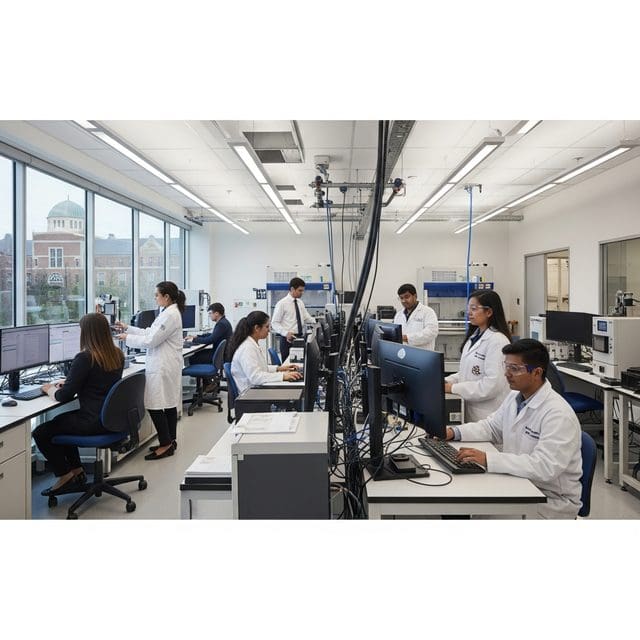
Educational institutions are shifting toward high-demand workforce training and specialized research to ensure student success in a competitive economy.
The traditional promise of a college degree is undergoing a quiet but necessary transformation. As the cost of higher education remains a central concern for American families, institutions are increasingly being judged not by their ivy-covered walls, but by their ability to produce specialized human capital that meets the immediate needs of the private sector.
LSU Online is leading this charge by expanding its construction-focused professional development offerings. This move signals a departure from broad academic theory toward the practical, stackable credentials that the modern workforce demands. By aligning curriculum with the booming construction industry, the university is treating education as a direct investment in the labor market, ensuring that students graduate with skills that employers are actually willing to pay for.
This trend toward specialization is also evident in the research sector. Texas A&M AgriLife recently opened its High Plains Research and Extension Center in College Station. This facility represents a significant investment in agricultural infrastructure, designed to bridge the gap between academic research and practical application for Texas producers. Similarly, the University of Utah’s Spencer Fox Eccles School of Medicine recently secured FDA clearance for a new orthopedic implant system developed at its innovation center. These milestones demonstrate that when universities focus on tangible outputs—whether it is agricultural efficiency or medical technology—they provide a clear return on investment for both students and taxpayers.
However, the path to professional success remains fraught with bureaucratic and personal hurdles. While a Pennsylvania history teacher was recently named the 2026 National Teacher of the Year for helping students identify individual strengths, other sectors face regulatory headwinds. The Coalition for Career Schools warns that proposed Department of Education regulations could disqualify 92 percent of beauty and wellness programs from federal aid, potentially cutting off a vital pathway to upward mobility for thousands of aspiring professionals.
Even in high-stakes fields like healthcare, the human element remains the most critical variable. At the University of North Carolina, the upcoming graduation of Caroline Robinson—a former cancer patient turned nursing student—serves as a reminder that personal resilience is as vital as any curriculum. Yet, the broader healthcare workforce is under strain, as evidenced by nurses at BMC South filing notice for a three-day strike starting April 30 over staffing and wage disputes.
As the American College of Physicians recently noted when declining to recommend certain performance measures for migraine treatment, not every metric leads to better outcomes. The most effective educational models moving forward will be those that reject top-down mandates in favor of market-aligned skills, personal responsibility, and the removal of barriers that prevent students from entering the workforce ready to contribute.
Daniel Owens serves as a Senior Correspondent for Just Right News, where he leads the newsroom’s coverage of Education, Workforce, and Upward Mobility. In an era where the national conversation often overlooks the practical foundations of success, Owens brings a principled perspective to the forefront of the media landscape. His work is defined by a commitment to the idea that a strong society is built on the pillars of quality education, a robust work ethic, and the removal of bureaucratic barriers to individual achievement.
Born and raised in Cleveland, Ohio, Owens’s worldview was shaped by the industrial landscape of the Midwest. Growing up in a city known for its grit and resilience, he witnessed firsthand the transformative power of steady employment and the devastating effects of economic stagnation. This background instilled in him a deep respect for the American worker and a healthy skepticism toward top-down government solutions that often fail to reach the communities they intend to help. As an African American man who has navigated the path to professional success, Owens approaches his beat with a nuanced understanding of how meritocracy and personal responsibility intersect with opportunity. He frequently draws on his roots to highlight the importance of family stability and community-led initiatives in fostering the next generation of leaders.
At Just Right News, Owens is the architect of the acclaimed feature series, “The Learning Curve.” Through this platform, he explores the evolving landscape of American schooling, from the rise of the school choice movement to the revitalization of trade schools and vocational training. He frequently challenges the status quo of higher education, advocating for a return to academic rigor and the practical alignment of degrees with market demands. For Owens, education is not merely about obtaining credentials; it is about equipping young people with the tools necessary to lead self-sufficient, meaningful lives. His reporting on “The Learning Curve” has become essential reading for parents and policymakers who believe that educational competition and parental rights are the keys to a brighter future.
Now based in Raleigh, North Carolina, Owens finds himself at the heart of one of the nation’s most dynamic regions for innovation and growth. Raleigh’s unique blend of traditional values and a fast-paced economy provides the perfect backdrop for his reporting on the modern workforce. From the tech hubs of the Research Triangle to the rural communities of the South, he tracks how shifts in the economy are impacting families and local industries. His reporting often highlights the success stories of entrepreneurs and workers who are thriving by embracing the values of hard work and innovation.
Throughout his career, Daniel Owens has remained a steadfast voice for the student seeking a better path and the worker striving for a better life. His reporting for Just Right News serves as a vital resource for readers who value common-sense solutions to the challenges of the 21st-century economy. By focusing on the intersection of policy and the human spirit, Owens continues to provide a roadmap for how individuals and communities can achieve lasting upward mobility.