

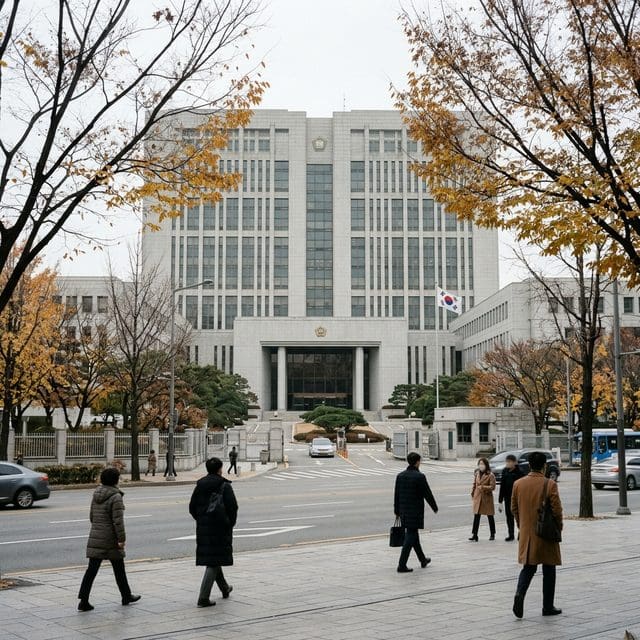
The Supreme Court of Korea set aside one part of the former prime minister’s conviction for insufficient proof of intent, while leaving key findings about his later conduct intact.
South Korea’s Supreme Court has drawn a boundary within the insurrection case against former Prime Minister Han Duck-soo: the evidence did not establish that his proposal to convene a State Council meeting before martial law was declared was made with the intent to subvert the constitutional order. The court overturned that portion of the conviction but left other findings in place, keeping the case alive on remand.
The ruling, reported by SBS on Nov. 19, is narrower than a wholesale reversal of Han’s conviction. The court distinguished the pre-declaration proposal from conduct after martial law was announced, including pressuring Cabinet members to sign martial-law documents and discussing plans to blockade the National Assembly and cut electricity and water to some media outlets. Those findings were upheld.
That distinction turns on what the evidence proves about a defendant’s purpose, as well as what he did. The court found the record insufficient to establish the required intent for the State Council meeting proposal. It did not, on the reported account, conclude that Han’s other conduct was lawful or that the broader effort surrounding martial law fell outside the case. Instead, the justices preserved findings tied to actions taken after the declaration, when the evidence described different conduct.
The court also upheld guilty verdicts involving a martial-law document prepared retroactively and Han’s demand that an official destroy it. Those findings, along with the surviving portions of the case, now return to the Seoul High Court for further proceedings. Han will remain detained while those proceedings continue, according to SBS.
The procedural history underscores why the decision should not be described simply as either an exoneration or a complete affirmation. The Seoul High Court had earlier reduced Han’s sentence from 23 years to 15 years after acquitting him on some charges. The Supreme Court’s full bench, led by Justice Oh Kyung-mi, has now overturned one additional part of the case while sustaining other findings, according to the Seoul Economic Daily.
The practical consequence is a narrower case on remand, not an end to it. The lower court must proceed in light of the Supreme Court’s ruling, which removes the challenged finding about the meeting proposal while leaving the upheld conduct and document-related verdicts in the case. The supplied reports do not specify how the remand will affect the ultimate sentence, so no new term can be inferred from the decision alone.
A separate Canadian sentencing decision reported by CBC illustrates a different kind of judicial judgment, and should not be confused with the South Korean constitutional case. In Welland, Justice Louis Strezos sentenced Steven Armstrong to two years less a day of house arrest followed by three years of probation, rather than federal prison. The judge cited Armstrong’s role as the sole caregiver for a son with exceptional needs, saying imprisonment could put the child in foster care and disrupt Armstrong’s rehabilitation. The sentence includes GPS monitoring, geographic restrictions, periodic reporting, a DNA sample and a lifetime weapons prohibition. Two co-accused received prison terms of 39 and 34 months.
The cases involve different legal systems and questions: Han’s appeal concerns the proof supporting criminal findings tied to an attempt to impose martial law, while Armstrong’s sentence reflects an individualized assessment of punishment and its consequences. In both, the operative details matter more than a broad headline. For Han, the Supreme Court rejected one theory of intent without erasing the rest of the case; for Armstrong, the sentencing judge imposed substantial restrictions without ordering prison.

Lila Hayes serves as a Staff Writer for Just Right News, where she anchors the “Courts, Law, and Constitutional Order” beat. Her work is defined by a steadfast commitment to the foundational principles of the American republic and a rigorous defense of the legal frameworks that ensure national stability. As a primary voice for the outlet, she provides readers with a clear-eyed analysis of the judiciary, focusing on the importance of originalism and the preservation of the separation of powers.
Lila’s perspective was forged in the American heartland. Raised in St. Louis, Missouri, she grew up in a Hispanic household where the values of hard work, faith, and respect for the law were paramount. Her upbringing instilled in her a deep appreciation for the American Dream and the legal protections that make it possible. This Missouri background remains a cornerstone of her reporting, providing a grounded, common-sense counter-narrative to the often-insular legal circles of the coastal elite. She understands that the decisions made in high-court chambers have real-world consequences for families and small business owners across the country.
At Just Right News, Lila has become widely recognized for her signature feature series, “The Rulebook of Power.” In this ongoing project, she delves into the mechanics of the federal government, examining how administrative overreach and judicial activism can threaten the delicate balance of the Constitution. She approaches her beat with the tenacity of a veteran journalist and the precision of a legal scholar, consistently advocating for a judiciary that interprets the law as written rather than legislating from the bench. For Lila, the Constitution is not a “living” document subject to the whims of modern social trends; it is a fixed standard that ensures the government remains the servant of the people, not their master.
Now based in Philadelphia, Pennsylvania, Lila finds herself at the very epicenter of American constitutional history. Living and working in the city where the Founders drafted the documents she defends daily provides a constant source of inspiration. The historic halls and landmarks of Philadelphia serve as a daily reminder of the high stakes involved in her reporting. Her presence in the city allows her to bridge the gap between the historical intent of the law and its contemporary application, ensuring that the legacy of the Founding Fathers remains central to the national conversation.
Throughout her career, Lila has remained dedicated to the idea that a free society requires an informed citizenry and a transparent legal system. Her reporting is more than just a collection of headlines; it is a defense of the constitutional order that has sustained the nation for over two centuries. By focusing on the “Rulebook of Power,” she ensures that her readers understand not just what is happening in the courtrooms, but why those decisions matter for the future of American liberty. Lila Hayes continues to be a vital voice for those who believe that the law should be a shield for the citizen and a constraint on the state.